Blue and green, RGB dress, making do with close-ups

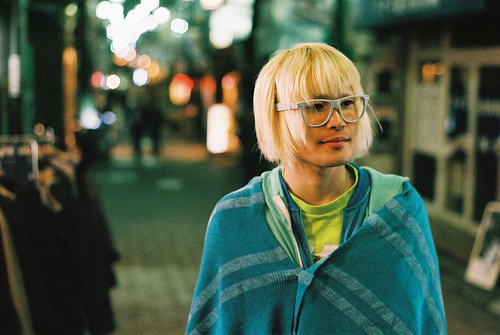
Koenji Ma Poule, by Jrim on Flickr

Those blue and green colours give me physical pleasure the same way red and blue do. There are other colour schemes that I get excited about, but I have a soft spot for red-green-blue because of working at a monitor all day.

All this to say that I made an RGB outfit and wearing it is my own spiritual rapture. The colours of personal happiness. On my body. I may or may not succeed in documenting it with a full length photo, but I have collected these fragments.

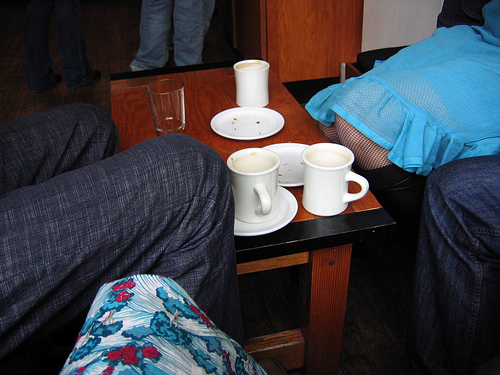
The bottom of the dress (I’m the fishnets).

bluesy saturday, by Fancy Hunt

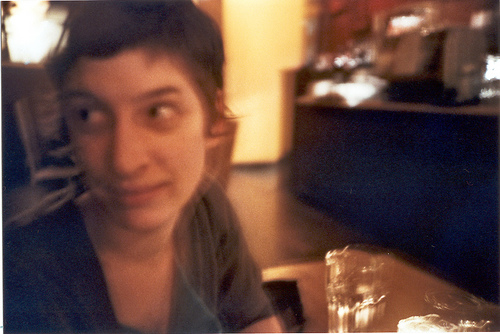
The top of the dress (under a cardigan, and I should mention that I shrunk one eye in photoshop because my camera has a bit of a fishbowl effect around the edges and sometimes it catches faces in distracting ways).

Pub, December, by me

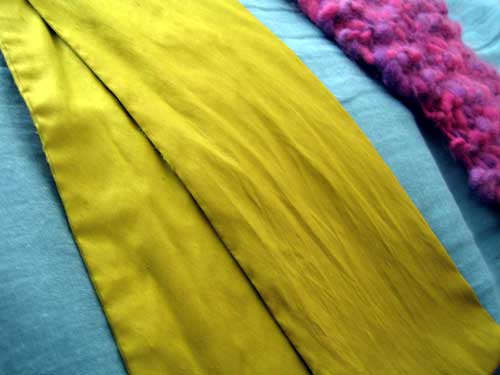
I made a sash out of lime green dupioni silk (shiny).

And then with this scarf, it makes the holy trinity of colour pixels.

Aqua, chartreuse, magenta, actually.

I’m working on expressing more political intentions with my wardrobe (slowly… I am mostly making things not buying them), but for now I am glad to express any conscious intention.

Soneteer


A sonnet is built on a fourteen-line frame, of five-foot lines. Hence, the soneteer knows exactly where he is headed, although he may not know how to get there.

I finished reading The Elements of Style. The famed, much recommended Elements of Style. It’s alright. You need to bring your own race and class analysis goggles. An example.

Style rule #2. Write in a way that comes naturally.

Style rule #15. Do not use dialect unless your ear is good.

Style rule #20. Avoid foreign languages.

Where this leaves a person whose natural dialect doesn’t sound good to an English professor is a matter for the analysis goggles.

I would at least pair the book with this old, also somewhat famed, David Foster Wallace essay about English usage wars.

That essay is a delight but I feel sad when I read it. I feel sad reading anything by DFW since his suicide, but there’s more this time. He gets all the way to seeing that language has class signifiers and that Standard Written English is an elitist, white, academic dialect, and then he gives in. His best suggestion for surviving in this classist, white supremacist (capitalist colonial heteropatriarchal… might as well get it all in there) system is to learn to pass. That is soul crushing advice.

I’ve gotten this vibe from a lot of David Foster Wallace’s writing. There’s a part that is generous and open and loving and grounded (he calls it a Democratic Spirit in that essay), and then a part with… I want to say with no faith in the power of consciousness. I don’t know if that’s exactly it. But something. Resignation? I count him as one of my favourite authors, but usually when I read something by him I have to debrief afterward. I just looked at my little list of “books read in 2006” and saw that my note for Infinite Jest was “not sure yet.” (Since then I’ve given it as a gift at least three times.)

I am really wishing that Dark Daughta’s archives were still public so I could link to something about passing and anxiety, or about changing the power dynamics of a situation by speaking and acting with a grounded analysis. DD, since you went members only, I sure notice how much I was depending on your output and not pitching in, so thanks for that wake up. If I find alternate links I will come back and stick them in.

I’m ready for my telepathic computer now please.

New device reads minds pretty well.

Whenever I read articles about advances in computer mind-reading technology, they focus on the benefits for paralysed or locked-in people. Fair enough, but I am also waiting for my generic mind-to-computer input device. Could you not then basically send telepathic messages to your friends? If a computer can read my mind, and computers can already talk to each other… that means I can send telepathic email at least. It makes me laugh. It’s such a clunky, budget vision of telepathy, but I think it’s good enough.

A few years ago, after seeing a documentary about a locked-in man’s telepathic computer, I had elaborate fantasies of starting a company to manufacture open source, recyclable, telepathic PDA things. It would be such an interesting device to design interfaces for. In my elaborate fantasy, there are mind-reading headphones that whisper interface feedback to you.

Being apparently more environmentalist than the average geek, I barely even buy any electronic gadgets, but I am so compelled by the prospect of adjusting my music volume up and down with my mind that I thought I might have to move somewhere cheap and kidnap an engineer to make it happen.

I have since chilled out, but I note with delight that these articles are showing up more often.

Like Busby Berkeley with censorship bars

I need to organize more time to hang out naked with my friends. I love it so much. In the summer, there is usually night swimming and maybe this year I’ll go to our local nudie lake with it’s one hilariously small dock. But what about winter? What about now? I don’t think there is a women’s bath or anything in this town. I need to organize some nudeness at home. Anybody want to come over and take expressive naked photos? Give me a call.

Down with praise, emotional dentistry, granfallooning.

I continue to publish drafts that have been lingering in the archives. This one lingered because it was veering towards criticising my friends and I was too scared and distracted to get it to a place that was honest and compassionate instead of either judgmental or passive. Check out how non-intense it is. This is the type of stuff that has been terrifying me for years. It’s kind of funny.

. . .

9 Feb 2008

I just went to the dentist for the first time in about seven or eight years. This particular dentist is explicitly “an emotional guy” who gives a lot of compliments about teeth, and expresses a lot of care and encouragement about your dental health. Full on, “I know I just met you, but I really care about your teeth and gums, because I know that dental health can really impact a person.” Totally sincere, enthusiastic. OK. Awesome. It also ran right into this discomfort I have with receiving compliments and praise, which I thought about a lot on the walk home from my appointment.

So I’ve been wanting to write out my ideas about praise and compliments, but I’ve determined that first I need to deal with this other dentist-related thing, being that a lot of my friends go to the same dentist and I’m a bit afraid of sparking some “we’re all in the Dr. Bjornson club!” celebrations. (This is a real “everything good is actually bad!” kind of post. I dislike compliments, and furthermore I dislike belonging! No fun allowed!) I’ve been belatedly discovering Kurt Vonnegut’s books, and in the last one I read (Cat’s Cradle), he uses this invented word, granfalloon, to describe an allegiance based on a shallow or pointless shared trait, like being from Iowa or going to the same dentist. I am happy to have this word, even just to clarify for myself that I don’t want to avoid all kinds of belonging. Only granfallooning gets the diss, because it is meaningless and distracting, and is, I think, a kind of vanity.

. . .

So, then, over a year later, I’ve thought a lot about my problem with compliments. I think there are two parts; one where I’m crazy and one where some compliments are crazy. I have book quotes to go with both of these.

The part about living in a crazy world is like this. From Nonviolent Communication.

Conventional compliments often take the form of judgements, however positive, and are sometimes offered to manipulate the behavior of others.

And the part about my own craziness goes like this. From Women Who Run With The Wolves, in a chapter about procrastination and creative blocks.

Troublesome contaminants in the river [of soul/creativity] are obvious when a woman turns away sincere compliments about her creative life. There may be only a little pollution, as in the offhanded “Oh, how nice you are to give such a compliment,” or there may be massive trouble on the river: “Oh, this old thing” or “You must be out of your mind.” … These are all signs of an injured animus. Good things flow into the woman but are immediately poisoned.

Not that my teeth are my creative life, but being a person who was both terrible at accepting compliments and struggling with intense procrastination at the same time, I figure it translates.

Another fashion face mask.

Pantyhose-esque face mask at a fashion show.

I still note pictures of masks in fashion and pop culture. I go on long quiet breaks every few years, but I also ponder some topics for years and years. I am trying to figure out what this persistence/absence is about. Hiding out whenever I am processing anything? Needing to be better at learning in public? Being a generalist and working on a thousand things at the same time, gradually, over a long period of time? Those are good starting ideas.

This mask, I think I like because it is both campy and inhuman. The pantyhose fabric is so gross that it’s funny, but then the full face coverage is too creepy to be fun. I am delighted.

I will leave the “gosh models are skinny, etc” disclaimer as an exercise for the reader.

Horror movies, self-mutilation, vampire-incest?, publishing old drafts.

Letting more old drafts shine their light into the internet. More quotations from The Monster Show .

I think the reason I saved this first quotation was that I hadn’t thought about movies being made by the most surgically altered and self-mutilated people around. I liked thinking about horror movies reflecting the horror of Hollywood culture, not only of wider American culture.

p.167, On Arlene Francis, star of Murders in the Rue Morgue:

Her real shudders came after the film was completed when other producers, eager to discuss her future in films, began wielding scalpels shaper than those of Dr. Mirakle. They would offer her riches, it appeared, but only if she would consent to give up a portion of her nose. Rhinoplasty was all the rage in a Hollywood that now placed a premium on robotic, standardized glamor in the Busby Berkeley mold. Dorothy Tree, for example, was a highly regarded Broadway actress of the late 1920s, but her strong profile relegated her to bit parts in films, shuffling around in a shroud, for instance, as one of Bela Lugosi’s vampire wives. Finally, after leaving her original nose behind her in the vaults of Dracula, she began to get speaking parts and billing. Producers and casting directors were eager to prescribe and preside over surgical rearrangements of the female body, an obsession beginning to be weirdly echoed, or perhaps weirdly magnified, in horror movies and popular literature. Indeed, the persistent, essential connection between plastic surgery, self-mutilation, and horror had only begun.

And this next one just made me curious about what this proposed link is.

p.191, on incest and vampires…

[In Mark of the Vampire, 1935, Tod] Browning and his screenwriter Guy Endor likely took some inspiration from Ernest Jones’ pioneering psychoanalytic study On The Nightmare (1931), which explicitly linked vampire fantasies to incest guilt.

Freaks, zombies, horror movies… old drafts.

More old drafts that have been sitting in the archives, more quotations from The Monster Show .

p.200-1

[Tod] Browning spent a lot of time at the ballpark and racetrack in the early thirties, and veteran Hollywood writer Budd Schulberg (author of The Disenchanted and What Makes Sammy Run? ??) had a memory of another Browning pastime. “The marathon dance was in vogue then and we went a few times to the Santa Monica Pier to watch the young unemployed zombies drag themselves around the floor in a slow motion dance macabre,” Schulberg wrote in his 1981 memoir ??Moving Pictures. “Even more appalling than the victims on the dance floor were the regulars, affluent sadists in the same front-row seats every night, cheering on their favorites who kept fainting and occasionally throwing up from exhaustion. One of the most dedicated of the regulars was Tod Browning, who never missed a night and who got that same manic gleam in his eyes as when he was directing Freaks.”

p.292

The rediscovery and rehabilitation of Freaks became almost a cause celebre in the film journals beginning in the early sixties. Once considered crass and tasteless, the film was now “compassionate” and “sensitive.” In a way, the appreciation of Freaks became a politically correct means to indulge a morbid curiosity about thalidomide deformities, while still being able to feel self-righteous and progressive.

An anti-war horror movie I’d like to see, old random drafts.

In the spirit of spitting things out rather than polishing them forever and driving myself crazy, I’m going through my archives and publishing drafts.

A couple of years ago I was reading a lot about horror and monsters. At some point I saved quotations from The Monster Show: A Cultural History of Horror.

p.186, regarding WWI vets.

The Frankenstein pictures continued to be a cultural dumping ground for the processed images of men blown to pieces, and the shell-shocked fantasy of fitting them back together again.

That was the first idea I ever heard about horror as a mirror of culture, from a Chuck Palahniuk interview. It doesn’t make me want to watch horror movies, particularly. But this next movie is something I would like to see.

p.205-6

For his unnerving final sequence— completely irrational, but nonetheless a devastating moral statement— [Abel] Gance recruited actual members of the Union des Gueules Cassées, and created a nightmarish montage of all the ruined faces that had been haunting the world’s cinemas for the past fifteen years in the guise of “horror entertainment.” The actual men are nameless, but they could easily be the living models for the masks worn by Lon Chaney, Boris Karloff, Lionel Atwill, and others. As a conscious antiwar statement, J’Accuse is superior; as an unintentional revelation of horror’s major subtext in the twenties and thirties, it is breathtaking.

Re-entry, being Scottish, the other end of cultural appropriation, not yet being able to write short sentences but maybe one day.

I’ve been sitting here for three weeks attempting to write my grand re-debut in blogging, where I would declare my intention to overshare again like I haven’t since about 2002, note that a lot of anxiety that I was blaming on work deadlines actually seems to stem from not writing enough about things I care about, and delve into the limitations I’ve been accidentally sticking to regarding not scaring my family or offending my friends or embarrassing my partner, but how about I skip that for now since it has become a bit of an albatross, and just post something already?

Yes!

So I’ve been thinking about European ethnicities, whiteness, colonialism, and cultural appropriation, and what I need to do to make sense of being, apparently, of 100% Scottish ancestry.

This Scottishness is new-ish information because my dad was adopted. Until my dad (or my mum?) saw his adoption paperwork a couple of years ago I thought of myself as half Scottish, half mystery, and really, mostly as a generic white settler person. Lately it has occurred to me that if I can get more rooted in being a specifically Scottish-descended settler person, I might be able to use that to subvert whiteness a bit. I’m thinking that since whiteness works as a generic, supposedly neutral, supposedly non-racial racial quality, then knowing my ethnicity better might help me to be more aware of whiteness instead of taking it for granted, and also might help start conversations about race and privilege in everyday life. This is very early stages here. I get the impression a lot of people have thought about this, and I have a lot of reading and thinking to do. I don’t know what “understanding my Scottishness” would look like yet. I’m hesitant to suddenly care about kilts and druids partly because maybe they aren’t relevant to me, and partly because I associate, e.g., Celtic knotwork jewellery with New Agers and metal bands. More on that in a minute.

This is part of a bigger, backwards personal growth quest. Years ago I started reading about death and dying, and got interested in denial. There’s a lot of writing about denial in radical politics and anti-oppression work. Privilege and denial, collusion and denial, performance and pretending. Darkdaughta writes (or did write, when she was public) especially clear analyses of how personal denial perpetuates political oppression.

Trying to be thoroughly anti-oppressive, then, merges right up with trying to be an honest person, and both missions lead to sorting through my family dynamics, my parents’ families, and back and back. It’s useful to apply some historical context and political analysis to all of that. So again, I have a lot more reading and thinking and talking to do.

For starters, I’ve been hunting for general history about Scotland and colonialism. It is very easy to find writing about the oppression of Scotland by England, but, predictably, harder to find anti-colonial perspectives on Scottish settlers.

This caption was the first promising thing I found: Professor Geoff Palmer of Heriot-Watt University believes Scotland is still in denial over its role in British slavery. A signal! Involving the codeword, denial! I found some leads and put some books on hold at the library about Scotland and colonialism.

Towards the end of that article though, they are talking about other aspects of the Scottish diaspora, and the subject turns to cultural appropriation.

David Hesse, an “urban intellectual from Zurich”, who gave up a journalism career to study in Edinburgh, says: “You could call my field the imagined diaspora. I investigate highland games in Germany and Scottish clubs in eastern Europe. I look at people dressing up as Scots. Those people have no “real” Scottish ancestry but feel aesthetic connections. I think international fascinations with Scotland and Scottish-looking things are a phenomenon.”

Hesse sees imaginary Scottishness as an identity that is becoming increasingly popular in northern Europe. “It is a folk identity, but it is quite macho. It involves military music and martial games. It is also a generally white phenomenon.”

I laughed when I read that. Cultural appropriation has never inconvenienced me before, but I think this is what’s going on with my cautiousness towards anything celtic. It’s been taken over by metal bands and the scented candle crowd. I’m used to thinking about cultural appropriation from the other end, choosing not to wear dreadlocks or sari silks, not to get tattoos of asian calligraphy, not to use imaginary ancient aboriginal terms for my menstrual period. I think Operation: WTF Scottish Roots is working already. Things that made intellectual sense make a little more experiential sense.

So, hi again internet. It’s been years since I wrote regularly and I think I must still write like a twenty two year old, but I’m ok with just spitting things out until I get the hang of it.