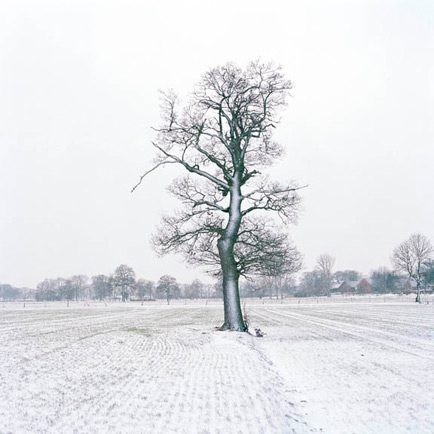
Tree with snow by Dietmar Busse


Edible gardens have been part of human culture for thousands of years. Along with harnessing fire, developing the wheel and domesticating animals, cultivating food is one of the benchmarks of human advancement. Growing plants that provide food and learning to store it for times of scarcity were advancements that allowed humans to develop civilizations.
— First paragraph of the introduction to The Canadian Edible Garden: Vegetables, Herbs, Fruits & Seeds by Alison Beck.
It’s been awhile since something like “the benchmarks of human advancement” would have slipped by me as a neutral measurement (when you define everyone’s progress by how similar they are to you, you can assume have problems with privilege), but I think I am noticing more assumptions now about the value of civilization and technology. I’m also noticing that the author’s list of “advancements” that allow humans to create civilizations skipped over colonization, slavery, militarism, genocide and all that.
I recently read Endgame: The Problem of Civilization & Resistance (thanks for the tip, Sarah), which is a thorough take-down of the assumption that civilization is an advanced way of living (vs. unsustainable and terrorist), that the point of technology is to become advanced (vs. to maintain a relationship with your landbase), that agriculture is an efficient way to gather food (vs. temporary and destructive). I think that was the book that got me reading about destroying agriculture. I’ve been reading a lot of books at once; it’s hard to keep track.
I am seeing this garden book as much more oppressive than I would have before, with a Eurocentric, anti-indigenous, environmentally unconscious position.
This is good, it gets me thinking about my love of gardening. I’m realizing that what I care about is getting to know plants and soil and living systems, resisting consumerism and capitalism by gathering my own food, and taking time to physically experience and love a patch of the outdoors. None of that actually requires a garden. I could be wildcrafting, or working more with local plant permaculture and forest gardens. Those are difficult when land is privately owned and violently policed, and wilderness is mostly destroyed and constantly under threat. Wild forests don’t need me in there taking all my food right now. And it’s hard to conceive of perennial ecosystems on temporarily rented space.
So… how could I be talking with my neighbours about guerrilla permaculture and land reclamation?
Game Developers Conference seems to be on right now. A few years ago I would have been following posts about the presentations. I’m still interested in interactivity design and game design, but I am taking a break from the technorati’s vision of revolution and progress (short version: pretend everyone can have a cell phone without destroying the planet).
Seeing all the GDC headlines reminded me of watching Will Wright present the demo of his super-hyped Spore game at the elite/elitist TED conference in 2007.
That’s the first time I remember being horrified by game design. Will Wright, known for his non-competitive, open-creative-outlet games, Mr. SimCity, spent fifteen minutes talking about teaching kids to colonize territory. Ouch. It is easy to dismiss the racist, sexist, violent shooter games when there are supposed alternatives. Where do you go from the alternatives when they have all the same domination and hate in a more covert, abstract form?
Are there any video games out there about resisting colonization? I mean as a whole system, not just in terms of blowing up invaders from space using weapons you built by invading and occupying your own planet to get resources and labour. I never got around to writing Will Wright to ask him to read up on what colonization really means before developing his next game idea. Spore II: Indigenous Resistance. I’d play that.
So here I am wishing for better video games when I am intending to take a break from people who focus on saving the world by building video games and electronic gadgets. Moving on.
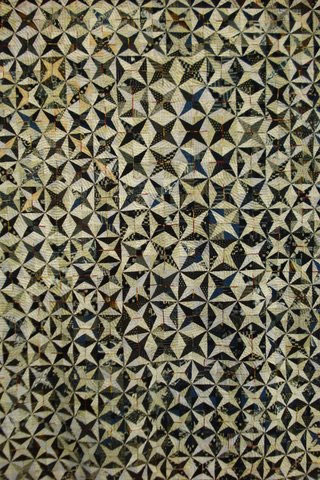
I know that in typography “dazzling” is a technical term where your eyes get confused by large areas of small, intense contrasts. Maybe quilting has that too.
I am feeling excited to research radical ecology and anti-industrial ideas lately. This is one result of considering my Scottishness: I decided to read extra-radical critiques of Eurocentric civilizations as a respite from the horrifying, delusional narratives in books about Scottish settler history.
Somehow I didn’t realize there were folks in radical ecology movements looking at very intersectional politics of oppression and how they relate to fundamental systems like agriculture, cities, and industrial production. Sometimes I find an analysis that also overlaps with what I know of media theory about currencies, clocks and the alphabet. I’m still in a skeptical phase where I am cross-referencing everything and looking for criticisms, but it is very relaxing to feel like there might be a way to fit a lot of interests together. One huge, complex idea to apply instead of a whole bunch of big, complex ideas.
This morning I was listening to ideas about agriculture.
Lierre Keith: A Hard Look at Agriculture, and Strategies for Collapse, a podcast at Resistance is Fertile. Why even veganism and local organic farming is not sustainable.
You have to understand what agriculture is. In very brute terms, you take a piece of land, you clear every living thing off it— and I mean down to the bacteria— and then you plant it to human use. It’s biotic cleansing. This lets the human population grow to gigantic proportions, because instead of sharing that land with millions of other creatures we’re only growing humans on it….
Besides the fact that you’ve permanently displaced any number of species— and when i say that, we’re really talking about extinction— the real problem is that you’re destroying your topsoil and topsoil is the basis of life [on land]…. We have to talk about overshoot.
And pretty soon, she starts connecting this to systems of oppression.
So you’ve got these power centers that arise wherever agriculture is started and they need a constant influx of new resources because they’ve overshot their landbase. Because you have a surplus, that means somebody else can steal it, so the first thing that happens in agricultural societies is you have a class of people whose sole purpose is to be soldiers. You’ve got the beginnings of militarism. The surplus has to be protected. But the surplus is also what lets there be an entire class of people who don’t have to get food, all they have to do is fight. So now you’ve got a class of soldiers.
The other thing that the power base needs is more resources because they’re constantly using them up. So the other job of those soldiers is to go out and get more and bring it back.
And the third thing that agriculture needs is slaves, because it’s back-breaking labour. By the year 1800, when the fossil fuel age began, three quarters of the people on this planet were either living in conditions of slavery or indentured servitude. The only reason that we’ve forgotten this is because we’re using machines now to do that work, but believe me when the fossil fuel runs out, we are going to remember just how much work is involved in this.
It’s this feedback loop, where agriculture creates the need for a military and the military is made possible by the surplus of agriculture. And the entire system together needs to keep taking land because it’s forever using up its own soil.
They go on to make connections between agriculture and patriarchy, disability rights, classism, imperialism, and some more.
I have a million ideas about things to do, but I want to post some more inputs before I write about them. I was quiet for so long that I feel like I have a lot of catching up to do just to make my premises clear.
I posted this on Craigslist today (personals > strictly platonic?).
Date: 2009-03-25, 12:34PM PDT
Or even just see it and ask you a couple of questions?
They seem so cool in theory, but I would like to try one out in person before I get too excited about the “convenience” and “lack of smell.”
Thanks in advance for sharing your humanure revolution.
Sarah H commented about handsomeness and masculinity.
I find it really useful to consider ideas of handsomeness in relation to concepts of masculinity— I can see where my own notions of handsomeness are based in someone (of any gender) being visibly self-controlled, unemotional and hardened. I wonder how we can reclaim words like this— like how do we compliment our loved ones on looking cute, without using words that reinforce these concepts of masculinity? I have tended to use the word handsome, but now it doesn’t seem appropriate.
I am interested in this too. I hadn’t considered the word handsome before, but I use it a lot (also to describe a person of any gender). After some reflection, I think for me it is a replacement for saying something more personal and honest. I’m making a judgment about beauty and gender instead of attending to my feelings and needs. There is an idea I like in non-violent communication, that making judgments reinforces hierarchy and external authority. From Nonviolent Communication: A Language of Life:
Most of us grew up speaking a language that encourages us to label, compare, demand, and pronounce judgments rather than to be aware of what we are feeling and needing. …
Life-alienating communication both stems from and supports hierarchical or domination societies. Where large populations are controlled by a small number of individuals for their own benefit, it would be to the interest of kings, czars, nobles, etc. that the masses be educated in a way that renders them slave-like in mentality. The language of wrongness, “should” and “have to” is perfectly suited for this purpose: the more people are trained to think in terms of moralistic judgments that imply wrongness and badness, the more they are being trained to look outside themselves— to outside authorities— for the definition of what constitutes right, wrong, good and bad. When we are in contact with our feelings and needs, we humans no longer make good slaves and underlings.
To work for anarchist/non-hierarchical relationships, I’ve been practicing not judging things as “masculine” or “feminine” and instead just saying what they are and how I feel about them. E.g., If I let go of describing a boy or man as effeminate, I can usually find more accurate, specific observations. Maybe he’s caring and kind, and likes to wear bright colours. And maybe I feel happy about that because I value kindness and diverse clothing options. I forget this all the time, but when I remember to get specific I like the way it makes me more aware of both the person and myself. I also like that it goes beyond resisting within binary gender and gets outside of gender altogether. Instead of questioning who can have feminine qualities, it is a way of questioning why we call some things feminine at all. I think that celebrating a man or boy for his feminine qualities still reinforces that passive, traumatized personalities are called feminine while aggressive, traumatized personalities are called masculine.
I’m thinking I could replace “handsome” the same way, with concrete observations and personal feelings. On top of letting go of judgments about gender (anyone can have a strong jaw or dark eyebrows), it would skip judgments about who looks more or less beautiful. Previously I’ve tried celebrating everyone as beautiful “in their own way” but I find it works the same way as celebrating genderblurred masculine and feminine qualities. It still reinforces the idea that I can judge who is beautiful or ugly and that it matters. I’d rather find ways to take responsibility for what I see and how I feel about it.
That has me wondering what I am trying to communicate when I tell someone they look handsome. I like to look at them? That is still very vague. I think they have social power because they fit a currently fashionable ideal look? I don’t want to play that game. When I look at their nose I feel hot and bothered? That is more what I’m aiming for. I think I’m using compliments as a substitute for conversations about desire and sensual appreciation. Wow. I would way rather have the desire/appreciation conversation.
I’m going to try eliminating handsome from my vocabulary for a few days, to find out what else I can talk about. I’m not sold on permanently eliminating words that describe judgmental categories because I also use them to talk about politics and the categories themselves, but a temporary ban seems like a good experiment in awareness.
More ideas?
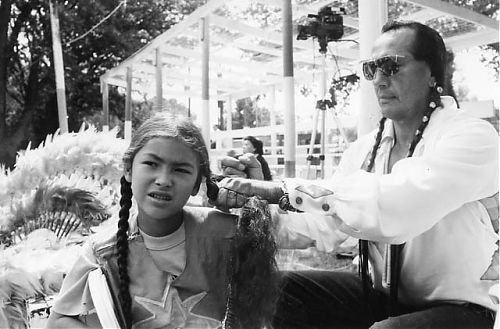
I like the way Russell Means began his 1980 speech, For America To Live, Europe Must Die.
The only possible opening for a statement of this kind is that I detest writing. The process itself epitomizes the European concept of “legitimate” thinking; what is written has an importance that is denied the spoken. My culture, the Lakota culture, has an oral tradition, so I ordinarily reject writing. It is one of the white world’s ways of destroying the cultures of non-European peoples, the imposing of an abstraction over the spoken relationship of a people.
So what you read here is not what I’ve written. It’s what I’ve said and someone else has written down. I will allow this because it seems that the only way to communicate with the white world is through the dead, dry leaves of a book. I don’t really care whether my words reach whites or not.
I read a lot of media theory, where orality and literacy is a giant topic. (I can see a book called Orality and Literacy from my desk.) And I think this is the first time I’ve encountered a first person, pro-orality perspective from someone with an oral culture. I feel shocked to realize this. But of course books about media have a bias towards text. And of course online articles have a bias towards text and mass media. Somehow I had the two topics in my mind, media theory and resisting white supremacy, but hadn’t made many connections between them.
There’s a rule of thumb which can be applied here. You cannot judge the real nature of a European revolutionary doctrine on the basis of the changes it proposes to make within the European power structure and society. You can only judge it by the effects it will have on non-European peoples. This is because every revolution in European history has served to reinforce Europe’s tendencies and abilities to export destruction to other peoples, other cultures and the environment itself. I defy anyone to point out an example where this is not true.
Means was talking about Marxism, but now I am thinking about printing presses and the internet.
I enjoyed this interview with Lierre Keith about destroying civilization, especially these definitions of genders.
Sexual domination and subordination are institutionalized into the very concepts of masculine and feminine. Masculinity is simply a conglomeration of the personality traits necessary for the patriarchal soldier-rapist: physically strong, emotionally cauterized, rational, domineering, cruel. All of this is supposed to add up to “handsome” as well. Likewise femininity is ultimately a description of the personality that results from trauma and powerlessness: weak, passive, yielding, emotional, hyper-vigilant to the needs of the dominators and desperate for the dominator’s attention.
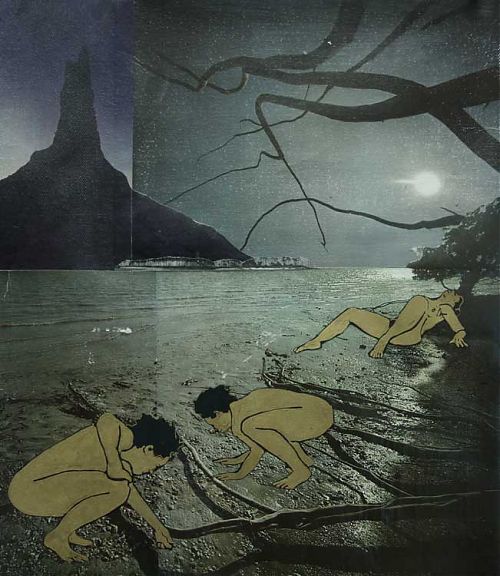
I’ve been going through some old photos that my mum brought me. They show a lot of crouching at the beach. This collage looked familiar in two ways then: the beach crouching from when I was small, and the nighttime trees from my neighbourhood now. I think this new combination will add something to my night walks.
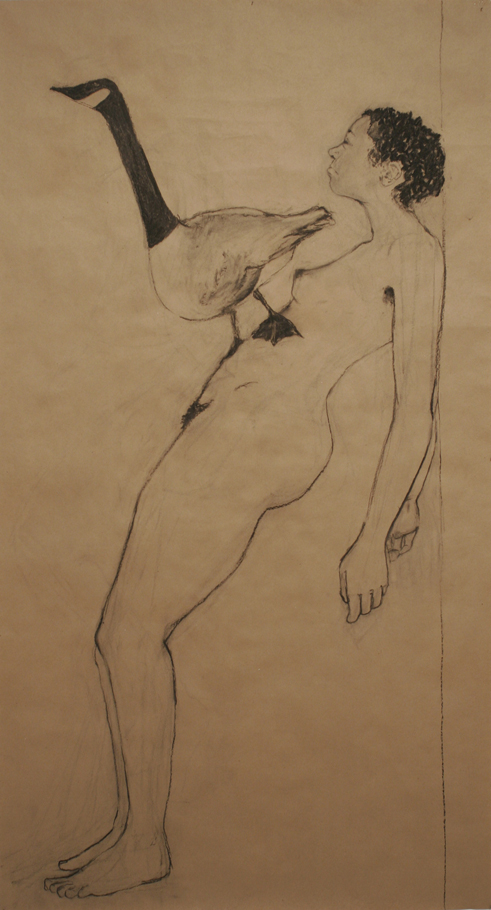
Capitalism works on the same principle as a glass company whose employees spend their nights breaking people’s windows and their days boasting of the public service they provide.
— Alfie Kohn in No Contest: The Case Against Competition
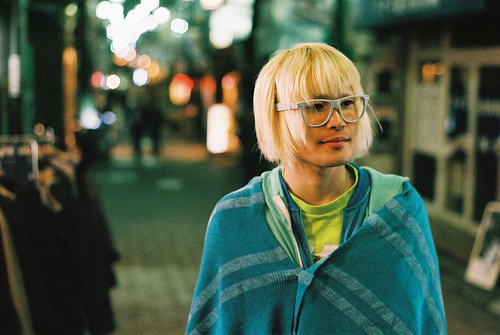
Those blue and green colours give me physical pleasure the same way red and blue do. There are other colour schemes that I get excited about, but I have a soft spot for red-green-blue because of working at a monitor all day.
All this to say that I made an RGB outfit and wearing it is my own spiritual rapture. The colours of personal happiness. On my body. I may or may not succeed in documenting it with a full length photo, but I have collected these fragments.
The bottom of the dress (I’m the fishnets).
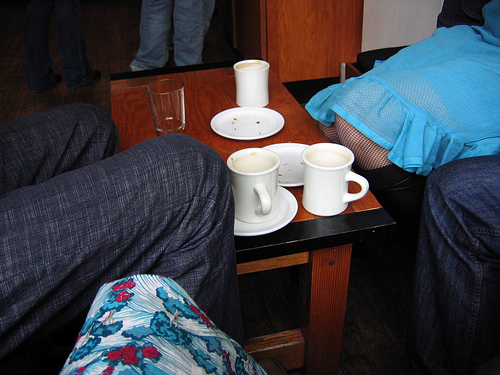
The top of the dress (under a cardigan, and I should mention that I shrunk one eye in photoshop because my camera has a bit of a fishbowl effect around the edges and sometimes it catches faces in distracting ways).
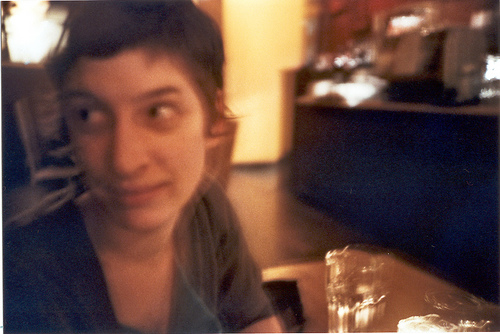
I made a sash out of lime green dupioni silk (shiny).
And then with this scarf, it makes the holy trinity of colour pixels.
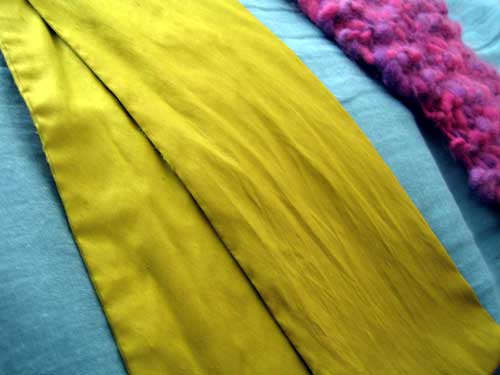
I’m working on expressing more political intentions with my wardrobe (slowly… I am mostly making things not buying them), but for now I am glad to express any conscious intention.
A sonnet is built on a fourteen-line frame, of five-foot lines. Hence, the soneteer knows exactly where he is headed, although he may not know how to get there.
I finished reading The Elements of Style. The famed, much recommended Elements of Style. It’s alright. You need to bring your own race and class analysis goggles. An example.
Style rule #2. Write in a way that comes naturally.
Style rule #15. Do not use dialect unless your ear is good.
Style rule #20. Avoid foreign languages.
Where this leaves a person whose natural dialect doesn’t sound good to an English professor is a matter for the analysis goggles.
I would at least pair the book with this old, also somewhat famed, David Foster Wallace essay about English usage wars.
That essay is a delight but I feel sad when I read it. I feel sad reading anything by DFW since his suicide, but there’s more this time. He gets all the way to seeing that language has class signifiers and that Standard Written English is an elitist, white, academic dialect, and then he gives in. His best suggestion for surviving in this classist, white supremacist (capitalist colonial heteropatriarchal… might as well get it all in there) system is to learn to pass. That is soul crushing advice.
I’ve gotten this vibe from a lot of David Foster Wallace’s writing. There’s a part that is generous and open and loving and grounded (he calls it a Democratic Spirit in that essay), and then a part with… I want to say with no faith in the power of consciousness. I don’t know if that’s exactly it. But something. Resignation? I count him as one of my favourite authors, but usually when I read something by him I have to debrief afterward. I just looked at my little list of “books read in 2006” and saw that my note for Infinite Jest was “not sure yet.” (Since then I’ve given it as a gift at least three times.)
I am really wishing that Dark Daughta’s archives were still public so I could link to something about passing and anxiety, or about changing the power dynamics of a situation by speaking and acting with a grounded analysis. DD, since you went members only, I sure notice how much I was depending on your output and not pitching in, so thanks for that wake up. If I find alternate links I will come back and stick them in.
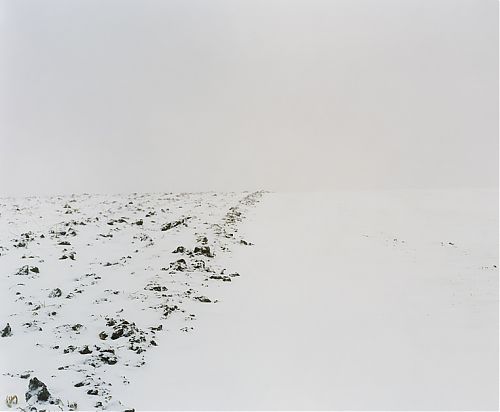
I don’t want to just start posting other people’s photos with no discussion, but on the other hand I don’t want to save this image forever as a draft. Posting it now, writing another day.
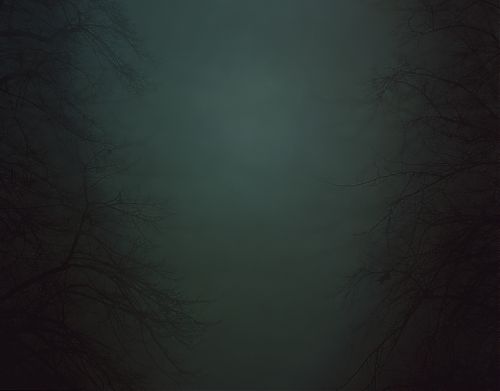
I think I saved this photo because I like walking at night.
New device reads minds pretty well.
Whenever I read articles about advances in computer mind-reading technology, they focus on the benefits for paralysed or locked-in people. Fair enough, but I am also waiting for my generic mind-to-computer input device. Could you not then basically send telepathic messages to your friends? If a computer can read my mind, and computers can already talk to each other… that means I can send telepathic email at least. It makes me laugh. It’s such a clunky, budget vision of telepathy, but I think it’s good enough.
A few years ago, after seeing a documentary about a locked-in man’s telepathic computer, I had elaborate fantasies of starting a company to manufacture open source, recyclable, telepathic PDA things. It would be such an interesting device to design interfaces for. In my elaborate fantasy, there are mind-reading headphones that whisper interface feedback to you.
Being apparently more environmentalist than the average geek, I barely even buy any electronic gadgets, but I am so compelled by the prospect of adjusting my music volume up and down with my mind that I thought I might have to move somewhere cheap and kidnap an engineer to make it happen.
I have since chilled out, but I note with delight that these articles are showing up more often.
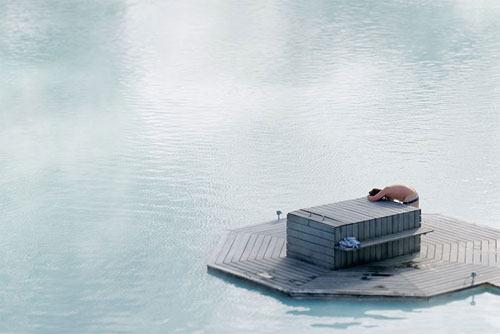
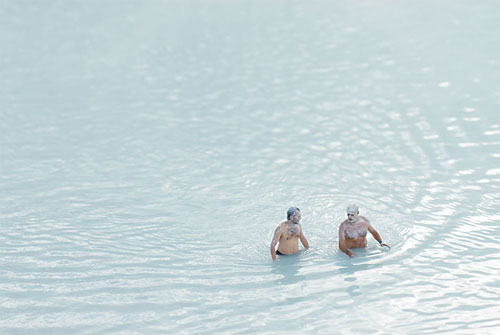
I need to organize more time to hang out naked with my friends. I love it so much. In the summer, there is usually night swimming and maybe this year I’ll go to our local nudie lake with it’s one hilariously small dock. But what about winter? What about now? I don’t think there is a women’s bath or anything in this town. I need to organize some nudeness at home. Anybody want to come over and take expressive naked photos? Give me a call.
I continue to publish drafts that have been lingering in the archives. This one lingered because it was veering towards criticising my friends and I was too scared and distracted to get it to a place that was honest and compassionate instead of either judgmental or passive. Check out how non-intense it is. This is the type of stuff that has been terrifying me for years. It’s kind of funny.
. . .
9 Feb 2008
I just went to the dentist for the first time in about seven or eight years. This particular dentist is explicitly “an emotional guy” who gives a lot of compliments about teeth, and expresses a lot of care and encouragement about your dental health. Full on, “I know I just met you, but I really care about your teeth and gums, because I know that dental health can really impact a person.” Totally sincere, enthusiastic. OK. Awesome. It also ran right into this discomfort I have with receiving compliments and praise, which I thought about a lot on the walk home from my appointment.
So I’ve been wanting to write out my ideas about praise and compliments, but I’ve determined that first I need to deal with this other dentist-related thing, being that a lot of my friends go to the same dentist and I’m a bit afraid of sparking some “we’re all in the Dr. Bjornson club!” celebrations. (This is a real “everything good is actually bad!” kind of post. I dislike compliments, and furthermore I dislike belonging! No fun allowed!) I’ve been belatedly discovering Kurt Vonnegut’s books, and in the last one I read (Cat’s Cradle), he uses this invented word, granfalloon, to describe an allegiance based on a shallow or pointless shared trait, like being from Iowa or going to the same dentist. I am happy to have this word, even just to clarify for myself that I don’t want to avoid all kinds of belonging. Only granfallooning gets the diss, because it is meaningless and distracting, and is, I think, a kind of vanity.
. . .
So, then, over a year later, I’ve thought a lot about my problem with compliments. I think there are two parts; one where I’m crazy and one where some compliments are crazy. I have book quotes to go with both of these.
The part about living in a crazy world is like this. From Nonviolent Communication.
Conventional compliments often take the form of judgements, however positive, and are sometimes offered to manipulate the behavior of others.
And the part about my own craziness goes like this. From Women Who Run With The Wolves, in a chapter about procrastination and creative blocks.
Troublesome contaminants in the river [of soul/creativity] are obvious when a woman turns away sincere compliments about her creative life. There may be only a little pollution, as in the offhanded “Oh, how nice you are to give such a compliment,” or there may be massive trouble on the river: “Oh, this old thing” or “You must be out of your mind.” … These are all signs of an injured animus. Good things flow into the woman but are immediately poisoned.
Not that my teeth are my creative life, but being a person who was both terrible at accepting compliments and struggling with intense procrastination at the same time, I figure it translates.

I still note pictures of masks in fashion and pop culture. I go on long quiet breaks every few years, but I also ponder some topics for years and years. I am trying to figure out what this persistence/absence is about. Hiding out whenever I am processing anything? Needing to be better at learning in public? Being a generalist and working on a thousand things at the same time, gradually, over a long period of time? Those are good starting ideas.
This mask, I think I like because it is both campy and inhuman. The pantyhose fabric is so gross that it’s funny, but then the full face coverage is too creepy to be fun. I am delighted.
I will leave the “gosh models are skinny, etc” disclaimer as an exercise for the reader.
Letting more old drafts shine their light into the internet. More quotations from The Monster Show .
I think the reason I saved this first quotation was that I hadn’t thought about movies being made by the most surgically altered and self-mutilated people around. I liked thinking about horror movies reflecting the horror of Hollywood culture, not only of wider American culture.
p.167, On Arlene Francis, star of Murders in the Rue Morgue:
Her real shudders came after the film was completed when other producers, eager to discuss her future in films, began wielding scalpels shaper than those of Dr. Mirakle. They would offer her riches, it appeared, but only if she would consent to give up a portion of her nose. Rhinoplasty was all the rage in a Hollywood that now placed a premium on robotic, standardized glamor in the Busby Berkeley mold. Dorothy Tree, for example, was a highly regarded Broadway actress of the late 1920s, but her strong profile relegated her to bit parts in films, shuffling around in a shroud, for instance, as one of Bela Lugosi’s vampire wives. Finally, after leaving her original nose behind her in the vaults of Dracula, she began to get speaking parts and billing. Producers and casting directors were eager to prescribe and preside over surgical rearrangements of the female body, an obsession beginning to be weirdly echoed, or perhaps weirdly magnified, in horror movies and popular literature. Indeed, the persistent, essential connection between plastic surgery, self-mutilation, and horror had only begun.
And this next one just made me curious about what this proposed link is.
p.191, on incest and vampires…
[In Mark of the Vampire, 1935, Tod] Browning and his screenwriter Guy Endor likely took some inspiration from Ernest Jones’ pioneering psychoanalytic study On The Nightmare (1931), which explicitly linked vampire fantasies to incest guilt.
More old drafts that have been sitting in the archives, more quotations from The Monster Show .
p.200-1
[Tod] Browning spent a lot of time at the ballpark and racetrack in the early thirties, and veteran Hollywood writer Budd Schulberg (author of The Disenchanted and What Makes Sammy Run? ??) had a memory of another Browning pastime. “The marathon dance was in vogue then and we went a few times to the Santa Monica Pier to watch the young unemployed zombies drag themselves around the floor in a slow motion dance macabre,” Schulberg wrote in his 1981 memoir ??Moving Pictures. “Even more appalling than the victims on the dance floor were the regulars, affluent sadists in the same front-row seats every night, cheering on their favorites who kept fainting and occasionally throwing up from exhaustion. One of the most dedicated of the regulars was Tod Browning, who never missed a night and who got that same manic gleam in his eyes as when he was directing Freaks.”
p.292
The rediscovery and rehabilitation of Freaks became almost a cause celebre in the film journals beginning in the early sixties. Once considered crass and tasteless, the film was now “compassionate” and “sensitive.” In a way, the appreciation of Freaks became a politically correct means to indulge a morbid curiosity about thalidomide deformities, while still being able to feel self-righteous and progressive.