Tree appreciation, old quotes, ex-vegetarians again.


Plants are in constant communication with each other. … Any place that roots touch other roots or their shared mycelial network, they can also exchange chemistries, medicines. One plant will send out a chemical distress call. The others will respond with precise antibiotics, antifungals, antimicrobials, or pesticides to help. Like my chickens when they sight a hawk, plants will give out an alarm call when a predator is near. Lima beans will release chemicals that warn other lima beans when they are being attacked by spider mites. When something ambulatory brushes past a plant in the woods, not only does the affected plant respond by stiffening as best it can, it also sends out a chemical warning that allows all the other plants nearby to stiffen their branches in preparation.

And there’s more. Buhner talks about archipelagos of plant communities, groupings of interconnecting plants around a dominant or keystone species, usually a tree. These archipelagoes form in response to mysterious and unpredictable cues, and often announce the wholesale moveent of ecosystems. The process begins with an outsider or pioneer plant, who literally prepares the soil for its cohorts. When the soil is ready, the nurse plant sends out the chemical message, join me. …

Once established, the keystone plant then calls the bacteria, mycelia, plants, insects, and other animals necessary to build a healthy and resilient community. The keystone’s chemistries arrange the other species and direct their behavior. “This capacity of keystone species to ‘teach’ their plant communities how to act was widely recognized in indigenous and folk taxonomies.” Elder trees are called elders for a reason.

The Vegetarian Myth page 88, talking about The Lost Language of Plants by Stephen Harrod Buhner.

And on and on about the amazingness of trees. Using 2/3 of their water to feed other beings, making masses of chemicals for other species, living for thousands of years. “They literally control life on earth.” I swoon. I love appreciating plant activities.

When I was vegetarian I would regularly find myself in conversations with folks who loved animals and joked that as vegetarians, their role was to kill all plants. I know it’s a joke, but I did find plant appreciation kind of lacking overall in vegetarian discussions. Some love for produce sometimes (local tomatoes, etc), but it’s funny to me to read this wide-eyed tree worship as part of an author’s journey to meat eating.

De-colonizing and Fair Isle knitting.

Keep Abortion Legal sweater by Lisa Anne Auerbach

I just read several knitting books and several anti-colonial books at the same time, and I have all these new ideas about my own knitting. As happens when you read different topics at the same time, I found where they overlap and connect. An example.

From Michael Pearson’s Traditional Knitting: Aran, Fair Isle and fisher ganseys, 1984.

Pages 121-2.

[The Shetland Islands] lie to the north east of Britain and are in fact closer to Norway than mainland Scotland. … The inhabitants owe their heritage to the Norsemen who settled there in the 8th and 9th centuries, living under the patronage of Norway for over 500 years before the influx of Scottish mainlanders in the 13th century. Norse influence then began to fade and ended with the sale of the islands in 1496 by Norway to the Scottish Crown.

From this date right through to the present day the history of the inhabitants has been one of ruthless exploitation— by the Stuart family till 1615 and then by the splitting up of the islands into estates run by rich immigrant Churchmen and landowners…

The two knitting traditions that had the most resonance for me were Cowichan sweaters and Fair Isle knitting, both affected by Scottish colonialism. The more I read about Scottish history, the more it seems like Scotland has been a volcano of settlers for hundreds of years. They can’t stay home. Why? I continue to read. I want to know more about how I ended up here, descended from at least five different Scottish settler families on Coast Salish territories.

But. Ideas I got from this round of reading.

  • Folk knitting history is patchy and there are many versions of events and stories.
  • Reading books by American and British people mostly involves serious denial about colonization of any kind. It’s almost a relief to read books about North American genocide, because at least the destruction is presented as destruction. I read one book about Fair Isle knitting that presented Norway’s sale of Fair Isle to Scotland as simply a “reflection of the fact that the island was by then more Scottish than Norse.” OK, author, but how did that happen?
  • Knitting has labour politics as well as the more discussed gender roles. I hadn’t thought much before about the history of underpaid cottage industries where poor people knit clothes for rich people, for peanuts per hour. It is still basically impossible to make a living wage selling hand knitting. Like gardening, it’s one of those subsistence activities that middle class people dabble in for leisure. Not sure what to do with that right now.
  • Again, being a folk art, patterns and ideas spread whenever one crafter meets another (or even a craft). It sounds like Cowichan spinners and weavers were keen to pick up knitting from European settlers and missionaries, just as crafters. But also, English style knitting (yarn in the receiving hand) was taught in residential schools as a “civilizing” domestic skill, sometimes to produce items the school sold for profit. I want to find out how Turkish style knitting (with the yarn around the back of the neck) ended up in the Andes, when by the time of colonization I think Iberians were knitting in continental style (yarn in the loading hand). So far I haven’t found a resource that has both crafty knowledge and awareness of colonialism.

More from Michael Pearson.

Page 128.

Because of the natural tendency to identify with areas within reach, British knitters have usually assumed that Fair Isle was the place where two-colour knitting was invented.

I don’t know how natural that is. It does seem to be part of British and maybe European culture, to assume cultural dominance or sameness. Do non-Euro people have a history of that too? Assuming that everything was invented nearby just because it’s here now? (Two colour knitting, as far as I have been able to find out, first turned up in Turkey and Egypt, then spread via trade routes to Baltic and Nordic Europe.)

JZ and DJ interview

This ten year old interview of John Zerzan by Derrick Jensen is helping me think about technology.

DJ: Let’s talk more about technology. Isn’t technology just driven by curiosity?

JZ: You hear people say this all the time: “You can’t put the genie back in the bottle”; “You’re asking people to forget.” Stuff like that. But that’s just another attempt to naturalize the craziness. And it’s a variant of that same old racist intelligence argument. Because the Hopi didn’t invent backhoes, they must not be curious. Sure, people are naturally curious. But about what? Did you or I aspire to create the neutron bomb? Of course not. That’s crazy. Why would people want to do that in the first place? They don’t. But the fact that I don’t want to create a neutron bomb doesn’t mean I’m not curious. Curiosity is not value free. Certain types of curiosity arise from certain types of mindsets, and our own “curiosity” follows the logic of alienation, not simple wonder, not learning something to become a better person. Our “curiosity,” taken as a whole, leads us in the direction of further domination. How could it do any other?

practicing talking about kenya, somewhat exhausted by it

  • i wondered how this part would be, coming home from a trip to kenya and having to talk to people about ‘africa’ and being a rich white tourist in kenya and so on. so far it is patchy and a bit exhausting, but i think i’m getting better.
  • first good talk with my mum about race and white privilege. finally enough tries.
  • i always need some practice to express things in a way people can understand. maybe because i spend so much time alone, and nonverbally? and hypertextually? i’ve really gotten to where i think in a big cloud of bits, not a focussed or linear way without effort.
  • a product of my thinking too much without talking… a lot of catching up to do on the talking front.

things that came up that i expected:

  • people generalizing about “africa” when i’m talking about specific places in kenya
  • people defining kenyan (and generalized african) societies as on a path of progress or evolution or civilization than ends up at a north american model
  • people much more willing to define or consider social problems in africa than problems at home
  • people defining the colonization process in canada as “more successful” than in kenya without considering that calling this successful defines genocide and occupation as a success strategy as long as it results in consumer luxuries.
  • people judging social and environmental problems in kenya and africa without considering their causes in western countries
  • when i try to process parts of my own privilege i’m uncomfortable with, decisions i would make differently now, i get back a lot of… like apologetic responses. ‘oh you did fine, how could you know any better? no one can do better anyway. that’s how things are.’ so many ways to silence a conversation.

Magical politics, a first attempt.

I’ve been hunting around for radical political magic. I ran into this pretty great book review by a druid, The Spells We Are Under, because it popped up somewhere under the site title “Healing Whiteness.”

[Van] Jones was astonished to find that the vast corporate structures against which he and many other progressives had been campaigning so hard— the WTO, the World Bank, and so on— were treated, by the people who run them, as mere tools to be used or tossed aside at will. The elite see themselves personally as the holders of power, and institutions as their means and modes of power. The activists outside the police barricades, by contrast, see the institutions themselves as the problem. The scene from “The Wizard of Oz” comes forcefully to mind; Dorothy and her friends try to figure out some way to deal with the terrifying apparition of Oz, the Great and Powerful, but never notice the little man behind the curtain.

Juxtaposed with:

Consider George Lakey’s fascinating account of the Otpor movement against Serbian dictator Slobodan Milosevic… One of the tactics Otpor members used to halt police violence against them was to take photos of their wounded and make sure the family members, neighbors, and children of the police got to see them. This was a brilliant bit of magic. The individual human beings who made up that reified abstraction, “the police,” were stripped of that identity by a spell of unnaming, and turned back into neighbors, husbands, children, parents: people who were part of civil society, and subject to its standards and social pressures. That couldn’t have been achieved if Otpor had reified and protested “police brutality,” since that act would have strengthened the reification of police as something other than ordinary members of society.

I know this idea from non-magical people too. (“Those big, powerful corporations have offices and CEOs with addresses.”) But I like having a name for this shift in perspective, and I think I like having a name that triggers dork associations about hobbits and +5 strength against goblins.

Embodiment and drifting.

Talking to Heather about embodiment, being in your body. She had an idea that maybe when teenagers are focussed on having sex even when it is pretty “rape-y” and risky and not beneficial or pleasurable, it has partly to do with their lack of other ways to feel their physicality and be in their bodies. No access to nature, nowhere to safely walk, not allowed to play outside unsupervised, even encouraged to eliminate or replace all body odours, etc. That’s a lot of pressure on sex for being physical.

It got me thinking about how I relate to the internet. I’m on here a LOT, in this disembodied place.

Anyway. I’ve been realizing that one of my big ways to be in my body for the last year or so has been looking at things. Sensing with my eyes, and sensing the reactions my body has to colours and shapes (and letters, boy howdy). When I got to go to the UK with my mum last fall, and we spent so much time in art galleries because it was rainy, that was the most physically altered I’ve felt since I stopped eating psychedelic drugs. High on modern art— physically dizzy and speedy and sometimes getting auras like before a migraine, from seeing enough art nouveau in one room to really experience and understand the concept of biomorphic whiplash. I made this website these colours because they do similar things to me— they are stimulating and encouraging and they make me want to write. I remember using music that way in the past. Galen would come home sometimes and be able to tell when I was working on something important, because I’d be blasting some or other personal power music. In high school— I just remembered this— I did a lot with smells. Other people’s sweaters, specific incense, open window when it rained.

*** where does fucking fit in?? ***

So, notably, none of this involves movement or muscles. It’s all sensing and processing and information. It’s physical to me, but it’s what a lot of people would identify as being in your head.

My forays into physical activity are marked by a lot of head time, too. Office bike— the exercise bike I can pedal while I make websites. Wing chun— if I have to punch and kick to learn which way shoulders bend and how momentum works, I guess that’s alright. Fucking— “erotics is the process through which sex acquires meaning.” I think I get bored, otherwise.

I’ve been casting around for some more physical motion in my life, to make me stronger.

I have high hopes for a bastardized version of this pretentious French art thing, the dérive, or drift. Walking to nowhere. OK. I do not like walking for the sake of walking, even though I love walking. Growing up, my parents were all about taking a walk, but not so much about negotiating where to walk or talking about what they feel like on the walks or whatever, so I have a lot of stored up experience being deeply bored with walks.

Walking to nowhere: ok. Just paying attention to see where you want to walk the most: ok. Also, paying attention to local geography and how it feels, that can go on forever. I think this could be useful in trying to figure out more of how I relate to being a settler on colonized land.

So yeah, I’m glad I’ve practiced walking by myself, home alone from various locations. I’m glad Victoria is a mostly non-threatening place for me to walk around.

“The imperative to renew and expand our observation skills.”

In a world where the quantity of secondary (mediated) observation and interpretation threatens to drown us, the imperative to renew and expand our observation skills (in all forms) is at least as important as the need to sift and make sense of the flood of mediated information. Improved skills of observation and thoughtful interaction are also more likely sources of creative solutions than brave conquests in new fields of specialised knowledge by the armies of science and technology.

The icon for this principle is a person as a tree, emphasising ourselves in nature and transformed by it.

— David Holmgren, co-originator of the permaculture concept, in Permaculture: Principles and Pathways Beyond Sustainability

tantra

Haircuts by children, my vanity.

Awkward stage.

Galen is getting his hair cut by a ten year old in a few weeks, as part of a performance about the segregation and disenfranchisement of children in society. An opportunity to trust the skill and style choices of a kid. I think this is a great idea for a performance and I’ve been telling a lot of people about it. (More explanation if you want it.)

I am not getting my hair cut. It turns out I am still terrified of bad hair cuts. I’m not terrified of no make up, belly rolls, showing cellulite in public, body hair, laundry day outfits, etc. But hair cuts, yes. I’m fascinated.

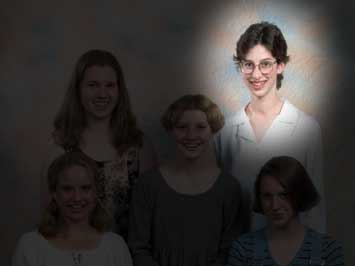
I had unflattering hair cuts that didn’t express my soul essence for about 13 years in a row, between my mum deciding I looked cute with a mushroom cut in grade 1, through a lot of small town $7 haircuts, through getting my friends to chop off my hair in grade 11 (somewhat better), through shaving it off in grade 12 (worse again), growing that out a bit (better again), and deciding to go to my grandmother’s hair stylist when I moved to Victoria. That was how much I knew about haircuts when I was 18. I thought the neighbourhood wash-n-set was the place to go for the punk rock haircut of my dreams. Granny’s stylist did alright as long as I kept it really short. It took me until I was about 20 to realize there were people who knew how to create a haircut on purpose, rather than just cutting to the approximate length and hoping for the best. My hair trauma is not helped by the coincidence that I was a giant nerd during pretty much the exact same time as the ugly haircuts. That photo shows me five minutes after having my hair cut and styled at some $10 Hair Hut type place at the mall in my hometown. It also shows me about 1 month into a three year stretch of on-and-off suicidal depression. COINCIDENCE? I’m joking about 50%. I could have used a hair mentor.

So. This haircuts by children performance may have cured me of my inner judgments about feminist environmentalists who won’t talk about reusable menstrual products. The shoe is on the other foot now. And even making that connection might help me sort out my hair terror. I had my share of menstrual shame and angst as a teenager. Maybe if I think about how I rearranged that, I’ll be able to rearrange my hair anxiety into something more in line with the rest of my values.

In the meantime I am telling a lot of people about these haircuts by children. So far I’ve prompted I think three people to set up appointments, one of them a stranger.

Why.

Keywords for me: BDSM, gender, cystic fibrosis, self-actualization, poetry.

The first time I watched this I got mesmerized and teary and couldn’t tell how much time had passed, especially during the list of hardware and tools.

Family names, Kurt Vonnegut, figuring shit out.

I’ve been considering the idea of giving all my kids different last names. Resurrecting various maiden names or something, picking them the way people often pick middle names out of their whole pool of known family names.

I think it is mainly being married that has me thinking about names and name systems. It’s easy to skip that whole “married name” business, but if you want to give your kid some kind of awesome, non-patriarchal name you actually have to come up with a plan. That gets complicated really fast, even in the common, surface solutions like hyphenating last names or using the mother’s family name in an attempt to go matrilineal (by passing on her dad’s name). All of those schemes run into the usual problems if there is a break from monogamy, if anybody leaves a relationship, breeds with more than one person, or dies. The “team name” gets broken all the time, even if you are trying to play along. Even just making up a new last name doesn’t solve the question of what the grandkids would be called.

Family structures and systems are fucking intense. Where do they all come from? Which ones are good? Research questions.

This multiple last name idea has been wildly unpopular with everyone I’ve mentioned it to. Intensely unpopular. Instant frowning. Worst idea ever. I still kind of like it. Galen and I already have different last names and we manage to be a family team. Maybe it would be good, if we had kids, to remember that they were individual people and not just “ours.” Maybe a team name is just a manifestation of compulsory/wishful monogamy and maybe we can do better than that. It scales well across multiple generations, unlike, say, hyphenation. I’m lucky enough to know a lot of my ancestral family names, and it seems like maybe reusing them would be a fairly robust way to remember your lineage if you moved or were displaced. Or maybe it would just make it impossible to find each other again.

Lacking a unified last name, maybe we could give our household its own name, to make it easy to refer to. That happens sometimes with places populated by roommates. (I’m thinking of places I’ve known called The Husbandry, The Folk Museum, The Queens Den, The Triple Crush Palace…). That doesn’t solve anything about family members who don’t live in the same home, but it’s a start.

This is unresolved. I just found an old booksale purchase called World Revolution and Family Patterns that I’m hoping might contain some inspiration. I also found a Kurt Vonnegut quote via Bex that I have filed away.

12. … Even when Vonnegut dared to propose a utopian scheme, it was a happily dysfunctional one. In Slapstick, Wilbur Swain wins the presidency with a scheme to eliminate loneliness by issuing people complicated middle names (he becomes Wilbur Daffodil-11 Swain) which make them part of new extended families. He advises people to tell new relatives they hate, or members of other families asking for help: “Why don’t you take a flying fuck at a rolling doughnut? Why don’t you take a flying fuck at the mooooooooooooon?” Of course, this fails to prevent plagues, the breakdown of his government, and civil wars later in the story.

Complicated middle names: noted.

Good spells, burning buildings, Alan Moore, Leslie Feinberg.

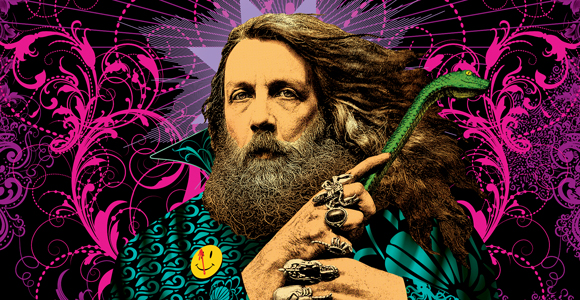
Alan Moore

I ingested a lot of Alan Moore media when The Watchmen movie came out this month, and I really loved his take on magic (in the sense of spells and incantations, not card tricks) in a interview with Stewart Lee. The magic topic starts at about 5:30 of part three. (Part 1, and part 2 if you want them.)

I suppose the thing with magic is that a lot of it is about writing anyway. “To cast a spell.” That’s a fancy way of saying spelling. Grimoire, the big book of magical secrets. That’s a French way of saying ‘grammar.’ It’s all about language and writing. It’s all about incantation. It’s all about all these things. And so magic, really, it turns out to just be a continuation of the stuff I’ve been doing anyway. Using certain arrangements of words or images to affect people’s consciousness.

I decided to keep that for my multi-year quest about how to communicate. Magick and neo-paganism is a minefield of gender terrorism and cultural appropriation, a bring your own analysis situation. But still, folks who are into magical spells do have a lot of ideas and practice related to speaking intentionally.

After keeping it on my (giant) reading list for years, I finally read Stone Butch Blues recently, and I saved this quote about semi-applicable resources.

I felt as though I was rushing into a burning building to rescue the ideas I needed in my own life.

It’s been a pretty good spell so far— I say it a lot when I’m getting inspired by a book that has a lot of problems and maybe embarrasses or enrages me. It’s good for books written by druids.

“Because love always causes a descent into the Death nature…”

These are quotes from Women Who Run With The Wolves that have been sitting here with no context, unpublished, since February 2009. I think I was interested in talking about love beyond infatuation, love as an action or alliance instead of a feeling. I still am.

I haven’t posted anything here, or done much writing at all, for many months. Spitting out some old drafts seems like a good re-entry. I seem to do this every now and then. Maybe I can promote it as a personal feature instead of a bug.

Anyway. Old quotes.

A part of every [person] resists knowing that in all love relationships Death must have her share. We pretend we can love without our illusions about love dying, pretend we can go on without our superficial expectations dying, pretend we can progress and that our favorite flushes and rushes will never die. But in love, psychically, everything becomes picked apart….

What dies? Illusion dies, expectations die, greed for having it all, for wanting all to be beautiful only, all this dies. Because love always causes a descent into Death nature, we can see why it takes abundant self-power and soulfulness to make that commitment.

More…

In wise stories, love is seldom a romantic tryst between two lovers. For instance, some stories from the circumpolar regions describe the union of two beings whose strength together enables one or both to enter into communication with the soul world and to participate in fate as a dance with life and death.

And more.

It is true that within a single love relationship there are many endings. Yet, somehow and somewhere in the delicate layers of the being that is created when two people love one another, there is both a heart and breath. While one side of the heart empties, the other fills. When one breath runs out, another begins.

Down with praise, emotional dentistry, granfallooning.

I continue to publish drafts that have been lingering in the archives. This one lingered because it was veering towards criticising my friends and I was too scared and distracted to get it to a place that was honest and compassionate instead of either judgmental or passive. Check out how non-intense it is. This is the type of stuff that has been terrifying me for years. It’s kind of funny.

. . .

9 Feb 2008

I just went to the dentist for the first time in about seven or eight years. This particular dentist is explicitly “an emotional guy” who gives a lot of compliments about teeth, and expresses a lot of care and encouragement about your dental health. Full on, “I know I just met you, but I really care about your teeth and gums, because I know that dental health can really impact a person.” Totally sincere, enthusiastic. OK. Awesome. It also ran right into this discomfort I have with receiving compliments and praise, which I thought about a lot on the walk home from my appointment.

So I’ve been wanting to write out my ideas about praise and compliments, but I’ve determined that first I need to deal with this other dentist-related thing, being that a lot of my friends go to the same dentist and I’m a bit afraid of sparking some “we’re all in the Dr. Bjornson club!” celebrations. (This is a real “everything good is actually bad!” kind of post. I dislike compliments, and furthermore I dislike belonging! No fun allowed!) I’ve been belatedly discovering Kurt Vonnegut’s books, and in the last one I read (Cat’s Cradle), he uses this invented word, granfalloon, to describe an allegiance based on a shallow or pointless shared trait, like being from Iowa or going to the same dentist. I am happy to have this word, even just to clarify for myself that I don’t want to avoid all kinds of belonging. Only granfallooning gets the diss, because it is meaningless and distracting, and is, I think, a kind of vanity.

. . .

So, then, over a year later, I’ve thought a lot about my problem with compliments. I think there are two parts; one where I’m crazy and one where some compliments are crazy. I have book quotes to go with both of these.

The part about living in a crazy world is like this. From Nonviolent Communication.

Conventional compliments often take the form of judgements, however positive, and are sometimes offered to manipulate the behavior of others.

And the part about my own craziness goes like this. From Women Who Run With The Wolves, in a chapter about procrastination and creative blocks.

Troublesome contaminants in the river [of soul/creativity] are obvious when a woman turns away sincere compliments about her creative life. There may be only a little pollution, as in the offhanded “Oh, how nice you are to give such a compliment,” or there may be massive trouble on the river: “Oh, this old thing” or “You must be out of your mind.” … These are all signs of an injured animus. Good things flow into the woman but are immediately poisoned.

Not that my teeth are my creative life, but being a person who was both terrible at accepting compliments and struggling with intense procrastination at the same time, I figure it translates.

Horror movies, self-mutilation, vampire-incest?, publishing old drafts.

Letting more old drafts shine their light into the internet. More quotations from The Monster Show .

I think the reason I saved this first quotation was that I hadn’t thought about movies being made by the most surgically altered and self-mutilated people around. I liked thinking about horror movies reflecting the horror of Hollywood culture, not only of wider American culture.

p.167, On Arlene Francis, star of Murders in the Rue Morgue:

Her real shudders came after the film was completed when other producers, eager to discuss her future in films, began wielding scalpels shaper than those of Dr. Mirakle. They would offer her riches, it appeared, but only if she would consent to give up a portion of her nose. Rhinoplasty was all the rage in a Hollywood that now placed a premium on robotic, standardized glamor in the Busby Berkeley mold. Dorothy Tree, for example, was a highly regarded Broadway actress of the late 1920s, but her strong profile relegated her to bit parts in films, shuffling around in a shroud, for instance, as one of Bela Lugosi’s vampire wives. Finally, after leaving her original nose behind her in the vaults of Dracula, she began to get speaking parts and billing. Producers and casting directors were eager to prescribe and preside over surgical rearrangements of the female body, an obsession beginning to be weirdly echoed, or perhaps weirdly magnified, in horror movies and popular literature. Indeed, the persistent, essential connection between plastic surgery, self-mutilation, and horror had only begun.

And this next one just made me curious about what this proposed link is.

p.191, on incest and vampires…

[In Mark of the Vampire, 1935, Tod] Browning and his screenwriter Guy Endor likely took some inspiration from Ernest Jones’ pioneering psychoanalytic study On The Nightmare (1931), which explicitly linked vampire fantasies to incest guilt.

Freaks, zombies, horror movies… old drafts.

More old drafts that have been sitting in the archives, more quotations from The Monster Show .

p.200-1

[Tod] Browning spent a lot of time at the ballpark and racetrack in the early thirties, and veteran Hollywood writer Budd Schulberg (author of The Disenchanted and What Makes Sammy Run? ??) had a memory of another Browning pastime. “The marathon dance was in vogue then and we went a few times to the Santa Monica Pier to watch the young unemployed zombies drag themselves around the floor in a slow motion dance macabre,” Schulberg wrote in his 1981 memoir ??Moving Pictures. “Even more appalling than the victims on the dance floor were the regulars, affluent sadists in the same front-row seats every night, cheering on their favorites who kept fainting and occasionally throwing up from exhaustion. One of the most dedicated of the regulars was Tod Browning, who never missed a night and who got that same manic gleam in his eyes as when he was directing Freaks.”

p.292

The rediscovery and rehabilitation of Freaks became almost a cause celebre in the film journals beginning in the early sixties. Once considered crass and tasteless, the film was now “compassionate” and “sensitive.” In a way, the appreciation of Freaks became a politically correct means to indulge a morbid curiosity about thalidomide deformities, while still being able to feel self-righteous and progressive.

An anti-war horror movie I’d like to see, old random drafts.

In the spirit of spitting things out rather than polishing them forever and driving myself crazy, I’m going through my archives and publishing drafts.

A couple of years ago I was reading a lot about horror and monsters. At some point I saved quotations from The Monster Show: A Cultural History of Horror.

p.186, regarding WWI vets.

The Frankenstein pictures continued to be a cultural dumping ground for the processed images of men blown to pieces, and the shell-shocked fantasy of fitting them back together again.

That was the first idea I ever heard about horror as a mirror of culture, from a Chuck Palahniuk interview. It doesn’t make me want to watch horror movies, particularly. But this next movie is something I would like to see.

p.205-6

For his unnerving final sequence— completely irrational, but nonetheless a devastating moral statement— [Abel] Gance recruited actual members of the Union des Gueules Cassées, and created a nightmarish montage of all the ruined faces that had been haunting the world’s cinemas for the past fifteen years in the guise of “horror entertainment.” The actual men are nameless, but they could easily be the living models for the masks worn by Lon Chaney, Boris Karloff, Lionel Atwill, and others. As a conscious antiwar statement, J’Accuse is superior; as an unintentional revelation of horror’s major subtext in the twenties and thirties, it is breathtaking.