Guy Maddin is my muse of the week

Interview with Guy Maddin, one of my favourite directors, from October 2006:

GM: I’m also kind of pleased with what I came up with. It was such short notice that I didn’t have time to make anything up, I had to just be very honest. So much so that I can’t really show it to my family. I’d be disinherited, things like that.

TB: It’s kind of funny to hear you say that about a film that involves organ harvesting in a lighthouse.

GM: Yeah, I sort of promised myself I’d never talk about that part of growing up. It’s all there now! But sometimes you can hide things in plain sight.

I watched The Saddest Music in the World three times over the weekend, with and without commentary, and now I find myself hanging on every word out of Guy Maddin’s mouth.

His comments about expressionism in the Saddest Music are helping me with my mission to draw. He did things like shoot the actors making assorted facial expressions against a black backdrop so he could stick them in whenever he needed a shot, figuring that nobody really cares whether the backgrounds are consistent or accurate: the characters are in the movie, that’s enough context. I like that specific tactic, to just stick everything in together and nevermind the accuracy. It’s helping me draw, and design websites. I’m good at thinking up parts; less good at accurately proportioning them.

This other comment is helping me think about giant projects that involve a lot of research:

I know the Japanese had a different way of presenting silent film altogether, with a benshi narrator who would get in to characters or supply their own narratives that ran athwart the text unfolding on screen and that sounds really elaborate. The most I wanted my interlocutor to do was sort of season up, spice up, the proceedings a little bit and, truthfully, clarify some spots where I may not have shot things clearly enough. The benshi thing I found out about just a bit too late to figure out how to work with it and incorporate it myself.

That happens to me a lot, getting into a project and then finding really inspirational ideas right at the end. I have to insist that it’s ok, a good sign even, to be spotting neat ideas all the way through a project instead of having a complete and perfect idea right from the beginning.

And of course I’m looking forward to sometime seeing the organ harvesting movie, The Brand Upon The Brain.

Dead teenager songs

Undead teenager... Madonna/Iggy Pop

Behold! The only discussion of dead teenager songs that I haven’t found completely tedious!

I love ridiculous catalogs that overwhelm even the archivist, and this archivist is barely keeping a handle on his dead teen songs. If I set out to organize dozens of melodramatic ballads by cause of death (cars, rivers… surfing…) I’d probably get a bit silly too.

Honey – Bobby Goldsboro (1968) Kind of a twist, it sounds like she crashed the car and survived, but then died of some sort of disease. Most of the song is about the tree he planted.

He makes fun of most of the songs, but he still catalogs them. This role model might help me break on through to a “so bad they’re good” appreciation of these songs. I’m always game to stop hating something.

What really makes this list for me, though, is the inclusion of songs I genuinely like. I may be all burnt out on Leader Of The Pack and Tell Laura I Love Her, but I can still handle these post-punk gems:

(The photo above is a shot of Madonna that Galen pointed out looks just like Iggy Pop. They’re both kind of undead.)

Maybe novelists are just nerds

This NYT article complaining about bibliographies in novels is hilarious to me. Have they never heard of sharing? Why this obsession with modesty?

“It’s terribly off-putting,” said James Wood, the literary critic for The New Republic. “It would be very odd if Thomas Hardy had put at the end of all his books, ‘I’m thankful to the Dorset County Chronicle for dialect books from the 18th century.’ We expect authors to do that work, and I don’t see why we should praise them for that work. And I don’t see why they should praise themselves for it.”

Do literary critics really have no interest in reading related books? Bibliographies are so clearly useful that I can’t understand anybody giving them the diss. Most of my reading list is harvested from the back pages of other books, especially for the indie thesis. I would love to see more bibliographies reference non-literary sources too: movies, art, people, places (you know, more like what websites do).

When websites post references and citations, that is taken as helpful even if it is a form of bragging. I guess on the internet it is ok to brag as long as you’re still contributing. I wonder how much that has to do with nerds taking delight in working too hard and caring too much. It’s not even real bragging or showing off, it’s just geeking out.

Songs about death #1 (with bonus beard)

One of the death-related things I’ve been collecting is music. Death songs aren’t as common as love songs, but they’re up there, especially if you count songs about killing. I’m hoping to regularly post music here… say, every Tuesday, since today is the day I found The Saddest Beard In The World.

“Hope There’s Someone,” by Antony & The Johnsons is one of my favourite songs about dying. So weighty! “Oh I’m scared of the middle place between life and nowhere…” I wonder if the solution to that fear could actually be unlocked by contemplating this bearded gentleman and his ice cream (and the ice cream in his beard).

I’m not kidding— those heavy sighs are committed and respectful as well as hilarious. Watching this video makes me feel ok about most things.

Sex, death and consensual education

Christina Aguilera as a schoolgirl in a Skechers ad.

I’ve finished reading Instead of Education, one of John Holt’s influential tomes about unschooling and home schooling. As soon as I started typing my notes into the thesis wiki, I had to make a Vagina deja vu category to keep track of all the concepts I recognized from studying women’s sexuality and reproduction over at All About My Vagina. The root of all the deja vu seems to be one single thing, and it’s one of my favourite things, too! It’s consent.

John Holt spends a lot of Instead of Education making the point that compulsory education is, by nature, oppressive and unethical. (The book is a bona fide manifesto! ‘Students, you have nothing to lose but your chains’… the whole deal. I liked it.) My favourite quotes on this topic are in the wiki:

This seemed vaguely familiar, but I couldn’t put my finger on why until, about a hundred pages in, Holt started writing about teacher-learner relationships. He insists that because these relationships involve one person assuming a position of authority and power (the teacher), teaching relationships need to be temporary, well defined, and free to leave. Maybe I’m the only person who hears that and thinks immediately of BDSM, but I think it’s a really useful parallel!

There is a huge amount of sex writing about boundaries, relationships, temporary roles, domination and, above all, consent. I think what John Holt was after was consensual education. When he talks about the impossibility of consensual education within the framework of compulsory schooling, he sounds exactly like lesbian feminists who believe hetero sex is automatically oppressive within a patriarchal society. It’s about consent, and the circumstances under which it is possible.

My favourite discussion of consensual sex is The Ethical Slut‘s characterization of consent as an active collaboration for the benefit, well-being and pleasure of all persons concerned. An ‘active collaboration’ is exactly the kind of learning John Holt promoted. E.g.,

Like a few children I know in the U.S., [unschooled children from Ny Lilleskole in Denmark] are probably much more able than most of their [conventional] schoolmates (who can only submit or resist it) to make use of [conventional] school, to get from it at least some of the things they want for their own reasons.

It makes perfect sense that a freedom loving gal such as myself would want all relationships to be consensual, but I’d never thought of teaching as a relationship. I started to wonder what other situations I might enjoy more by examining the relationships involved and finding ways to make them consensual.

I think this definitely applies to self-defense (I had trouble making sense of it until I realized that being attacked is a relationship, not a situation). Cooperation and competition in business is another one.

Mainly though, I think this might be a good way to think about dying and death. There are obvious hot topics about death and consent (euthanasia, living wills, etc), but I wonder what could be gained by trying to have a consensual relationship with Death itself. It clearly has terms of engagement; maybe I could come up with my own set of terms and we could collaborate.

Jaron, wishing for crowd science

Digital Maoism Revisited lays out Jaron Lanier’s concerns that we don’t know how to build an open, optimistic kind collective intelligence. (I seem to have started collecting instances of people talking about The Age of Complexity.)

There is a third empirical problem to tackle, and it is the least comfortable. To what degree is mob behavior an inborn element of human nature? There are competing clichés about human identity: that we naturally and inevitably form into competing packs or that we would refrain from doing so if only we had decent gang-free peer groups in our teens. These theories can actually be tested. The genetic aspects of behavior that have received the most attention (under rubrics like sociobiology or evolutionary psychology) have tended to focus on things like gender differences and mating strategies, but my guess is that clan orientation will turn out to be the most important area of study.

I always find Jaron such a calm and polite writer, in contrast to the shit storms he occasionally stirs up around himself. I like this. “It is the least comfortable.” Such a considerate warning.

Regarding Sarah, among other things

Frame from 'Regarding Sarah'

In a discussion about music becoming meaningless, these two great moments:

“e.g., a type of music symbolizes rebellion rather than provoking rebellion, symbolizes outrageousness rather than being an outrage…” (frank kogan in the first issue of why music sucks, 1987)

i am afraid of the analogous phenomena happening: blog as signifier for experience, rather than experience itself.

I saw a great short film recently that had some smart ideas in this vein. Regarding Sarah is about an aging woman who starts videotaping her life because she is afraid she won’t remember it. Hilarity ensues, and eventually it becomes clear that the short film itself is Sarah’s final “highlights reel” about her life; once she completes it she will give up her recording habit.

(Aside: I wish you could watch this film online. How does that work for indie filmmakers? Is it helpful to show more people the film, or does that screw up festival applications and such?)

I remember the turning point of the film being something to the effect of, “It got to the point that I could allow myself only one hour of real living each day, or I wouldn’t have time to edit and review all the tapes.”

This was so analogous to the kind of media overload that people complain about on the internet— there are so many blogs to read that I don’t have time to write my own blog, there is so much writing to do in my own blog that I don’t have time to see people— that I may have started to hyperventilate.

I definitely started hyperventilating when Sarah began turning all her cameras off, one by one, saying for each one “I will no longer record myself sleeping, but I trust that I will still sleep,” and so on. (By the time the directors’ Q & A came around, I was all squeaky and kind of hiccupped out my question. It was dumb. Next time: deep breaths.)

The film ends with something like, “and I trust that God is recording everything perfectly, so it’s ok if I don’t remember it.”

I thought this was a new and strangely technological role to give to God. This is the first time I’ve seen a relevant spiritual reaction to excessive urges to record and interpret your own life. “When there was only one set of footprints, that’s when I blogged for you.” That would actually probably be comforting for a lot of bloggers.

The ending also brought a very old quote bubbling up from the depths of my memory. I’m afraid it is Perry Farrell.

I get off on athletes when they start getting all inspirational
Then they gotta go and mention Jesus and ruin it

I have no interest in relying on God to make life meet my expectations, whether by counting on a higher power to record my legacy or by any other method. I thought all those good ideas about media, time, memory and experience could have been pushed further than that. (My internal meanie-meter is going off right now, but I can’t find a way around it.) Why settle for faith in complacency when you could have a weird epiphany about technology, right?

I don’t know what that epiphany could be yet, but I think it might have something to do with these star employees from the tragic half-baked ideas department:

  • we are all fundamentally alone (an oldie but a goodie, right?)
  • lowering your standards is one way to trust more easily, but there’s a more powerful way that has something to do with love (this one is half-baked both in the sense of “that’s deep, man… [exhale]” and in the sense of “not very thorough”).
  • expectations: if they are wrecking your life, they are probably the wrong ones. (Also known as, “just because you want something impossible doesn’t mean God should do it for you.”)

And… insert some kind of joke about how I’ll keep you posted, except if I figure this out I’ll have no urge to post, by definition, but I’ll probably post anyway… except, you know, funny and not morose like this. Whee!

Our town

Last night I found more people who have independently created a fantasy about choosing a small town and moving there with all their friends. This makes… five times, I think, in the last few months, that I’ve run into this daydream.

It’s straightforward enough: pick a small town with cheap real estate, move there with all your friends. All of you make some contribution like growing organic vegetables or opening an indie cinema. Get enough people on board to make the town really cool. Optional bonus features include buying a huge statue for the center of town— say, one of the Lenins that periodically gets offloaded by former Eastern block countries— or hiring a promising architecture student to design a whole street or subdivision, like a mini version of Gaudi’s Barcelona.

I’ve heard different opinions on the ethics of taking over a town, and how to be respectful of the existing townsfolk, but the main idea doesn’t seem to surprise anybody.

So now I’m curious. Why is this such a common fantasy right now? What is it about?

I wonder about a couple of things. (Warning: I’m high on coffee and I’m about to dork out.)

Fear of complexity. I might as well put this first; it’s the only thing I seem to talk about these days. Is the desire to move to a small town, where it is easy to be influential, a reaction to overwhelming complexity? Cities are second only to maybe anthills as the most commonly discussed example of systems that are too complex to understand or control without special new theories, and where individual actions have unpredictable impacts on the whole. Could moving to a small town be a way to get away from information overload and find a less confusing, more simplistic cultural life?

The death of indie. I’ve complained before about how the indie/hipster counterculture has become pretty much just a commercial shopping habit. We’ve had what, twenty five years worth of young people moving to the big city to get in the loop with indie culture (meet tastemakers, be creative, go to shows, buy sneakers, etc)? I think of moving to a small town as a hipster fantasy, because that’s who I hear it from and also because having a freelance creative job— the kind of thing you could transplant to a small town— is kind of a hipster ideal. Are hipsters ready to find a new way to be countercultural, now that everything indie is so mainstream and so designer? Seeking cheap rent is, to me, usually a sign that people want more time to work on changing something, or more time to participate in something meaningful. Or, is this like the last gasp of hipster vanity, to get into a pond so small that you can be indie and amateur and still be the biggest fish around?

Displacement. The more obvious factor is just how expensive cities are getting, and this one in particular. This is basic gentrification— a neighbourhood gets expensive and only one kind of people can afford to live there anymore. All the diverse tradespeople, artists, families, students, businesses and various workers who made the neighbourhood awesome go somewhere cheaper. Maybe this desire for everybody to move to the same place is just a survival instinct, trying to preserve the diverse, fun city life by moving it to a sort of cultural nature reserve. Is the idea of moving to a remote, small, undesirable town a protective manoeuver, to get as far away as possible from invasive condo developments, and to avoid ever being displaced again?

OK! No more explainy voice! I keep turning this over in my head to see if it would actually be an awesome thing to do, or whether it would be a weird, defensive, vain thing to do. I can’t decide. (I also can’t imagine getting many people to commit to such a plan… but still I must get to the bottom of it, for some reason.)

Unschooling to death

So far I haven’t found anybody talking or writing about independent college or graduate level education, but there’s a whole world of literature and resources about independent education for children. Homeschooling, unschooling, self-directed alternatives to elementary schools and high schools. I’ve started with books by John C. Holt, under the recommendation of my partly unschooled friend Isak.

John Holt was feisty. I like reading balls-out manifestos— whether or not I actually agree with them, it’s exciting to see people be demanding— so this is fun. So far, in the first thirty pages of Instead of Education, he has laid out utopian visions of work, life and government, and settled on overthrowing compulsory education and standardized testing as his first strategic move. Balls out! No wonder every book about homeschooling starts by thanking this guy.

Next to the right to life itself, the most fundamental of all human rights is the right to control our own minds and thoughts. That means, the right to decide for ourselves how we will explore the world around us, think about our own and other persons’ experiences, and find and make the meaning of our own lives.

That sentiment has quite a share of ranting for and against it, in philosophical texts (which I will look up at some point). But what I like right now is how applicable that is to my actual investigation of how to die properly. A big chunk of a happy death, especially if you don’t believe in an afterlife, is usually a happy or satisfying life. I get the feeling that all the educational theory I’m about to read will have a lot to say about how to make life meaningful.

I don’t know why I didn’t expect this. Reading about two different topics at once almost always turns them into one bigger topic, right? My friend Matt prefers to read at least two things at once, for the bonus connections. Right now it is sunny, so I’m going to take two opposite books to some place with a patio.

The vagina method of narrowing a thesis

Today I went hunting for influential works about death and dying on Amazon and got vagina-related deja vu again. Last time this happened I was reading hospice literature about rejecting the default role for dying people, and it was exactly like vaginal literature about rejecting the default role for women (or sexual beings, mothers, etc). Death is regularly compared to both birth and orgasm, so maybe my background in vaginas will be useful in more direct ways than I expected. Ha ha.

I joke about having a Bachelor of Vaginas, but I think I might start saying that more seriously. I did pretty extensive studying on the subject, but I’m starting to wonder if I may have also worked out a decent method for researching general, interdisciplinary sorts of topics, like vaginas or death. It makes me feel a little safer to realize I know how to choose books and papers to read, and how to make sense of them. Go team!

But more importantly (for me), All About My Vagina might be a workable machine for turning curiosity into thesis topics. As I’ve been telling more and more people about my indie thesis, I’ve become more and more aware of how painfully broad my topic idea is. What I want my death to be like, or how I’d like to deal with dying? That’s big, and too vague to be a real thesis topic. A book topic maybe, or a website topic, but not a new, exhaustive, academic contribution on a specific idea.

And yet, “all about my vagina” is exactly as big and fluffy a topic as this (I could call this project All About My Death, yes?) and I’ve managed to pull a specific area of expertise out of that website. Ask me sometime about women understanding ideal vulva shapes and forming body image in relation to their own childhood genitals.

I could write you 100 or more pages on it, with dozens and dozens of references including my own primary research. Except none of the primary research is actually rigorous, and I’ve never written out the whole document, because that’s not what I had planned to do with the vagina website. (What does a person plan to do with a vagina website? That’s funny.) So I think that project will stay a website, and not be any kind of thesis. But it could be, I think, in a pinch.

So here it is:

Method for turning curiosity into thesis topics using a vagina website.

  1. Post everything you know that is interesting or important
  2. Keep reading and investigating
  3. Post your new results and ideas
  4. People will ask you questions. A lot of them will be the same.
  5. Try to answer the questions. Research to find answers.
  6. Post the new results. Get more questions.
  7. Notice the things you can’t find answers to. They are thesis topics.

This strikes me as a Wisdom of Crowds type of method, where I’m kind of an aggregator. Hooray! I like thinking about complexity and information overload, and how generalists and interdisciplinary projects are useful to deal with that, so it’s kind of hilarious to see that it might work the other way, too. Complexity and crowd actions might be useful for dealing with generalism and interdisciplinary projects! (I only said kind of hilarious.)

Erotics of sports?

Chinlone players from the movie Mystic Ball.

Here are two things I’ve been trying to combine in my head since June:

  • I watched the World Cup soccer games this summer. I’ve never been a sports fan. The competition seemed meaningless, like it was wasting its potential. It was still fun, but I wanted something. Surely atheleticism and competition could add up to more than some arbitrary, slightly psychotic spectacle.
  • In his workbook The Erotic Mind, Dr. Jack Morin wrote that “eroticism is the process through which sex acquires meaning.” That made me think immediately of sports, believe it or not. I think my experience with sports might be like boring sex, without any erotic framework.

I’ve just been kind of storing that partial idea, pending further inspiration.

But, I think I found a film I need to watch. I spotted it in the Vancouver International Film Festival guide (after the festival was over— argh!). It’s called Mystic Ball.

Chinlone is a unique combination of sport and dance, a team sport with no opposing team. The focus is not on winning, but on how beautifully you play the game.

For director Greg Hamilton, what begins as a physical exercise soon becomes a meditation and a dance with gravity. Mystic Ball follows Hamilton as he evolves from an awkward beginner to a teammate capable of soloing with the greatest chinlone players in the country. During numerous trips to Myanmar and the city of Mandalay, Hamilton is embraced by a community that shares his passion. We see the development of his friendship with the “Golden Princess” Su Su Hlaing, the greatest chinlone solo artist in the country. And we learn what chinlone means to a couple of elders who have been playing the game everyday for the last 70 years.

That movie might be beyond my New Age threshold (Golden Princess?), and the sport sounds suspiciously like Burmese Hacky Sack, but I’m going to file it away just in case.

Swallowing the toad

I’ve been catching up on some internetto that I neglected while I was on vacation, and while I was really busy before I went on vacation. So I was listening to an October podcast on 43 folders, where Merlin Mann interviews David Allen about procrastination.

It’s a great little interview, although I didn’t get any new ideas out of it (probably because I’ve read practically everything Merlin has every published on the internet… while avoiding work of course). But I did get really fascinated by the phrases and metaphors David used to describe the kind of personal epiphany where you stop being afraid of secret parts of yourself, and just get on with your life. He first describes the topic starting at 2:18.

The thing that is closest to your soul is the thing you’re gonna avoid the most. The thing that will tap into… the part of you that has not yet come to the fore but wants to be expressed but you’re so afraid of it— you will absolutely find every single thing in your life to avoid doing that.

And that one… there is no trick about that one. You just need to be aware of that.

(Aside: business people are so much more into self help than aging single women. I’m waiting for a Bridget Jones type franchise about a bumbling marketing manager with a heart of gold.)

This being-aware-of-your-fear thing is kind of an ongoing theme in our house. I’m really big on solving personal distress by looking for the scariest or most embarrassing course of action, since it is probably the thing I want to do the most. Lately, Galen has been into a similar thing— in his gentler way— of trying not to be afraid by accident. These both sound just like what David mentions.

I don’t have a name for these assorted processes, but I like to collect the metaphors people use to describe them. I say things like “it popped” or “pop the cork” a lot, or things like “cut to the chase”— aggressive shortcuts. Alternately, I talk about hunting and finding and getting to the bottom of things, about being thorough or honest. And then I have my hard-ass forms of encouragement like “grow up,” “suck it up” and “skip to the good part.”

The David uses some familiar words—

  • jump right to the real bottom line
  • show up
  • uncork
  • step up to the plate

It’s funny to me that a mental experience can spark common physical metaphors in different people. I’m a little weirded out by how kinetic— almost violent— most of these are. Pop, jump, cut.

So, simple contrast might be the main reason I like my favourite version so much. I found this description on a random mailing list archive: swallowing the toad. Evocative, yet gentle! It’s more like “take your medicine” than “smash your fear,” and I appreciate a peaceful option.

The post attributed the phrase to Jung, but I haven’t been able to find other references to this anywhere. Maybe it’s a blissful mistranslation? In any case, cheers to finding more toads.

This is the dawning…

This is a bit flaky, but I’d like to propose that we are living in The Age of Complexity. Not the information age, or the age of media, internet, connectivity or whatever, but the age of complexity. I think that’s the primary obstacle in modern problems and stresses: how to stop clinging to simplified half-truths and start understanding complex, interconnected systems. Naming the thing might help us to remember to figure it out.

Complexity— and how counter-intuitive everybody seems to find it— comes up everywhere these days: in media and internet, software design, urban planning, health, environmentalism, psychology, and anything that tries to organize a group of people. I think George Lakoff’s work with the Rockridge Institute, to provide priorities and frames for progressive ideas, is part of dealing with complexity, even though his books are about politics and linguistics, not systems theory.

I’ve been thinking about generalism and distributed knowledge for my independent education project, too, which just struck me as a sort of complex system of learning. Rather than specializing in a particular field, I’m trying to figure out what would count as graduate level work on a general problem (the topic so far is what I want my death to be like). And rather than hook up with a structure or institution, I’m trying to use a lot of small, independent resources. This pleases me more and more, because it suits how I think about information and the web, etc. (Is that called symmetry, when different levels or parts of a system have the same patterns?)

So. This is the link that finally put me over the edge, when I was catching up on Kottke today.

I wanted to ask a more general question: how can people stop needing simple stories, and what can we use instead? I remember, back when I first started making websites in the ’90s, when I first understood hypertext as an alternative to linear narrative, it seemed like the same idea that Kottke is looking at, up there, in the history of science. (How’s that for a hyper sentence, remembering things in the past and present? It seems accurate so I’m going to leave it.) My favourite websites are still the ones that use links as complex context, instead of in sequence.

All of this is just the last chapter of Death and Life of Great American Cities all over again. That’s the chapter where Jane Jacobs describes the kind of problem a city is, and suggests that human knowledge needs new tools to understand organized complexity. The longer I live after reading that book, the more I can’t believe how many people haven’t read it, or how I hadn’t heard of it until I was 25. I come back to that book all the time, and it wasn’t even the first thing I read about complexity or emergent systems.

I think the reason Death and Life had such an impact on me might be because Jane Jacobs is so definite and concrete in that book— she really captures the “aha” of suddenly seeing patterns in chaos, of seeing the bigger, realer simplicity. She sums up the problem of cities in only four principles. Four!

The books I’d read before were much looser. Christopher Alexander’s pattern language for designing houses and cities has over 200 items. Godel, Escher, Bach never intends to sum up intelligence in a set of patterns, although it nearly does anyway. Jane Jacobs got her perspective down to a tight, efficient package, without simplifying anything. It’s inspiring.

There are more general introductions to complexity and emergence (like say, Emergence), but I would still recommend Death and Life as the essential tome on the subject. So far. I’m still learning.

The appointed

Her Majesty's appointed maker of barley waters.

This cloudy grapefruit beverage is marked “By appointment to Her Majesty The Queen Elizabeth II manufacturers of fruit squashes and barley waters.” It’s the royal appointment that finally put me over the line; I made my long overdue Google search for the master list of all the ridiculous items the Queen has secured in steady supply.

I always thought the Queen only appointed one item of each type, as though she were filling an ark— one sloe gin, one bubblebath, one chutney.

But no, apparently HP Sauce is at constant risk of having to share E2’s table with a second steak condiment. She has claimed just about every brand of champagne, and at least eight suppliers of potted trees. AND YET, not a single provider of swan-related services. That’s just unbalanced.

A selective list

  • BOYD COOPER LTD, Makers of Nursing Uniforms (Appointed by HM The Queen – The Lord Chamberlain’s Office)
  • RIGBY & PELLER, Corsetieres
  • SWAINE ADENEY BRIGG LTD, Whip & Glove Makers
  • ANELLO & DAVIDE (BESPOKE & THEATRICAL) LTD, Bespoke Shoe Manufacturer

Royalty is absurd

  • J.W. WALKER & SONS LTD, Pipe Organ Tuners and Builders
  • ALBERT AMOR LTD, Suppliers of 18th Century Porcelains
  • BERNARD PARKIN, Racing Photographer
  • PETRON LOFTS, Pigeon Loft Manufacturer
  • SSAFA FORCES HELP, Manufacturers of Fancy Goods
  • THE GENERAL TRADING COMPANY (MAYFAIR) LTD, Suppliers of Fancy Goods

It just goes on. See if you can find Her Majesty’s royal purveyor of potted shrimps.

Toothcase

I went to the Surgeon’s Hall in Edinburgh, which is the original home of the Royal College of Surgeons. These days it contains three creepy museums on the history of surgery, pathology, and dentistry. It gave me lots of ideas relating to my indie thesis, but more on that later.

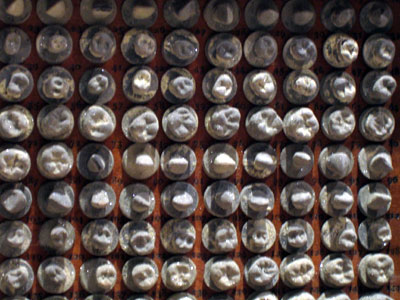
Rubber tooth forms, from the Museum of Dentistry in Edinburgh

Right now, teeth! The Museum of Dentistry was all about collections of things. Sets of antique drill bits, sets of ornate knives, sets of tooth brushes, sets of teeth. I’ve always liked collections of many objects that are similar but not exactly the same.

I remember at the Mendel Museum of Genetics in the Czech Republic, they had all these framed collections showing different phenotypes— 64 similar leaves arranged in a matrix, 25 drawings of similar feathers, 4 types of pea plants in square garden plots. I almost had a seizure, from glee.

Rubber tooth forms, from the Museum of Dentistry in Edinburgh

I don’t know exactly why I enjoy similar sets so much, but I suspect you’ll just know what I mean. Similar-but-not-the-same objects are so common in nature, and so commonly considered beautiful, that there are whole design books on the topic. (My favourite discussion is in Christopher Alexander’s The Timeless Way of Building. Repetition with variation was a big part of his rationale for pattern languages.)

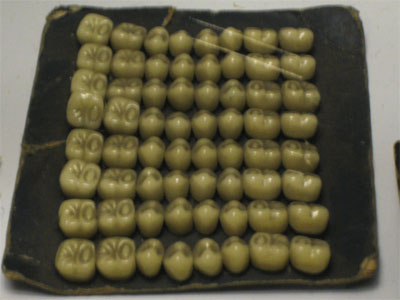
A set of teeth, from the Museum of Dentistry in Edinburgh

So these dentistry sets would have made my day no matter what, but the teeth were off the scale. I had never thought about it, but a mouthful of teeth is a similar-but-not-the-same set to start with, and then setting up grids of multiple mouthfuls in different sizes… my mind reels.

Crown former set, from the Museum of Dentistry in Edinburgh

Furthermore, some of these tooth sets— which were blanks meant for casting false teeth— were arranged in cases. They were a lot like type cases— if I had a tooth case I would definitely keep the top teeth in the upper case and the bottom teeth in the lower case, like letters in a printing font. Thinking about uppercase and lowercase teeth has multiplied my affection for my mouth, because now it is not just a mouth but a printing press for bite marks.

Snacks: a last holdout against globalization

I just spent two weeks in Scotland and England with my mum. It was lots of fun, but I was a little disappointed in how similar everything was to home.

When I was in Europe in 2003, the fashion was so far ahead I could only point and laugh, and there were always some obvious local specialties. In Holland, every pub had Heineken and Grolsch on tap, as you’d expect. Bars in Granada served free tapas with every drink; bars in Barcelona didn’t.

On this trip, we had to hunt and hunt to find anything we couldn’t get in Vancouver. There were more people dressed fashionably, but the frontiers of fashion were set in approximately the same places as they are here.

I made my mum take a highway exit twice so that I could get another fleeting glimpse of some highland cattle, because they were so hard to find. Despite spotting millions of sheep in the countryside, we were hard pressed to find any non-tourist shops selling local woolens. Do Scottish people ignore their huge wool harvest, or do they just wear the dumb tourist sweaters? It was frustrating.

Right after my mum and I had been sort of lamenting that globalization had made travel more boring, we stopped to buy some snacks for the trip to the next place. I remembered all the weird chips and candy I’d hoarded in Eastern Europe, and made a trip down the “crisps and biscuits” aisle.

Gold!

Walker's Lamb and Mint Flavour Crisps

Nobby's Nuts

The green V logo in the corner of the next one means “suitable for vegetarians.”

Bacon Streakies

Besides the snack differences, the UK might be the world headquarters for design that uses an object to replace a letter in its own name. Every mention of Italy used the boot for the L; every fish shop’s name was spelled with a fish… every package of bacon streakies had a little bacon streaky for an I. So there’s that.

Paging… a doctor… of some kind…

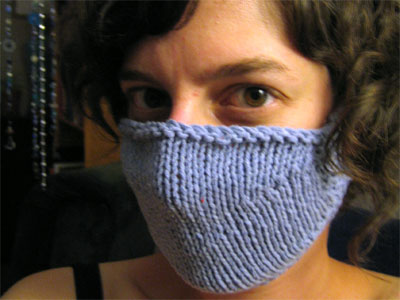
Knitted doctor mask

I’ve been trying to figure out who to name this knitted doctor mask after. It seems like surely there is a doctor who presides over fashion with accidental political relevance, the way Dr. Freud presides over objects with accidental sexual inuendo. Perhaps I am confusing doctors with saints.

Galen, in a heroic effort to work with my vague doctor-related presentiments, suggested Dr. Lagerfeld as the patron doctor of fashion. That’s as far as I’ve gotten. No, he isn’t really a doctor.

Free knitting pattern: cozy doctor mask

The mask is worked in stockinette stitch with a narrow garter stitch border, with garter stitch ear straps attached afterwards. The mask has decreasing short rows to shape the chin, and increasing short rows to shape the nose. It’s surprisingly warm and cozy to wear!

  • Gauge: 4.25 sts and 6 rows per inch
  • Needles: 4.5mm (or size to obtain gauge)
  • Yarn: under 25g of worsted weight
  • Size: adult (one size)
Pattern

Row 1 (RS): sl 1, P2, K to last 3 sts, P3.
Row 2 (WS): sl 1, P to end.

These two rows make up the pattern (stockinette bordered by a 3-stitch garter border).

Main mask

Beginning at bottom edge, CO 30 sts.
Row 1 (RS): sl 1 knitwise, P to end.
Row 2 (begin short row shaping): sl 1 knitwise, P to last 3 sts, wrap and turn.
Row 3: K to last 3 sts, wrap and turn.
Row 4: P to last 4 sts, wrap and turn.
Row 5: K to last 4 sts, wrap and turn.
Continue in this fashion until you have wrapped a total of 5 sts on each side.
Row 12: P across (working wraps together with sts).
Row 13 (RS): work in pattern, working wraps together with sts.
Continue working in pattern for 12 more rows, except m1 inside each border on rows 15 and 23
Row 26 (WS): sl 1, P to last 7 sts, wrap and turn.
Row 27: K to last 7 sts, wrap and turn.
Row 28: P to previous wrap, P wrap together with st, wrap and turn.
Row 29: K to previous wrap, K wrap together with st, wrap and turn.
Continue in this fashion (keeping in pattern), until you have wrapped 5 sts on each side (the last wraps will be on the 3rd sts from the edges).
Row 36 (WS): P across.
Row 37 (RS): sl 1, P across.
Row 38: sl 1, P across.
Row 39: BO all sts purlwise.

Straps

Pick up 3 sts at top of left edge of mask. Work in garter stitch until strap is long enough to fit around ear. BO all sts. Sew end of strap to bottom of left edge of mask.

Repeat on right side of mask.

Finishing

Weave in ends.

Tips and notes

The mask is pretty warm, and I think it would be a great alternative to a scarf. A face-warmer, rather than a neck-warmer. The obvious accessory would be matching gloves (ready for surgery!).

I can’t stop obsessing about the timeliness of a mask. It’s a disguise, in an era of paranoia about privacy and spying. It’s a gag, in an era of paranoia about censorship and secrecy. It’s a veil— one level more retro than burlesque. It’s kitschy like ninjas or pirates. It’s a surrogate beard for the ladies, since hipster facial hair doesn’t seem to be going away.

Three favourite recent masks:

Justin Timberlake in a bandit mask

Harajuku cosplayer on Flickr

Santos hoodie by Anticon

My head is full of plans for masks made of lace, eyelets, stripes, and checkers. Or tweed, for business situations.

Compassion for freaks who buy the t-shirt

I just finished reading Douglas Rushkoff’s old book, Playing The Future, about how people are adapting to the digital age and how it isn’t the end of the world (I gave it 3/5 on Amazon). He points out the conflict between rebel attitudes in subcultures like skateboarding and snowboarding (the book came out in 1996) and the masses of commercial logos and general expense of those sports. Buying commercial products to display your outsider status.

I have noted this commercialism in a lot of subcultures that for me are about DIY or revolutionary acts— geeks buy gadgets, crafters buy stash, sex activists buy toys, environmentalists buy organic, hipsters buy everything, even vagina-body-image nerds have products they promote.

This sometimes gets me down. What is wrong with people that they can’t rise above shopping? Two little quotes that I’ve been saving up are helping me appreciate rebel shoppers.

If your popular revolution demands that its adherents eschew popular culture it’s not going to be very popular.

Cory Doctorow in conversation with RU Sirius

The fallacy is to think that social networks are just made up of people. They’re not; social networks consist of people who are connected by a shared object.

Jyri Engeström on ‘object-centred sociality’, after Karin Knorr Cetina

To me, activities and ideas can be excellent objects to share with friends, but it is starting to make sense that people are eager for more and more stuff to share with their outsider pals. Why just knit together when you can fetishize handspun yarn as well? Maybe sometimes that’s just friendly, not so much evidence of weird addiction.

Further evidence that I’m not really in a target demographic for normal businesses


Name shack

Last night at a screening of short films, I was being introduced to a new guy who kept claiming bad hearing and getting everyone’s name wrong.

(1) This would be a good gimmick for business men who obsess about remembering everyone’s name. You’d have an excuse to repeat the names a lot, plus you could “jokingly” get them wrong and everyone would find you charming. (2) This guy’s misheard names were way better than our normal names (Sarah = Sierra. Jessica = Destiny. Galen = Hayden. We are instantly teen idols or brands of vodka!).

I think he should go into business in some way. Maybe you could call him up and tell him your ideas for naming your pets or the characters in your new novel, and he could just repeat them back to you through his auditory filter of awesomeness. Maybe he could deliver some sort of televised oral history newscast.

Surprise! Hope you’re more vain than paranoid!

Two nights ago, I was talking about web design rates with my friend Michael, who is making a site for a private detective. His ladyfriend Erin suggested he just trade services, and then we were all sort of hoping to be the subject of Michael’s bartered private investigation, just so we could get some weird surveillance photos of ourselves. And now I think that should be a business of its own: just the surveillance photos.

Real detectives probably don’t take big, black and white glossies anymore (nope), but my non-investigative, non-incriminating surveillance photography service sure would. And we’d make a special effort to get shots of the subject holding up her collar against the wind while stepping into a taxi, laughing in a restaurant with an unseen dinner companion, or generally looking over his shoulder all the time. If surveillance is going to be biased and weird, it might as well be biased towards glamour and intrigue.

I can’t stop thinking about what a great (weird, confusing) birthday present that would be for an unsuspecting friend. “It’s… is this a threat?”

Internet wish: find likely pornographic typos

Any page offering advice on choosing a domain name will insist you consider common typos and misunderstandings. No need to end up the latest sexchange URL (lawyersexchange.com, editorsexchange.com…). And nobody wants to end up a typo away from hardcore porn. Especially if your website features Christian hymns.

So why can’t I find a tool to check these things?

I just got an email from a web design client (who really does make Christian hymns) saying that one of their customers had accidentally found porn while trying to type in their website address. “They probably just made a typo.”

But darned if I can figure out where this typo porn actually is. None of my misspelled attempts are registered domains, and I can’t find a tool that suggests similarly spelled URLs that exist.

There are lots of tools to find websites with similar content, but none to find websites with similar addresses. This second tool is what I wish for.

Compassion for teenagers

I get the Baby Fever off and on, and I usually try to remember that babies don’t stay babies, and that if I want to spawn I’ll have to learn to love a teenager. The hormonal creepiness, the narcissism, the volume levels. I’ve actually been practising this, more because I like new skills than because I am laying away emotional supplies for a baby event. I am like a bird-watcher, for teenagers, except I don’t follow them to their nests or anything.

My favourite teenager thing right now is watching little groups of 14 year old girls out on their own. Physically, they are hilarious— even in groups of eight or nine kids, you only get one of each kind. Small and skinny, big and moosey, tall and gangly, eerily voluptuous: nobody has caught up to anybody else by 14, and nobody understands her own hair. I call these groups Variety Packs.

I’ve come to realize that an easy way to love teenagers is to basically laugh about how ridiculous they are. It’s about camp: “Oh, they’re so terrible— I love them!” I’m working on finding a less condescending way to appreciate pupating humans, but for now, the I’m so bershon Flickr pool is feeding my addiction.

Three indie thesis tips, while I get organized

I’ve talked to about four people since I declared ““thesis on!”:/2006/08/10/i-call-it-an-indie-thesis” and already I’m overwhelmed by notes. I’ve got this grand plan involving a wiki, but while I get the squirrels up to speed, here are three solid tips that have immediately become apparent.

3 tips for learning to write a thesis without going to school

  1. People love to talk about their own education. Sir Ken Robinson’s excellent, funny presentation about education from TED 2006 covers this, and so far it’s my experience as well. My friend Towagh just gave me about three hours worth of explanations and advice about Masters work, starting from “OK, a thesis… what’s that?” (Thanks, Towagh!)
  2. If you are going to have a three hour meeting over coffee, pick somewhere with a convenient restroom.
  3. A tip from Towagh that strikes me as hilarious: if you want to talk to a professor, even an imposing, famous professor, call up their Department and ask for their office hours. Do many non-students sneak into office hours? I’m a little suspicious that I should keep this tip under my hat, that I might encourage the one yahoo who will abuse Office Hours and ruin it for all of us. (You know, all of us who want to talk to professors about critical problems without enrolling in school.) It will be a sad day, when office hours have some type of warning sticker attached.

Got any thesis tips of your own? I’d love your comments. (And I should mention: I’d love them even if you’re from the future, and you’re reading this in 2012 and you presume the conversation is dead. I’m posting here while the site is still semi-secret, so don’t feel like a latecomer.)

The best thesis since Xena

I helped my granny pick her peach tree on the weekend, so I took the opportunity to explain my new thesis project to her and ask for her input about mortality and dying.

She’s 86; she grew up on a farm; she’s had her funeral and burial plans pre-paid for years; she tells a story about her experience speaking with the spirit of her recently deceased sister; and we often have conversations about my grandpa’s advanced Alzheimer’s dementia and the merits of burning out versus fading away (elder nursing home version). I thought she’d have lots to contribute.

The first thing out of her mouth?

“Oh darling, there’s a book I’ll have to give you when I’m finished. It’s about one of those… those men who never die? (Well he could die in a fight, but not of old age.) And he’s supposed to hunt evil? It goes back centuries. Just centuries.”

(The name she’s looking for is Dark Hunter, and he surely owes his existence to Boris Vallejo.)

Dark Hunter novel cover

I know that I need to start narrowing my topic as soon as possible— at the moment I’m reminded of my aunt’s high school independent research project on the entire history of ancient China— but for now, while I scope out the lay of the land, it’s pretty cool to just ask everyone I know if they have any tips or resources about dying, to see all the different angles that pop up. I would not have thought to examine sexualized immortality in post Buffy pulp fiction if granny hadn’t suggested it.