A start: normal dying processes

I’ve heard a lot of stories of dying people needing to get a good sleep before they have enough energy to die, or of dying at contrived times like right before an annoying doctor is due to show up, or right after seeing a new baby relative.

I’m sure a lot of those stories are coincidence, but I’m intrigued by the idea that dying is an action the body takes, rather than an event that just happens when the body fails. Zoe pointed out the other day that many people think of death as a failure of medicine, rather than as a normal event in everyone’s life. To me, thinking of death as an active, biological process makes it seem more like a normal function (which I’m interested in, for now).

This morning I’ve been hunting for information about the normal dying process, and how it varies, and whether there are conflicting models for “normal” death responses the way I’m familiar with different, biased models of sexual response from working on my vagina website (and indeed, Kubler-Ross’ stages of grief seem to draw similar controversy to Masters and Johnson’s model of the human sexual response cycle).

Zen Hospice has a great overview of the physical changes a person goes through as they die, from a hospice perspective. I recognize all of those symptoms from the few people I’ve known at the end of their lives. I can see immediately why there are so many comparisons between giving birth, having orgasms, and dying: all involve extreme physical responses that start to seem normal when you know what to expect. Learning about the physical symptoms of dying feels a little like getting to know the birds in your neighbourhood or something: gaining context.

Graceful Exits:How Great Beings Die apparently deals with conscious dying and dying on purpose, such as the idea of elders wandering off alone into the woods to die. It sounds a bit flaky (i.e., possible use of ambiguous generalizations like “aboriginal cultures”), but still really compelling to me. I’m all for special skills, and this intro sort of makes dying sound like a superpower:

Then the person is left alone. He or she sits down, and within a matter of minutes is able to intentionally close down the body and die.

That would be both more and less useful than being able to cry on command.

But, from my scattered reading this morning, I gather that I should do some searching for literature about “deathing” and “timing of death” rather than the process of dying. It’s a bit weird that “dying” gets used more as adjective than as a form of the verb “to die.” When a person “dies” that describes the moment of death fairly precisely, but when a person “is dying” that could refer to almost any stage of life or illness or injury.

This is the kind of jargon I should figure out soon— it’s hard to organize notes when you don’t know the names for things (and stuff).
Ready the moisturizer

This sensory-deprivation floating tank sounds like something I could make at home, using my accidental stockpile of Epsom salts. (I tend to buy supplies, then come home and discover I’ve already bought some. Ask Galen about the quantities of cornmeal we amass before I remember to make polenta.)

Why have I never thought to make a super-floaty bath? Saturating a bath with 10 pounds of Epsom salts would be a good way to use up that part of my craft stash.

Having made several small projects without putting a noticeable dent in the stash, I’m remembering that my original intention with the stash manifesto was to make huge craft projects. Things you can only accomplish with ten pounds of origami paper, not small things here and there. Floating tank, several pints of Epsom salts… I think it counts.

Research on defanging

I’m a little bit fascinated with the idea of going over to hipsters’ houses when they aren’t around, and rifling through their pop culture possessions.

It seems like if you read all a hipster’s books, watched all her movies, listened to all her music, played with all her toys, and looked at all her web bookmarks, she’d have no way to show off her cultivated taste and connections. I think of this as a defanging. “I’m not much for using media consumption for cool points” is how I characterized this fascination over on MOG.

I haven’t quite gotten to the bottom of this defanging fantasy yet, but this CPU post about creating The Nod has at least given me a solid idea about a website I could make to express my troubles.

Sit in a cafe with a Mac PowerBook, and chances are you’ll get The Nod… Display GNOME on your ThinkPad and you’ll get The Nod. But run Windows on your Dell and you won’t.

Why do some things get The Nod but not others? And isn’t it really the user that gets The Nod, and not the product?…

The Nod is a way for one user to tell another:

“We’re smarter.”

Or

“We’re risk-takers.”

Or

“We’re more indie.”

Or

“We’ve been at this from the beginning (unlike these clueless newbies).”

Or…

Gross! I do love that this article was written for marketers, and I think that’s what unlocked my articulation on this issue. It sounds catty and obvious to declare that it’s shallow and maybe vain to use commercial products to proove your identity, but somehow hearing marketers make up catchphrases about it (“The Nod”?) gives me the necessary boost up onto my high horse.

So this defanging website, to express my troubles. I tried out several previous possibilities on Galen, but they all seemed doomed to hypocrisy.

My latest version is this: it would be fun to interview people about what they like to do and how they spend their time, and simply refuse to print any anecdote containing a brand name, a catchphrase, a club affiliation, or the like. Basically anything you could get A Nod about would be blanked out. Maybe even retroactively, if something you mentioned was easily imitated and sparked a trend. It could be sort of a Last Person Standing competition in inimitability.

It ties a little into this quote I read in the beginning of an Ansel Adams photography textbook. I think it was originally about Mozart, and it said something to the effect that “It’s no great accomplishment to be the first to do something. What we should aim for is to be the last; to do something so extraordinary that it can never be repeated.”

Namin’ names

  • Someday, maybe I will start a sysadmin dance band called Deee-link.
  • I hope someone starts selling eels or eggs online, before it becomes completely gauche to add ‘e’ to the front of a word, to denote online commerce. eeggs.com would be pretty awesome, probably.

Jellyfish couture still ascending

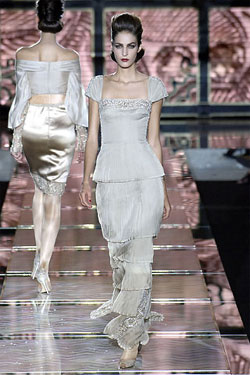
Jellyfish dress by Valentino

I bought some thrift store yarn in Sidney last weekend (three bags of matching nubby grey cotton), and it gave me fashion monkeybrain. I drew a lot of silly outfits in my notebook when we got home, mostly still in the vein of jellyfish couture.

There are two jellyfish garments in particular that I think really need to get made, after looking at the initial Fall 2006 runway photos on Style.com (which is something I apparently do now). The spirit of the times, it is a spirit of jellyfish!

First, I have some sheer, iridescent red fabric that used to be bed curtains, earmarked for a shoulder tutu. I’ve described this in my notebook as “like a big filmy donut made of gauze” and it sits around your shoulders like a huge shawl. (You know, a huge gauze donut that you wear…) It would be like a jellyfish body, around your shoulders (err, my shoulders), and would double as a sort of bizarro 1940s fur collar.

Secondly, the tentacle underskirt. This is something I keep threatening to knit, but which I should probably sew. It would be a long, slim skirt made of verticle ruffles, to turn your legs into jellyfish tentacles. You could wear a shorter, puffy skirt overtop. I see this as the logical evolution of letting a lacy slip show under your dress hem. Just a straight, obvious, rational line, really, the development of the jellyfish underskirt.

But check it: if you ignore the probable artistic “point” of several fashion collections, you can spot a lot of shoulder tutus , long ruffles and general jellyfishiness.

Also worth noting: I hope this Givenchy collection means that my fantasy of women with coiffed facial hair is finally ready for public consumption. If I could grow a beard, I’d style it so hard.

I should really go visit my old relatives

Last night Galen and I popped down to Pagliacci’s to pick up a pre-amp from Brooke, who was playing there. Pag’s jazz jam in full effect! It had been awhile since I’d been down for one of those nights. I think it was officially a Marc Atkinson show, but he was out of town, so the rest of the band asked Brooke to come play, and then various musicians came in off the street, and everyone on stage played several instruments so they all took turns switching. A pot pourri.

Of particular note, I finally got to hear Devon sing, and he is not kidding around about singing. I was having major grampa-convergence feelings watching him get settled on stage, though, because he was wearing the same kind of cuddly, old-man cardigan that my grampa always does, and this great plaid cap. Furthermore, Devon started out sitting in a chair on stage with no instrument and no microphone, no obvious reason for being there, just looking contented and watching the other guys play the intro.

My grampa does that kind of thing a lot, since his Alzheimer’s got noticeable. I’ve done a lot of sitting with the old guy, looking around and being contented. It made me think that my grampa should join a band. I think he’d be into it, as long as they played something old timey.

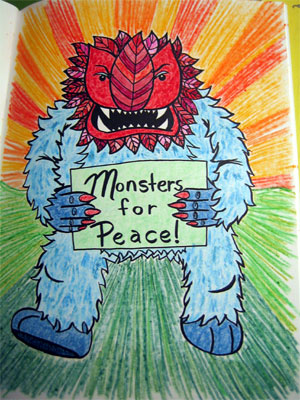
Color This Book

Galen got me a present in Anacortes. Best present ever! I didn’t know I would be so excited about an indie colouring book, but it’s really blowing my mind. This is the first time I’ve done any colouring since I’ve been obsessed with colour schemes and combinations. Playing with colour schemes is a lot more fun when you’re starting from a picture of say, a pensive rhinoceros writing its memoirs, or a knitting squirrel!

I just mailed this one to my parents (for the fridge). It’s red and blue, and coming to getcha.

Monsters for Peace colouring page

Mini me

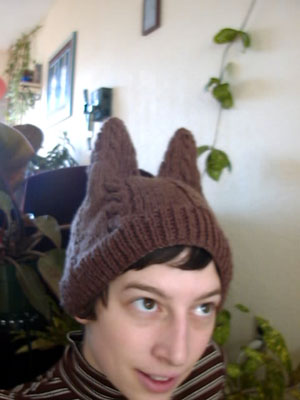
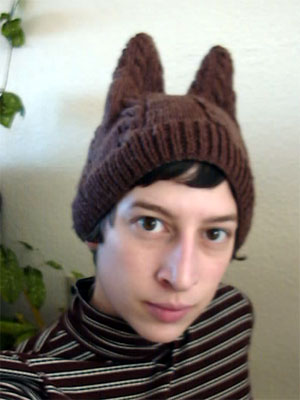
More photos from forgotten file directories. This is me, looking cute and androgynous in a bunny hat I knitted, in December 2002. I was 23. I look a lot younger— the soft (aka crap) focus probably helps. Everybody has baby skin in blurry photos.

I like this one, where I’m making a rabbit face.

Younger me, in a bunny hat

And this one, where I’m making a… stern rabbit face

Younger me, in a bunny hat

I taught myself to knit by inventing that hat, during a 40 hour bus ride to Winnipeg. I double-knit the ears on two straight needles, including the cables on the front and back. For any non-knitters reading this, that’s fucked up, that’s self-torture. When I think about how I learn, this is the project I think of: I don’t so much go for baby steps.

These photos are very funny to me— they might as well have been taken to document the dawn of the current era of me. I was about to be self-employed, living in the first apartment after deciding I only wanted to live in corner suites in Fairfield, addicted to knitting, and cultivating a potted jungle in my apartment. I stand by all those decisions! Way to go, stern bunny, for laying solid foundations.

Mossy scarf (with free knitting pattern)

Mossy scarf

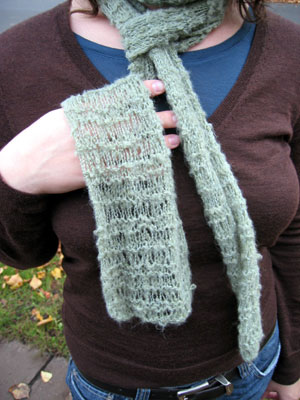
Yikes! This classically headless blogger-photo was clearly taken in the fall. Hopefully last fall and not years ago! I found it during an expedition into one of the dustier corners of my hard drive.

It’s a scarf I made from some thrift store yarn.

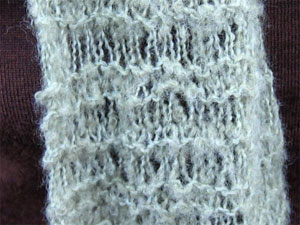
I tried a few different stitch patterns before settling on this. The pattern made me happy immediately and I still think it really suits the yarn. It reminds me of Old Man’s Beard lichen in a big way.

Dropstitch garter is the True Destiny of skinny, gray-green, wool boucle. Who knew?

If you can’t work out the pattern from the photo, it goes like this (very easy and straightforward).

Mossy scarf

Gauge, needles, etc: whatever, it’s a scarf. Aim on the loose side.

CO 20 (or more)
Rows 1 and 2: K to end.
Row 3: K, wrapping yarn twice. Drop extra wraps on next row.
Repeat these three rows until scarf is desired length.

One 50g ball made a very, very long scarf. I wear it folded in half, wrapped twice around my neck and it still hangs to my waist.

Mossy scarf

You’d yelp too

Euphorbia in bloom

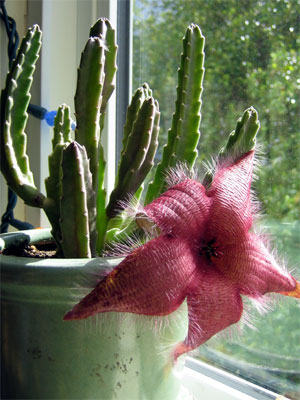
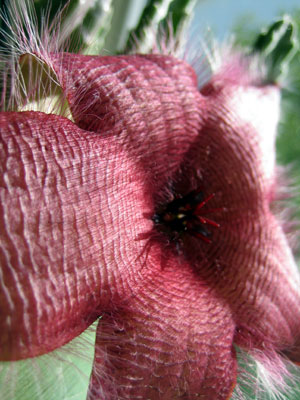
I awoke to this. Giant flower buds have yet to disappoint!

Galen is away on tour, so I exclaimed several things out loud to no one. Fortunately, Marc dropped by to loan me a book on his way to work, so I got to share the special thrill of outlandish botany with another human.

Two neighbourly humans agree: it’s so hairy.

Euphorbia flower-- it's very hairy

My immediate thought was for the pollinator. What is supposed to rub its body on that flower? Marc surmised that the pollinator should be at least as hairy as the plant.

Hopefully the flower is hard at work summoning this creature, and later this afternoon I’ll find some variety of Ancient Beast knocking against the window screen, trying to achieve its hairy destiny.

Of course I needed an anarchist’s perspective

Why didn’t I think earlier to look for anarchist and class-struggle critiques of V for Vendetta? I came out of the theatre thinking that the movie, in which the politics are less extreme, made me appreciate the book’s take on anarchy and revolution all the more. The movie was a good foil for the book, in other words, besides being a fun movie.

This anarchist’s take on the movie covers lots of good ground, especially, I think, regarding modern anarchist ideas as something of a fairy tale— fitting for an action movie.

The comic, and to a lesser extent the film, are often viewed as anarchist. I would submit that they are “anarchist “ mostly because at the time of the writing, the anarchists had the most new, vibrant and semi-underground white subculture. … I think it’s mostly seen as anarchist because anarchist theory is so heavily mythological when it comes to revolution.

The general strike has historically been the mythical event that was most often cast to usher in the new world. Leaving the caveman fetishists aside (who, no, I don’t view as “real” anarchists), the critique of vanguardism and political manipulation has left anarchists, in a post-revolutionary union world, without a grounded theory of revolution. Paris ’68 suggested that students spraypainting walls, refusing to attend class, and fucking in the streets might be enough to disrupt the “Spectacle” and push people towards true awareness of their role in society of oppressed and oppressor. …

… Many anarchists and fellow travelers are so starved for positive signs that we mistake repackaged hipness as revolutionary art.

Mostly I like seeing him criticize the theory in the movie, while still obviously appreciating it as an entertaining movie. So balanced, so personable.

Off to read the further commentary linked from that post!

Babies

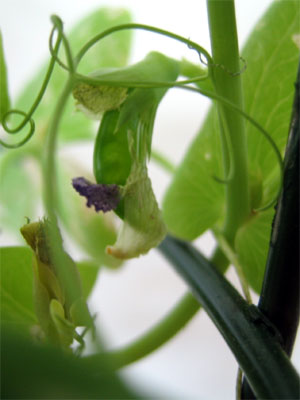
Baby sugar pea So it turns out you can’t really grow a “crop” of peas in a single pot, but you can grow snacks. I’ve been dutifully planting into this pot at three week intervals, indulging my little gardening urges. My reward appears to be four to six peas at a time.
I’d been pollinating the sugar pea blossoms with a fluffy paintbrush, but I don’t think the plant sex is necessary. When I was tickling each flower in just the right place, the pods would end up nursing a single, swollen pea among 5 or 6 shrivelled unpeas. Since the vines have gotten denser I’ve been missing a lot of the flowers, and their pods look less Knocked Up and more like regular sugar peas.

Either I was not a very good lover or virtue makes peas strong.

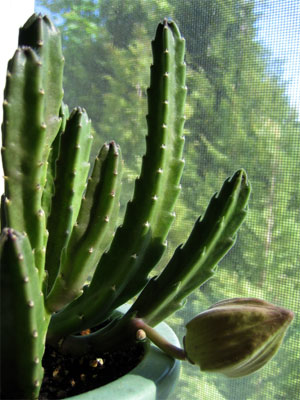
My euphorbia is in a family way The big news around my fake garden, though, is the monstrous bud the euphorbia is making. I don’t know how long it has been growing this; I spotted it about a week ago. It’s about the size of a golf ball— hilariously out of proportion to the rest of the plant.

The bud is shaped like a bird head, like it’s about to start talking. It’s covered in peach fuzz. I am excited just to have such a ridiculous bud hanging around. I wonder how long this will go on before it pops.

Rebecca thinks euphorbias are related to pointsettias, and that I might soon be the proud guardian of a pointy red flower. She also maintains that when cacti flower, they flower for weeks at a time. She’s a bit of a garden enabler.

Bride of the Unicorn necklace

Bride of the Unicorn necklace

I’m not sure whether all green and white jewellery would look bridal, or whether it has to involve tiny pearls and botanical clusters. This necklace ended up with an overpowering resemblance to a wreath of ivy and grapes. It is a hairband for a unicorn, or better yet a wedding bower for fairies. I can’t wear this. I am not bethrothed to a pegasus, and I feel it would give the wrong impression.

I started to get misgivings before I even finished making it— same method as yesterday’s necklace— but I was determined to keep up my stash-into-treasure momentum. I gave Bride of the Unicorn a couple of weeks and tried it with different outfits, but no dice.

I figure if I can find a big unicorn pendant to hang off one side of this, I might be able to bring it back from the edge of whimsy, back into territory controlled by the Empire of Irony. (Just thinking about the necklace is apparently enough to shift me into the conventions of epic fantasy. Thus begins the Age of The Reluctant Bride and her Pearly Necklace!)

Fair tax and other aphrodisiacs

Grist has a great little article about economic responsibility, the neglected cousin of social and environmental responsibilities.

Much more than most progressive or activist websites, Grist seems to make an effort to come up with a simple vision of priorities, and start pushing the vocabulary to go with it. I appreciate their thoroughness, and skill. In this piece, the writers suggest we need to refocus on gigantic environmental issues like global warming, and we can’t do that without more sustainable economics.

Incidentally, how did economists get to be such rock stars on the internet? It started before Freakonomics, maybe to do with social software engineering and online community theory? It’s Clay Shirky’s fault maybe? I have no basis for this hunch.

In any case, the latest bit of Grist that puts a twinkle in my eye:

Economic issues have long been the poor cousins within the corporate-responsibility debate. For many years, they were considered to be synonymous with financial issues, and widely assumed to be well managed. But as concerns like fair trade, fair pricing, and fair wages have increasingly made headlines, it has become clear that economic issues are surprisingly ill-understood by most corporations, and an underrepresented dimension of the corporate-responsibility agenda.

And getting into the meaty words and definitions:

Let’s just toy with one of these dimensions: economic equity. This addresses the reasonably transparent — and certainly strategic — management of the creation and distribution of wealth. It includes issues like fair trade; fair wages (is it reasonable for 50 cents of the price of a $100 sneaker to go to production workers, and $18 to the retail labor selling them?); fair pricing (is it reasonable for the world’s poorest to pay from two to 20 times as much as the richest for their food, water, energy, and drugs?); and — the new humdinger — fair tax (is it responsible for business to see corporate taxes purely as a cost to be avoided, rather than part of their “social contract” with society?).

‘Fair tax’ would be a hot response to any mention of ‘“tax relief”:http://www.rockridgeinstitute.org/projects/strategic/simple_framing,’ which is a phrase that I notice has started popping up in Canada now that we’ve got a conservative federal government. (“Hot response?” Hot? This is what I’m talking about. Since when do economic buzz words have sex appeal?)

Space Race: a necklace

My new necklace, plus some bananas

I’ve been getting the feeling that turning my entire crafting stash into finished objects is not really going to be about emptying my stash closet. Plunging into the bead portion of my inventory is making this even more clear: this endeavour is about generating masses and masses of treasure.

I suddenly have three necklaces to my name, and the stash has not gotten visibly smaller. It doesn’t take many beads to make a necklace, at least in the context of my 15 pound supply. Either I need to make a lot of necklaces, or I need to reconsider my decision not to make another beaded curtain.

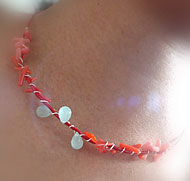
This is copycat jewellery

I copied this necklace

The first necklace to come out of my stash is my attempt at copying something that caught my eye at the Starving Artist Bazaar. The original was fluorescent red and blue, which triggered my spider senses from afar.

I haven’t attempted to make jewellery since I was about 8 years old, so I’m still getting my inspiration really directly and obviously. I like to think of this in the spirit of sketching from masterpieces.

I’m excited to figure out how to make more things up out of my head, though. All those neck bones and cords to work with!

Basic ingredients and method

I used two units of stash:

  • a bag of about 50 pointy, purple, glass beads
  • a collection of 5 aqua blue, glass beads

Then I went and ruined it by buying more crafting supplies!

  • a length of black cord (used half)
  • a spool of silver wire, which has definitely settled into stash status
  • a set of clasps

It took about an hour to make this, mostly spent figuring out how jewelry works.

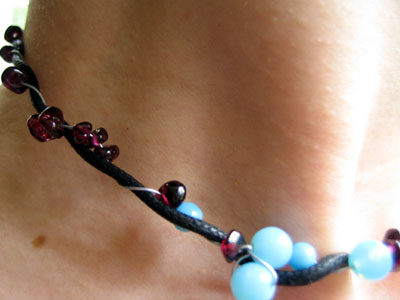
I settled on twisting the wire around a pencil to make a long spiral and threading beads onto that. Then I threaded the black cord into the spiral (easy), and pulled the wire at both ends to tighten it against the cord. I poked some of the beads around and made an extra loop to create that bump of blue, then clamped on the clasps.

I judge this a success

I’ve been wearing this a lot. The colours and the blue orbs remind me of retro visions of space. Space Race: a Necklace!

Focus on: Space Race necklace

Weird weekend

Yesterday I spoke on a panel discussing the film Petals, which follows a photographer who creates a collection of vulva portraits. In one of the scenes, a woman who has studied some kind of native southwestern or Mexican sexual tradition is naming different vulva shapes. Deer woman, buffalo woman, dancing woman. OK.

Towards the end of the scene her explanation gets away from her a little and she starts just stringing animal names together, at which point Galen and I both cracked up despite ourselves, and despite having the film’s producer sitting with us. “Sometimes you’ll see a woman who is half deer, half sheep, and that’s called a fox, and…” Stop, stop!

During the post-film discussion, a woman in the audience asked about the vulva names and where she could learn more about deer woman and company. It suddenly sounded a lot like the fabled 100 Inuit words for snow. The panel didn’t go there at all, but I wondered what I would do with 100 words for genitals, how that would help me communicate or think. (Howard Rheingold’s They Have A Word For It is a great book on this theme.) I’m not sure I want to get into categorizing body shapes and types. What it really made me want to know was 100 words for feeling weird, because I was deferring a lot of weirdness at that moment on the panel.

When I showed up for the screening, the film festival director didn’t recognize me when I said hi, even though we’ve met several times and my name was in the program. He still didn’t know who I was when he invited the panel to come up front, and instead of covering with any grace he just sort of squinted at me with his mouth open. The producer I was sitting with piped up with my name, so it sort of worked out. Then the panel turned out to be unmoderated, no one got introduced, and the director wrapped up the discussion by walking in front of the stage and shouting “Is that about it?” like a reluctant teacher interrupting a boring student presentation. Whoa.

So I’m looking for a word, English or otherwise, to explain the general sentiment that “This would embarrass a lesser woman, and I’m sure glad that I know better than to let this ruin my weekend. Where are my usual friends and when can I hug them?”

I’m also in search of a word to express my reaction to a photo shoot I organized on Saturday where somebody invited about 30 extra models (quadrupling the total population of the shoot), and other various things. We went to a barbecue and the address was abandoned? Galen was moved more than once, this weekend, to declare, “At least we still have our dignity.”

What is the word for this kind of weekend, and what language has catalogued silly angst in this level of detail?

Urban duck parenting

Urban ducks in love

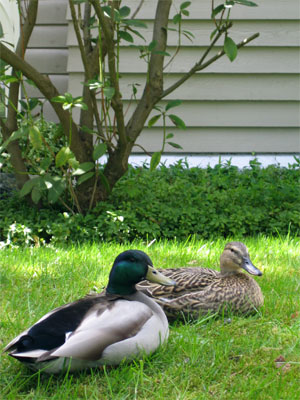
Just in case the crows and cherry blossoms didn’t make you think I was a sappy hippie, here is a portrait of two neighbourhood mallards that seem to nest in inappropriate urban locations every year, and raise their ducklings on apartment lawns.

Last spring I saw a business woman in a power suit and sneakers trying to get a fuzzy puddle of ducklings to stop following her down the sidewalk. Who will be their victim this year? And does the football shape of a duck make you want to tuck it under your arm too, or is that only me?

Paging any unicorns in the area…

Snow cover

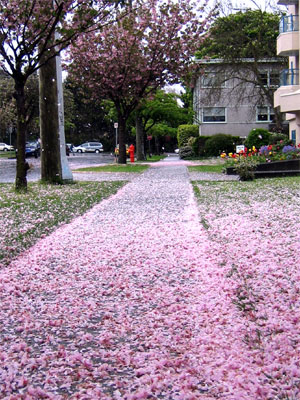
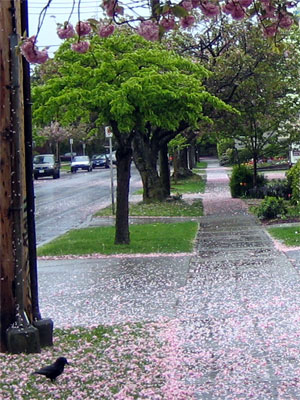
My favourite local microclimate effect is the pink snow globe that will sometimes develop on single blocks, where one street’s cherry blossoms are just ripe enough and the wind just strong enough to make it snow cherry petals.

As if it isn’t enough to regularly find sidewalks blanketed in pink flowers, or legitimate drifts of blossoms in the gutters, sometimes we can walk around in air full of swirly pink flakes that smell like cherries. But only for one block.

Something about Victoria’s proximity to the ocean or our particular collection of hills results in very pronounced weather differences between neighbourhoods or across streets. It’s pretty normal to get simultaneous hail and bright sunshine over different parts of your own yard, even.

Consequently we have cherry trees in bloom in different parts of the city from January through almost to June, one pink block here and one there, as each climate pocket hits peak cherry breeding conditions.

Walking past a single fragrant cherry tree is enough to cheer up most people for a few minutes (especially by moonlight!). I’ve had such a prolonged, steady dose now, after four months of spring, that I’m almost ready to cry sometimes when I walk around the neighbourhood and pass through a block-sized cloud of cherry perfume. I’m saturated.

The other side of the street

It’s absurd that this tree blossom marathon is even possible, and we’ve got several weeks to go before the Victoria spring season is over. The chestnut trees have barely started, and I just saw my first lilac yesterday. I might as well be on happy drugs.

I went out for coffee with my friend The Hawk today (a real person, not my spirit animal), and the weather was making it clear that this city was built over a coastal rainforest: windy, rainy, gray. I was grumbling a bit on the way home, in the ritualistic way we complain about weather here, and then I turned a corner and there was a snow globe on Southgate Street.

It was raining flowers harder than it was raining water, and the flip side of the rainy climate was suddenly dominant. We get this surreal rainforest light sometimes, where it’s quite bright, but shadowless because of the cloud filter, and it turns kind of green from reflecting off so many plants. The light makes everything look like it is glowing.

It made me feel a little better about the fact that a couple of generations back, somebody paved over the local cedar groves. At least they put up a ridiculous, Dr. Seussian city, where today, for one block, even the vertical surfaces were getting plastered with airborne flowers. On one side of the street, anyway.

Crow snow tunnel

I was just about to formulate some mental joke about how unicorns or winged foxes (maybe a talking spirit bear?) could appear at that moment without surprising me, when a few crows started collecting sprigs of cherry blossoms, presumably for their nests. Close enough! I can’t even process little black birds growing up in a pink nest. It’s sensory overload.

My mum has this old, ceramic mixing bowl that is robin’s egg blue, and when I visit her I just want to put things in the bowl and look at them. Yellow cornmeal, white or brown eggs, red lentils, black olives, buttons, a toad, chocolate milk, anything, as long as it goes in the blue bowl. Today was like that; I wanted to look at these crows poking around in a glowing pink and green lawn forever!

Activist patterns

I posted this in a discussion about The Grim Meathook Future over on Warren Ellis’ new Die Puny Humans site.

I find all this talk of leaders and critical masses and movements fascinating. To my mind, everything keeps getting more fractured and more complicated and we can’t put it back in a nice tidy box. Simple, reductionist, comprehensible viewpoints only lasted until we built machines that could handle thousands of variables at once. Now look how many things actually have thousands of variables at work. Practically every news story boils down to “it had more consequences than we thought.”

I don’t think any kind of movement will gel. These problems are bigger than human minds can handle, at least the way we’re used to thinking. When, before now, have average peasants fancied they might figure out how to alter the course of every society on earth in this level of detail? I think progress will be about learning to deal with complexity, and not just the parts with catchy names like “emergence” or “the long tail.” Parts like “a land war in Asia” or “we’re all getting cancer.”

Lots of fields have formal techniques for dealing with complexity. “Scale later” in software, etc. I’d be really curious to collect similar patterns from activists or politicians.

Then I immediately thought of a bunch of possible patterns and places to find them. I’m going to post them here, before I go see to what degree my comment has been eviscerated by other puny humans. I can’t believe I said “practically every…” on the internet. Bring on the nitpickers!

These are mostly about compassion.

  • The Fog of War documentary about Robert MacNamara by Errol Morris talks a lot about understanding your enemy and understanding that war is very complicated
  • Cory Doctorow says, “If your popular revolution demands that we give up on popular entertainment it won’t be very popular.” I think that’s a big part of the problem facing environmentalism these days.
  • The Ethical Slut gave me a lot of ideas about getting what I want without imposing on other people, and about finding ways to collaborate.
  • Fernando Flores gave me ideas about using trust as a tool for change, and as a good partner for criticism. I wish his books weren’t so ’80s.
  • I’d really like to hear Heather Corrina’s ideas about patterns for activists, because she spends so much time and energy on activism.
  • Lots of people talk about 80/20 rules, but I like Umbra Fisk’s explanation best.
  • Women, Passion and Celibacy is really angry and ranty, but it had a lot of good ideas about doing without things, in this case sexual relationships. The author compared celibacy to vegetarianism, which actually blew my mind. I like to compare both those things to atheism, and reduced consumerism.