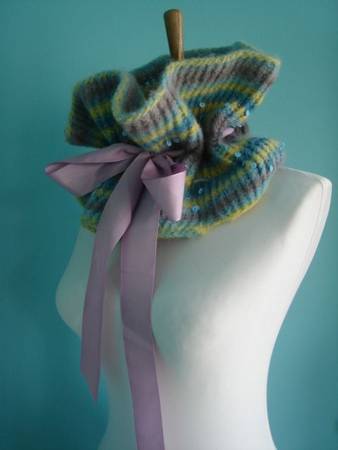
My instinct is to knit up a weird costume/uniform and wear it every day. When I don’t instantly know the name of an article of clothing, I seem to interpret it as having some qualities of a costume. This is a ruff, I suppose. I feel it is festive.
My instinct is to knit up a weird costume/uniform and wear it every day. When I don’t instantly know the name of an article of clothing, I seem to interpret it as having some qualities of a costume. This is a ruff, I suppose. I feel it is festive.
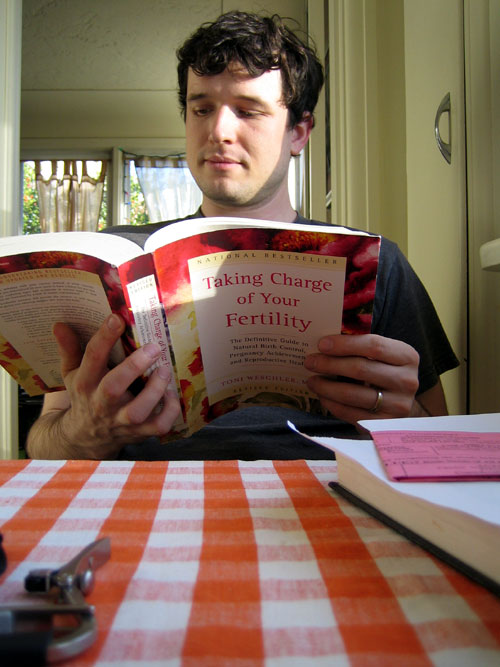
Galen is reading Taking Charge of Your Fertility. Partway through a chapter, he popped in to do a dance of excitement about how interesting he is finding fertility awareness. Ovaries! Mucus! Feedback cycles! DIY science! He asked whether it would have been cool to learn about cycle charting when I was thirteen or so, so I could have had a lifetime archive of data about my reproductive health. Wow, that caused a lot of feelings at once.
First, go team! It is useful and friendly for bio-guys to learn about female physiology, reproductive health, menstrual cycles and all that. I still tell people gleefully about the time last year that (male) Galen and our (male) friend Nathan were discussing their favourite features of the diva cup. (“Well it has marks so you can measure your blood.”) Doing their part to make the world safe for menstruators.
But also, awww, yes I do wish I’d known interesting ways to chart when I was starting out, or had any decent period information. It is amazing to me that after a solid eight or nine years of purposely investigating menstruation and cultivating positive attitudes and general insatiable curiosity, I still get ambushed by leftover sad feelings around menstrual cycles.
I don’t seem to have had an especially negative or ignorant upbringing compared to other people I know, but I managed to accumulate a fair amount of emotional trauma about periods just through a general lack of self-determination as a teenager. Dumb everyday stuff, like I was neither in charge of buying my own underwear nor in charge of how the laundry got done when I lived with my parents, so I was constantly frustrated and embarrassed (and often getting yelled at) about dealing with period laundry. It seems like surely I could have been responsible for either or both of those things if it had occurred to me— I don’t think my parents were that authoritarian— but strangely I remember arguing about wanting to do my own laundry my own way and being unable to work out any arrangement. Even now, I often find simple plans impossible to coordinate with my parents, for reasons I can rarely even remember. It’s deeply confusing. I think part of my lingering upset about menstrual cycles is actually due to the fact that I can’t recall any coherent explanations for past conflicts on the subject. Hmm.
Galen knows all this, at least superficially. I talk about vagina-related feelings with pretty much anyone who’s up for it. The most recent neighbourhood rock club was on the theme of songs to change your past and I picked a song that might have prevented me from going on the pill if I’d heard it while I was resigning myself to modern living through pharmacology. (In The Evening by Nina Nastasia and Jim White, because it makes me feel stubborn and that’s what I needed to be.)
I am sad that I ate all those chemicals, and that it seems to have done some damage to my cervical crypts (where the infamous eggwhite fertile mucus is produced). Sad sad sad. Angry too, to feel so misinformed. Disappointed that I didn’t listen to my own better judgment, and betrayed on behalf of the part of me with better judgment. I said most of that at rock club, but I’m not sure that is something people can relate to without a fair amount of relevant experience or other knowledge. Erin afterwards said she had a grieving process about the pill. Me too, going on it and again going off.
So Galen’s latest round of excitement about menstrual cycles is complicated. I was immediately glad to have company, and also immediately lonely, realizing I’m cut off from the possibility of feeling simple, impersonal excitement about uteruses and their ways. It was good to realize that he’s in the rather privileged position of not having personal emotional baggage about menstrual cycles. Once I managed to make him all sad about my damaged cervical crypts and assorted teen angst, we had a better connection there. It’s good to be on the same team.
So. For my future babies, I keep track of books like Cycle Savvy, in case they don’t want to talk with me about their personal strategies and feelings about periods.

Sometimes I bookmark things just for one particular comment.
What kingdom, phylum, class, order, family, genus and species is the Alaskan Malamute?
no one cars about alaskan malamutes, you peope have no lives. this is site is pathetic, thanks for wasting my time

I’ve seen many versions of Eunny Jang’s endpaper mitts online, but this is the first pair that made me want to knit some. Good colours! I previously experienced that diamond pattern as kind of fussy and fancy, but the orange and brown version is more my speed. Geometric and, you know, orange. I would knit these, and then I would make kung fu hands like craftster mozilla in the photo there.

When I feel like the internet turned out to be a machine that manufactures trends, I contemplate pages that are not properly designed to make sense to me, and I feel better. I have no idea if this massive photo description is sincere or not, but even that is reassuring.
The litter ‘moonlanded’ in a black asphalt moon-gate that contains an area of 3,141 m² . Therefore you can call it a π-gate. It belongs to a landscaped pedestrian precinct and is the left part of a twin-moon∩gates-ensemble, i.e. tar-black asphalt-circles lined up two abreast in lane 3 of the running track that extends on two long sides of the Eastgate in Berlin-Marzahn.
This moon-gate is the most western of the 11 (∑=2+3+2+2+2=4+4+3) totally black circular tar bubbles. These special eleven fields do not contain – like those other 26 {1|2|3|e|a|s|t|g|a|t|e| ∟ |e|a|s|t|g|a|t|e|e|a|s|t|1|2|3} surrounding the building – white alphanumeric signs, but these are void and black like gravel-free tar. …

“olive says: there’s too much heed paid to the law of thirds.”
This topless group portrait including one woman with double mastectomy scars is strangely sweet. They look like they’re having a good time, with their huge pants from 1996 and their various breast shapes.
During a mission to get a couple of books for holiday gifts (look out family, I have eliminated my filter on gifts related to self-help and patriarchy), I picked up a copy of Urban Tantra for myself. The author, Barbara Carrellas, seems like a fab and interesting person in the realm of Annie Sprinkle, Betty Dodson, Kate Bornstein, etc., so I decided to risk offending my atheist sensibilities.
So far, as long as I interpret all talk of Kundalini snakes and chakra colours metaphorically and keep an eye out for my personal standards of cultural appropriation, the ideas and practices in the book are useful and fun and kind of adorable. I laugh with delight at least twice per chapter. It helps that besides being “urban,” the book is super queer, feminist, safety-aware, BDSM-friendly and supportive of sex workers.
My top delighted giggle so far is this suggestion from the chapter called “How to Touch.” She’s talking about something she calls “the Resilient Edge of Resistance,” a balance between pressure and support, touch that isn’t too hard or too light but just at the edge where you can gradually go further. She suggests some exercises to practice finding this edge, including this one:
Practice by petting a cat or a dog. Pets give great feedback. If they stick around and beg for more, you’ve found their Resilient Edge of Resistance.
I don’t usually think of that as feedback, but of course it is! I’m happy to see somebody giving pets credit for being in touch with their bodies and uninhibited about communicating feedback. That seems genuinely body-positive, to not just acknowledge our animal natures but admire other animals’ skills.
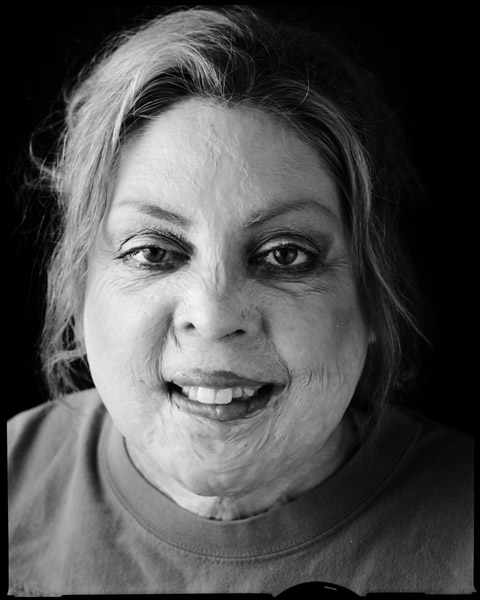
In 2001 I met a burn survivor who allowed me to photograph her. She told me that she wanted to be photographed so that people could stare at her without feeling embarrassed. It was such an extraordinary experience that a few months later I flew to a burn conference and set up a makeshift studio in a hotel room, and asked people to let me know if they would like their portraits made. I was astonished at how many people did. What I learned from this extraordinary experience was that every burn survivor has a tale of courage to tell, and that the burns have their own eerie beauty. I also learned that after a few hours it becomes very difficult to see the burns anymore. When I returned and developed the photographs, I had to keep asking my wife “does this person look burned to you?”, because they all looked quite normal to me. My only regret is that I didn’t continue with this project longer than I did, but life intervened.
I love love love the possibility of not being able to tell who is scarred and who isn’t. Eye of the beholder.
I just found this really old draft from my notes on death and dying. My lag time idea is really starting to shape up!
I’ve been working my way through Heidegger’s being-toward-death ideas from Being and Time, with the help of a How To Read Heidegger guidebook. It all hinges on death as nothing, non-existence, non-being (uh, non-Being).
Death, as possibility, gives Dasein nothing to be ‘actualized’, nothing which Dasein, as actual, could itself be.
(Dasein being basically a self-aware entity, a person. I blaspheme. Here’s a more thorough explanation.)
One irrelevant aside before I get to my point: my How To Read Heidegger guide was published in the US and written by an American, but uses European typographic conventions (in the quote above, the comma is outside of the quotation marks, for example). Presumably this is because that’s how Heidegger wrote? I didn’t notice the punctuation in Being and Time at all, but reading an American book with this old country punctuation was actually making me feel weird and scholarly. Using an alternate prose style guide— yikes!
Anyway. Death as non-Being. I just finished reading Mary Roach’s Stiff: The Curious Lives of Human Cadavers, which, in a way, is all about the kinds of being you can pull off when you’re dead. She talks about cadavers having superpowers— not being able to feel pain, for example— and being uniquely qualified to fill certain medical and research roles. She spends serious energy insisting on the importance of being an organ donor, of being useful to other people after death.
I ran into that same phrase at Body Worlds in Vancouver. Being useful. The body donation forms have checkboxes where donors can fill in their motivations, including items about serving a good cause and contributing to medical research. My memory of the poster at the exhibit (in 2006) was an option about “continuing to be useful after I’m dead,” but maybe that was just the vibe I got from this set of options (from the 2007 form).
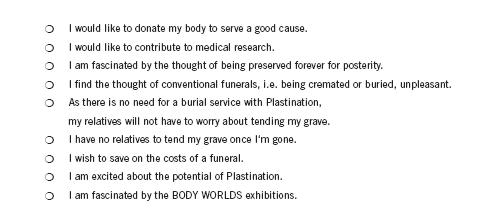
That makes sense in a very practical way (what else are you going to use that body for?), but at the time it made the hairs on the back of my neck stand up and it still does. Telling people they can be useful after death borders on exploitative, to me. There are sane reasons to do something useful with your body, but there could be some unfortunate denial that I wouldn’t want to encourage. It’s a twist on the usual spiritual afterlife— “yes, you still die, but not all the way.”
Not to mention the striking similarity that the “motivation” section of the body donation form bears to a market research questionnaire. In Vancouver, the Body Worlds exhibit ended with a big display about becoming a body donor, with posters and consent forms. It was positioned right in the exit, so everyone had to walk through it, the way museums often position the gift shop. Creepy! And not because of the dead bodies! The whole thing struck me as a self-perpetuating industry, a closed circle of marketing. The exhibit is designed to convince people to donate their bodies to make more exhibits to attract more donors to make more exhibits… A bit of a pyramid scheme.

After reading this fairly incidental profile of a Top Model contestant with Asperger’s Syndrome, I am wondering if fashion model is the most mind-bendingly ironic job for someone with a diagnosable inability to conform to social expectations. Maybe an Aspie con artist would be more unexpected.
A photo: where I’ve been, by dayzoid on Flickr. A self-portrait I think.
I like this scar— I like looking at most scars, and I work on looking at the rest. But the photo itself seems like the kind of thing that gets referred to as “real” beauty in skincare advertising. An older woman, but with flattering makeup and lighting. Gray hair, but stylish and even. Not a bone rack, but posed to look smooth and curvy, never lumpy or saggy or folded. Making some kind of cute and peaceful facial expression. Definitely feminine, but not sexual (not coincidentally, usually looking freshly washed and clean). It’s a very contrived and limited type of “real.” Looking again, this photo is not as extreme as all that, but the demure smile and the smooth white hair reminded me.
I don’t get why more people don’t rant about how patronizing it is to use “real” as a euphemism for old or fat. I can’t decide if it is better or worse than the older concepts of “imperfect beauty” or “inner beauty.” There are probably more phrases in body image activism that drive me bonkers. The whole focus seems off to me— I don’t think it helps anyone to offer these alternate, consolation prize types of beauty, more ways to win at being beautiful. That doesn’t do anything to get away from ranking people or competing. I really think the focus should be on learning to see more kinds of beauty, to be a better beholder.
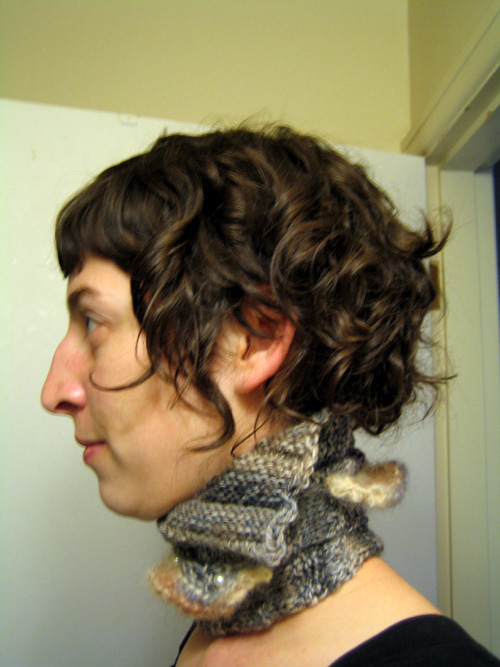
The first neck brace scarf was so quick that I was inspired to make another one. Usually I’m all about elaborate crafts that involve at least a year of delayed gratification, which I think makes me very vulnerable to the finished-object high. More more more!
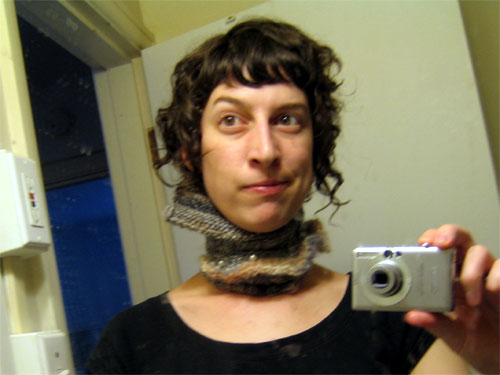
I probably could have stopped before adding the fuzzy ruffle thing, but I wanted to make it weird. My vision was jellyfishy, but unless jellyfishes have a European royal court I’m not sure that really comes through. More of a bizarro-Elizabethan neck brace.
Here’s a snapshot through a dirty mirror that shows the front, and also, incidentally, a quite accurate representation of my personal idea of what I look like.
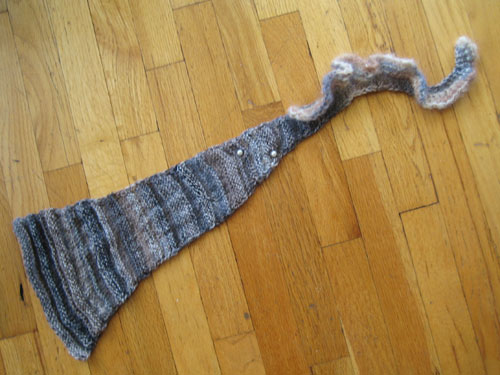
The creature itself looks like this.
Some patterns for knitting one.

At first I was just looking for a few photos of people’s scars, having been reminded by Erin’s copy of the Learning to Love You More book. But, in typical internetto fashion, now I am intrigued by the patterns that show up when you look at a mass of public scar photos. There are some popular subjects— self-harm exhibitionism and processing, scars from pregnancy and cesarians (not so much finding episiotomy scar pics), voyeurism with optional processing (especially around major burn scars, and ritualized scarification by some African cultures), manifestos and statements about beauty and beautiful scars, and more general scar pride and storytelling. I find this last one the least complicated, the easiest to post photos without major accompanying comments. (In this one I’m only spotting basics, about how it’s easier to be proud of pretty much anything when you are cute and posing, but I still like how that calculator watch makes her look tough.)
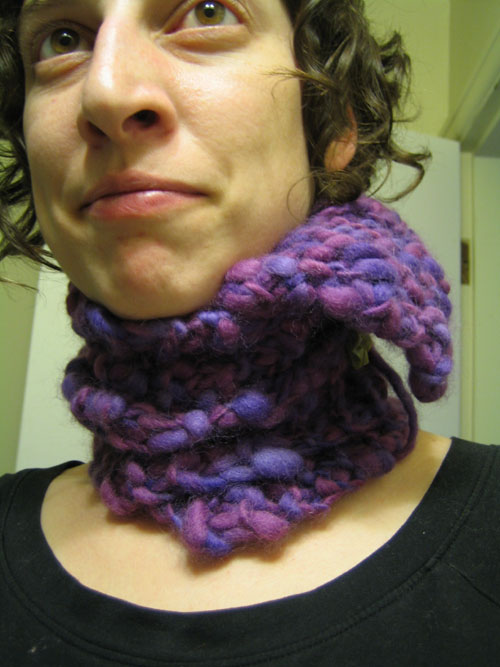
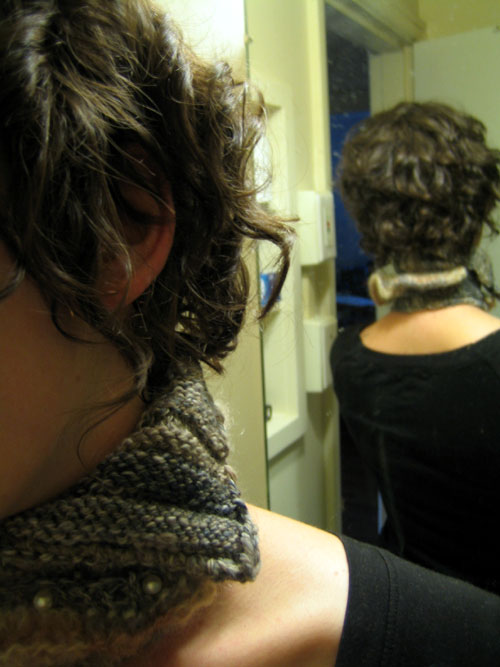
I made this neck warmer in one afternoon, with no counting. Hooray! It even ended up with half a Darth Vader collar that I like, and made a couple dents in my crafting stash. Time for heroic poses in the bathroom mirror.
I was remembering this tapered neckwarmer and this scarflink (scroll to Oct 27, 2002) while I knitted.
It looks like this on its own, if you want to make something similar.
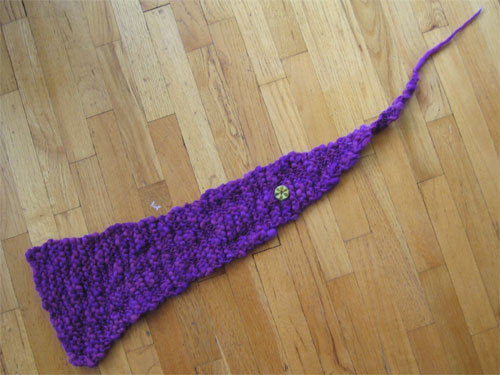
This pattern is such a non-pattern that I insist on writing it formally, because it is funny.
CO 22 sts.
Work in garter stitch, decreasing one at each end of random rows (approximately every 4-6 rows), down to 2 sts. K2tog.
Pull yarn through remaining stitch and leave the tail hanging out as a fastener.
Weave in the cast on end.
Sew or tie the two buttons together to make a cuff-link type thing. Button it into the outside layer of the scarf and wrap the tail around it to fasten. (Move or flip the button at will.)
The end.
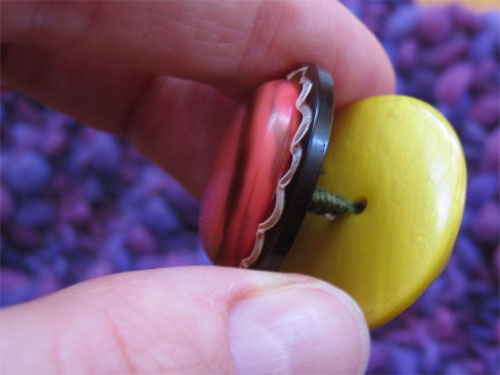
All the ingredients have stories. Past projects, hand-me-downs, gifts, inheritances. That feels good.
Photograph a scar and write about it is still one of my favourite assignments from Learning to Love You More.
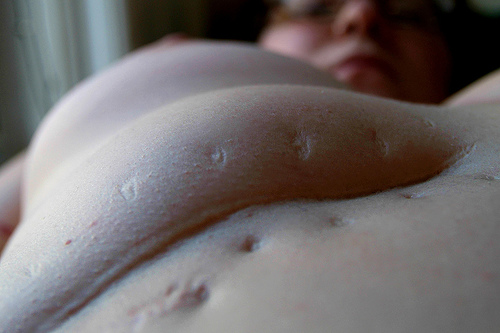
by the time i hit grade nine i not only had a surface piercing in my scar, but had also cut a scar-shaped hole in a tank top the better to display it.
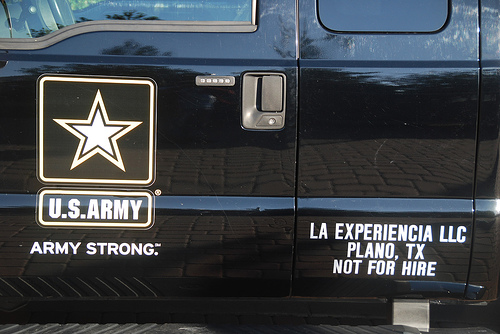
This is how I picture the army talking anyway. “Army strong! Army hungry! Join Army!”

I’m reading a book on the history of horror movies (finally, prompted by a haunted house analysis that Dark Daughta linked). My horror book quotes a character from Upton Sinclair’s 1922 novel They Call Me Carpenter, talking about The Cabinet of Dr. Caligari.
This picture could not possibly have been produced in America. For one thing, nearly all the characters are thin. … One does not find American screen actors in that condition. Do your people care enough about the life of art to take a risk of starving for it?

The rest of that horror essay I was quoting yesterday debates a super-Freudian interpretation of the “final girl” in slasher films— the one who doesn’t die— as a simultaneous castrator and phallus-envier. Cut something off that monster and wave your big knife in the air, ladies. The horror can’t end until the cocks are properly distributed according to your moral fortitude. Meh.
After all the feminist sexuality reading I usually do, it is bizarre to read an essay where somebody takes Freud seriously, even temporarily. Nobody seems to get away with discussing Freud’s take on sexuality without at least a disclaimer about the myth of vaginal orgasms, but in discussing horror apparently it is acceptable to dive into repressed womb envy and castration complexes with all sincerity. Maybe the academic tone of the essay disguised the author’s disdain, but it seemed like she was buying it.
I got a lot more interested when she started pondering why it has been so much easier to have women transition into monster-killing hero roles on film than to spend any screen time on men screaming in terror. Gender as theatre, this is more my speed. It actually made me sad for guys, to think of (mostly) guys in the ’80s making slasher movies for (mostly) other guys and having to kill all the men quickly in the distance while the women got butchered in close-ups. The audience’s only chance to identify with fear in most of those movies was through feminine characters. Men had a very limited range of possible emotions and options for expressing them. How were people supposed to learn about masculine fear? That’s terrible!
The author pointed out that the cliched lack of stereotypical femininity in the surviving girl (always the smart one, or the one wearing pants, or the one who doesn’t put out… also usually the one named Stevie or Georgie or something) might not just be about misogynistically killing all the feminine or sexually active women. She suggests it’s about giving guys a somewhat mannish hero to identify with, since an actual terrified man is off limits. The last girl is the character who realizes the full scope of the danger— she’s the most afraid, and spends the most time being afraid. Those are the interesting emotions, the ones that prompt the shivers and startles. I think it’s terrible that it’s still largely taboo for that to be a man’s role! Hopefully my kids will be able to activate their repressed fears with screaming victims of all genders.
If anybody knows some movies where men scream and cry in terror (preferably half naked?), do tell. I feel like I must know some, but all I can think of at the moment is Deliverance. Maybe some war movies would fit the bill.