Look good naked, bring your own analysis, a lot of video links.

A bloggy friend of Erin’s posted about a TV show called How To Look Good Naked. I don’t have cable, and I didn’t know anything about this show. This blogger, Sarah, said the show basically relied on body image coaching to help women like their nude bodies, with no weight loss or surgery suggestions at all. I found this improbably thrilling news regarding a reality makeover show, so I looked it up on YouTube. This is from the American version (the original is British).

They just pointed out that plastic surgery doesn’t work? On TV? And they used their feelings to decide how to solve their personal distress? Yay hooray! The clips I found raise a ton problems for me, but wow, I am really happy to see this conversation happening on a mainstream makeover show.

Problems/boring parts:

And yet, I am still definitely pleased to see a rounded woman’s butt cellulite on screen in a positive context, hear someone make the basic point that clothes need to fit your body and not vice versa, and even see men touching each other fairly comfortably.

This is a very narrow discussion of body image, but it is at least in a direction that I value: unpacking all the crap that people said you should do and deciding for yourself. (My body and I are totally bff almost all the time anyway, so I’m not disappointed about the lack of new ground.)

It’s quite the comment on the state of TV that eliminating weight loss and surgery without discussing anything else is cause for celebration, but maybe these baby steps will make some room for a similar show that adds a couple of elements, and then a couple more. No weight loss, no surgery, and no dissing fat. Or getting to know your body without looking at it. Queer eye for the straight girl, finally, or a show where women come up with ways to enjoy their bodies without a host/star/authority at all. I dream.
Ernst Haeckel, categorization, sets of sets, primary colours, dog tv

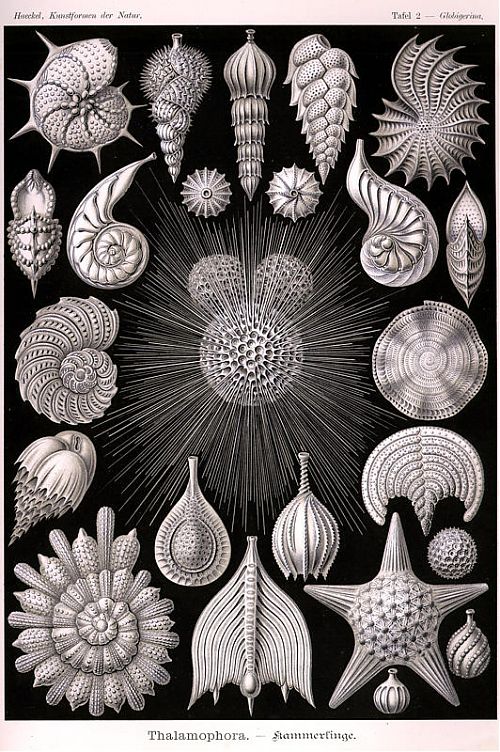
Ernst Haeckel, Kunstformen der Natur

I fell into a bit of a well of naturalism and anatomy links, and ended up wanting to read Stuffed Animals and Pickled Heads: The Culture and Evolution of Natural History Museums, although I’m pretty sure it isn’t as critical or curious as I want it to be. One review quotes this tedious oversimplification as a “philosophical insight into the scientific and human impulse to categorize.”

“To have a concept… is to have its negation already in tow…. There is a class of things called ‘dog,’ and there is a class of things (quite substantial, in fact) that are ‘not-dog.’… Language and thought cannot really function without this most basic tool for carving up reality.”

Never heard of fuzzy continuums and the rewards of using them, I guess? Odd, since natural history museums are full of ambiguous specimens (two headed mutant dog, alleged dog-cow hybrid, newly discovered tentative dog, etc) that illustrate quite nicely the space between dog and not-dog. Sort of dog. Possible dog. Both dog and yet not dog. Natural history museums are pretty much ground zero for failed categorization schemes and fuzzy margins, sets that are more complicated than somebody was hoping they would be. Maybe the quote is just out of context. There are a lot of ellipses in there.

To balance out the sad saga of binary categories in science, I like to think about primary colours. These seem like a life-affirming, pro-ambiguity, scientific success. Primary colours are sets of colours that are chosen to maximize the usefulness of the spectrum between them. A noble, everybody-wins way to think about categorization, and also an easily visualized example of information organized into multiple overlapping continua. Wikipedia points out that “Any choice of primary colors is essentially arbitrary; for example, an early color photographic process, autochrome, typically used orange, green, and violet primaries.” Concrete! Maybe this is because colour science is so bluntly tied up in perception and perspective. It has to be aware of observer bias and intention, because it is about observing. My favourite bit of that Wikipedia page:

If a human and an animal both look at a natural color, they see it as natural; however, if both look at a color reproduced via primary colors, for example on a color television screen, the human may see it as matching the natural color, while the animal does not; in this sense, reproduction of color via primaries must be “tuned” to the color vision system of the observer.

I wonder how long it will be before someone makes a TV for dogs, with two kinds of pixels instead of RGB. Or TV for bees, with four kinds.

7 wrens, sets of sets

seven wrens

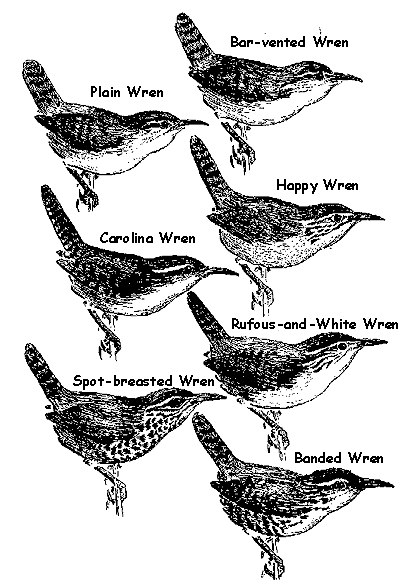
I was thinking about sets of sets when I came across this set of similar wrens, discussing the collections of identifying marks that make up a distinguishable bird species.

The same site has a lovely little discussion of preparing the mind to see birds.

Experts say that when we lose something, before we begin our search to find the lost thing we should picture the object in our minds. This kind of “visualization” causes the brain to do something wonderful. On the one hand, it appears to filter out many unnecessary sightings but, on the other, if something even remotely resembling the lost object comes into view, the mind seems to “jump” at it.

Power of pattern matching.

Crap emails, man angst, better living through feminism…


I try to be calm and cool…… but my body language always gives me away & creeps women out some how. I start conversations easily, but I find myself saying too much or confusing women by saying things that they cannot understand or are too deep, for the amount of Vodka-Red Bulls that they have consumed.

This post at Letters From Johns reminds me of this (much longer and funnier) Crap Email From A Dude. They both remind me of crap emails I’ve received in the past from various acquaintances and from strangers who read about my vagina.

It’s weird to recognize a whole collection of traits— the insistence that they like women even though they are unable to avoid venting their anger at/about women, the over-analysis often constructed from one chapter of [dead guy of your choice], the obsession with yet lack of self-awareness (“I’m very direct, here’s 3000 words about nothing.”), the refusal of independent responsibility (“I hate it when people hang out with me even though they obviously think they’re too good for me.”), the fucked up gender stereotypes, the obsession with yet discomfort over sex… It’s a whole syndrome. In high school, my friends and I called these characters Deep Teen Smurf, or Bad Teenaged Poet.

Off and on, I’ve wished for a book to recommend to these guys, to help them snap out of it and get past being so angry and hurt about their entitlement not working out for them. I would call this book “Put On Your Big Boy Pants, OK Thanks.” I’ve seen The Gender Knot recommended as a book that explains how patriarchy even causes problems for men (while distinguishing those problems from the problems of being oppressed). So maybe that would work. It’s on my excessively long personal reading list for 2008, to find out.

G-rated YouTube porn, feathers.

I ran into this while I was looking for info about whether found feathers can have any germs or mites or whatever (probably not). I love the wealth of g-rated porn that has blossomed under YouTube’s anti-nudity terms of service. I don’t think they intended to create a video sharing service where only kinky sexplay is allowed (watching women fart, smelling socks…), but I guess that’s a fairly predictable side-effect of banning mainstream, tab-a-slot-b, show-the-boobs sex in an online space.

So far I haven’t found anything especially subversive— lots of groomed women and muscular men, lots of hypergender, whatever— but I actually like this tickling video because the tickler and the ticklee seem to have actual communication with each other. “OK, OK,” feet flex, feet relax. That’s kind of magic to see on YouTube.

Curling, graininess suitably expressing surreality.

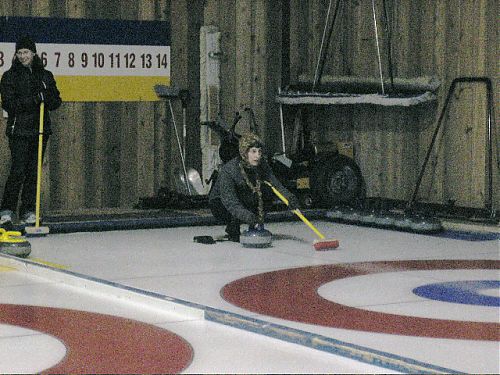
Uh, me curling.

I went curling after hours at a rink owned by some friends of my cousin, out near Sidney.

  • It was surprisingly fun, in the way that bocci, billiards and croquet are fun. Minimally-confrontational exercises in physics.
  • So far I’ve never once been a fan of flattening large areas of land (parking lots, malls, golf courses…), especially land where I understand something about it having been colonized and occupied. It’s extra absurd when the flattening is done for sports. Non-cooperation overload.
  • If I were actually into playing sports, I would set up a beautiful place to play for once. Rinks, fields, courses and courts are all so ugly! Wow. I wonder if spending time in artificially lit, flattened out, weirdly-proportioned, echo-y, energy sinkhole type spaces might be damaging on its own, even without the formalized competition and violence and the addiction to contrived adrenaline rushes. (Hi, I have fun ideas about sports!) Certainly people say that about office cubicles, that the ugliness is demoralizing, even without the bureaucratic hierarchy crap.
  • And, curling was really fun. Pushing heavy things across ice with measurement marks is basically sensory play. Balance, momentum, angles, stretching, muscles. I bet curling kink parties would be fun.

Excessive red and blue in my kitchen, being impressive, calendar trivia…

Red and blue kitchen.

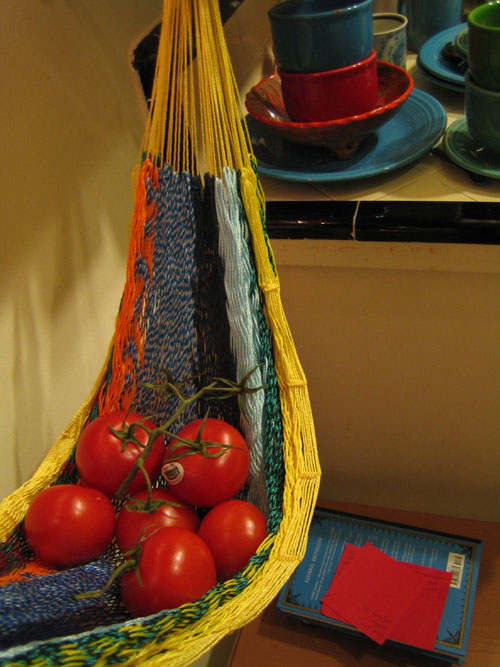
For a moment I was feeling disappointed that I hadn’t come up with any simple theme for the photos I’ve been posting this week. (I don’t know if anyone even noticed them, but the matching sets of red and blue and crafty ideas and so on were making me more comfortable.) I got to thinking about the ways I use gimmicks like that whenever I make things, as a way to add automatic value to whatever I produce. Obvious extra effort. If nothing else, the project will look like a lot of work, which is impressive in certain ways, by default. I’m trying to stop doing that automatically and cut to the chase more. Be more honest instead of more impressive. Probably every adult thinks about this at least a little bit, in some context. I thought I was doing alright with this personal growth project, but then at a festive feast with my extended family, a cousin’s friend commented that I seemed well read. That’s probably my number one trying-to-impress-you habit, being smart. It’s complicated, because I do like to learn things and I do like to share what I find out and not hoard it, but if I want to be your friend I will almost surely start telling you a lot of fanciful trivia related by a larger theme instead of, for example, asking you to tell me about things you seem to know that I don’t. Reading about DIY education is helping me work on this. It makes nonconsensual teaching really, really embarrassing.

So. As my early morning mind-map hopefully explains, I was all set to embrace the non-patterned nature of my really low-effort holiday posts. Then I got to thinking about how much I love the way the last week of the calendar year can get divorced from daily reality and kind of out of time. Students and lots of workers are on holiday from their regular schedules, you never know when shops are going to be open, many households have visitors or go visiting, a lot of people eat really strangely… Regular patterns don’t hold. It reminds me of an ancient Roman intercalary festival that I can’t remember the name of. So now of course, that’s my theme for this week’s little photos. Intercalary disorder. I think this sort of doubly violates my goal of not acting so impressive.

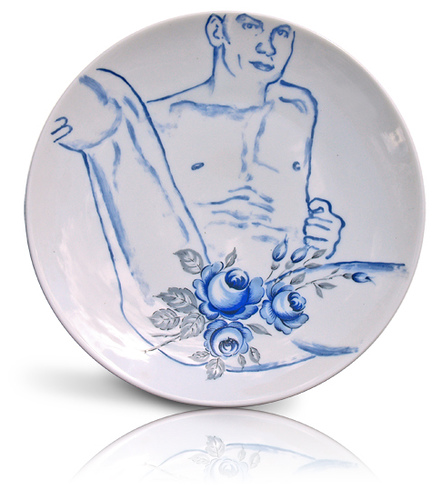
a skinny older man body

{Flickr photo}

When I saw the Century Project (a man took nude photos of women from ages 0-100), my first thought was to wonder whether anybody was making a similar collection of naked men. I think there is more of a lack of images of naked men overall. So I collected this one a few months ago, and that’s as far as I got.

“this should be a typeface, called Godbold”

{Flickr photo}

‘John Gambell suggests the typefaces we as a society choose in which to set our messages are meant to stand in for the speaker of the words themselves’. I do think God would be represented as speaking in bold, generally. I’d be curious to see what would happen with something like Godhandscript Extra Light Distressed. Casual whispering God.

Old men knitting, a gap, then young men knitting

Flickr photo

I posted a few photos of knitting ideas this week, and when I was thinking about what to post to round on the week’s set, I got to thinking about men knitting.

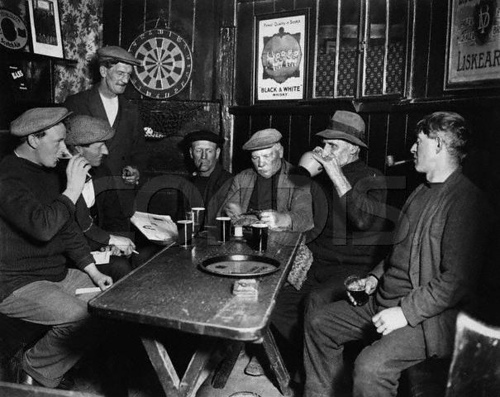
Several times, I’ve had old white men come up to me while I’m knitting (or especially the few times Galen has been knitting in public), and they’ve talked about how they used to knit, or about how all their sailor or fisherman coworkers used to knit their own socks, hats and sweaters. People in my grandparents’ generation. Pretty much the exact dudes in that photo. The middle one is knitting. Can you tell? That’s my usual move, knitting while everybody else drinks beer.

My gramma, who has been my main knitting tutor other than books, is totally unphased about men knitting. She seems to find it normal and expected, which strikes me as odd since knitting is now cast as such a gendered activity, as a feminine art to be reclaimed and valued, as something our grandmothers did. When guys knit now, it’s celebrated as a happy transgression similar to chicks fixing cars. I should ask my grandparents about this, see if they remember a break when western or North American men stopped knitting.

(My brief googling for pictures of men knitting turned up lots of men knitting within apparently conventional knitting roles in Peru — Andean male knitting traditions are well-known— as well as Turkey, plus net-makers all over the place. Only the young urban male knitters in North America had any kind of “breaking tradition” vibe happening. E.g., a drummer, a subway rider.)

I wonder if it has anything to do with different modes of transmitting knowledge. I’ve never seen any written knitting instructions or patterns geared to guys before the last few years (Knitting with Balls and the like). All the heaps of vintage commercial patterns I’ve seen are for the ladies. I would assume the knitting sailors and knitting workmen maybe learned it right from another person. I could also see job changes, mass production, world wars, and gendered income differences being involved in there.

I haven’t even tried to google this. It’s just going in a pile with other vague research topics that I casually keep an eye out for. Knitting grandfathers. Maybe I’ve got some.