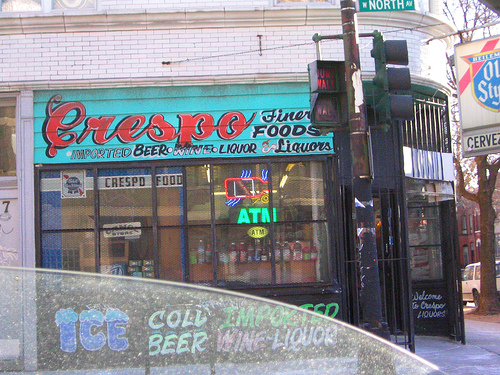
“Finer” foods is a nice touch.
“Finer” foods is a nice touch.


Casey phoned the other day to ask about my top photos of undressed women, as a response to seeing one of those lame “babe of the day” widgets on somebody’s Facebook profile. (I think he wanted to build an arsenal, in case he had the opportunity to unleash it on somebody.) I am pleased that somebody thinks I am a potential resource for images of people who are sexy in the body hair and bellies kind of way, but I don’t have a stash of that stuff at all.
For a start, I thought of Rose and Olive, photographers I found awhile ago, I think on Warren Ellis’ blog. Their photos are often quite posed, and they seem caught up in starving artist glamour and that artier version of girls gone wild that hipsters like (wet shirts, polaroids, poetry…), and they have a blog at Nerve.com which is a creepy place to have a blog… and the photo above is one of only two black models in their entire archive as well as one of a very few models who look older than nineteen and aren’t showcasing skinny bony shoulders… but also, they seem to know that wide thighs and forehead wrinkles and messes are beautiful, and they seem sincere, so I pick and choose from their photos.
I appreciate the love of armpits, textures and complicated facial expressions going on in this photo, and the way the model is kinda subverting a classic pin-up pose. It makes me want to be on that roof, in that light, touching skin with somebody. So this might go in my babe of the day stash, if I had one.
I feel a meandering mind-map coming on, starting from an essay about slasher movies by Carol Clover (roughly summarized here ) that I read in this anthology about gender in myth.
On the civilized side of the continuum lie the legitimate genres; at the other end, hard on the unconscious, lie the sensation or ‘body’ genres, horror and pornography, in that order. …
It is a rare Hollywood film that does not devote a passage or two— a car chase, a sex scene— to the emotional and physical excitement of the audience. But horror and pornography are the only two genres specifically devoted to the arousal of bodily sensation. They exist solely to horrify and stimulate, not always respectively, and their ability to do so is the sole measure of their success…
I’ve seen a lot of people try to show that horror and pornography are related, usually based on some inarticulate statement about the similarity of sex and death. This bodily-sensation aspect seems like a more accurate connection. It’s got me editing my ideas about pornography (again), too.
For the last couple of years, my working definition has been that something is pornographic (to me) when it is presented for its own sake with no intention to communicate further meaning. Literal as opposed to symbolic, I guess. Showing literal sex rather than any experience of eroticism, or showing literal blood and gore rather than communicating a meaning of injury or death or fear (a la gore-porn). I don’t mean that as a diss to actual porn, more as an explanation of why I call Cute Overload cute-porn, and why I sometimes object to the ways other people use hyphenated, non-sexual porn labels. (I’m not sure I experience the Ikea catalog as storage-porn just because it shows a lot of shelving.)
This sensation definition is way simpler, and avoids having to argue about what is meaningful or symbolic. Since porn is some of the most intensely deconstructed media around and easily supplied with symbolic meaning, I think this simple sensation definition is a lot more accurate too. So thanks for that, early nineties essay collection.
Thinking about movies that are made for my body got me thinking about imax. All I want from a six-story tall movie is a strong sense of vertigo! I see an imax film about once every two years, but in my limited sampling they seem to be getting less motion-sick overall. Anybody have better evidence on that? (Tosczaks, or other bearers of yearly passes?) At the least, I’ve been disappointed with the imax films I’ve been seeing. I don’t want a plot at the imax, I want a bodily experience. More helicopter shots going over a cliff, please. I want imax to be more pornographic. Imax has not been fulfilling its potential.
So yup. The other idea I want to store here is about “legitimate” genres. I don’t really buy the idea that they’re less focussed on bodily sensations. The most pretentious, high-class films I’ve seen could be called superiority-porn. Feeling superior is a real sensation, although not often acknowledged as a physical/chemical state. I just dug up a clip from the Helvetica movie where Erik Spiekermann explains that he just likes looking at type. “Other people look at bottles of wine, or whatever, or you know, girls’ bottoms. I look at type.” He looks; it feels good. I’ve only seen the trailers, but that documentary is clearly modernist-typography-porn, and totally classy. (Or, ahem, neutral.)
The pretense seems to be that some cinematically-induced sensations are intellectual, rather than bodily, which actually seems very similar to my original working definition about pornography being devoid of meaning. So again, why am I reading anthologies about symbol and myth in these “body” genres if they are so literal and physical? This seems like a very weird manifestation of the usual classist aesthetic distinctions, where “legitimate” good taste just happens to be whatever working class / uneducated / trashy people don’t appreciate. Classy movies are secretly about sensations, and trashy movies are secretly full of cultural symbolism. Oops.
I’m probably specifically bad at this game— personality quiz questions on the theme of “do you pay more attention to rational thoughts or gut feelings” make my head explode, because surely thoughts and feelings exist in the same soup. I mean, you have to feel whether you’re being honest about your logic; I don’t know any other way. From now on I’m paying special attention to how my body feels when I watch fancy art films.

i wonder if the heart symbol is a joke. i’m also having a lot of cognitive dissonance concerning those substitute/symbolic Os and the idea that letters are things, not pictures of things, while words are not things, but pictures of things. this leaves the graffiti approximately nowhere, but i still like the colours.
This year’s Mystery Movie surprise screening at Cinecenta was Persepolis! I’d never been before, but the idea is that they screen something anticipated that hasn’t been released over here yet. Our only guess was that it might be that crazy Bob Dylan movie with multiple people trading the lead role… and then as soon as we had any kind of guess, I was worried that when we were wrong it would be disappointing. Surprises are fragile.
Seeing the film come up in black and white animation was so optimal that it felt sort of charming. This was the only upcoming movie I’ve been looking forward to, and almost the only one I even knew anything about. It’s hard to be more fun than anticipation, but I don’t think that accomplishment was the charming part. A guy from the Cinecenta staff had come out and introduced the screening beforehand, so already it was feeling like a human social event rather than a commercial transaction, and then it turned out to be a movie made by people I could picture in my head from watching the little making of feature on the movie website. Lots of people involved, rather than only vague forces of fame and culture and money. I think that was what felt so warm and fuzzy. (Maybe especially after considering a movie about Bob Dylan as a sort of opaque, unknowable icon?)
I don’t understand why more cinemas don’t put an effort into spectacles and gimmicks like this on a regular basis. Surprise movies (old or new) are going on my local cinema wishlist, along with having a human introduce each screening, offering table seating, downloadable mp3 commentary tracks, loveseat-style seating in more places than just the back row of The Roxy, and beer in non-plastic containers.
I’m not much for movie reviews, but I suppose I should mention that I liked Persepolis. Funny parts, sad parts, angry parts, cute parts, and a lot of characters processing ethics out loud, and integrating external wars and politics with internal, personal feelings. The animation was very beautiful. (And boy do I like the various Arabic Persian nose shapes that Satrapi draws.) I think you could check out the books and the movie in any order without wrecking anything.
This whole episode has been a curious test of my 7-day posting lag. When I realized which film was showing, I felt like I’d been hoarding information because none of my companions could read the future archives of my blog, where I’d stashed links and details about the movie. That’s exactly counter to my anti-exclusive motives for posting to the future. And then I felt disappointed that I wanted to write a follow-up post when the first thing I wrote about Persepolis might be due to publish less than a week in the future— my follow-up was at risk of being weirdly late. It turned out to be pretty well-timed after all, but it is hilarious the way media influences real life reactions. This is more disconcerting than the “I wish I’d brought my camera / Kodak moment” feeling.
A hand-animated movie version of Persepolis, Marjane Satrapi’s two-part graphic novel about growing up in Iran during the 1980s Islamic Revolution, will apparently be out on December 25. I’m curious about this movie. I read the first of the two books quite awhile ago, and I remember liking it, but I’ve been doing a lot of thinking and learning since then and I wonder how I’d find it now. I think it has promise.
Out of this curiosity, I’ve been reading a bunch of interviews with Marjane Satrapi. She’s pretty opinionated and direct, so even though the same topics come up over and over, I like to read her responses.
Most press I’ve seen about her is by writers who see her books as “complex,” because she writes about “good” people who do bad things and “bad” people who do good things. In interviews, she talks a lot about dealing with people as individuals rather than making assumptions based on their culture or race (that really doesn’t sound complex). But in this recent promo interview in the NY Times, the journalist seems to want Satrapi to act as an anti-fundamentalism or anti-Islam spokeswoman, rather than taking the usual “complex,” general progressive stance.
All that intro (hmm…) so that I can announce: I love the turn that interview takes, right here.
Your books denounce Islamic fanaticism, particularly as it curtails the rights of women. Is that your main theme? Oh, no, not at all. I don’t consider myself as a feminist but more a humanist.
Still, in your work, you are constantly contrasting your love of food, smoking and sensual pleasures with the acts of self-denial demanded by the mullahs, like wearing a chador. It’s a problem for women no matter the religion or the society. If in Muslim countries they try to cover the woman, in America they try to make them look like a piece of meat.
Are you suggesting that veiling and unveiling women are equally reductive? I disagree. We have to look at ourselves here also. Why do all the women get plastic surgery? Why? Why? Why should we look like some freaks with big lips that look like an anus? What is so sexy about that? What is sexy about having something that looks like a goose anus?
I never really thought about goose anatomy. I looked when I was on a farm in France.
I am making an effort to barf more on this blog, and to write long-winded, feelings-based rambles like when I first started making the vagina website, ages ago. But I am still self-conscious about it. I have realized that even though I was always in favour of keeping my various websites fairly integrated and putting the vagina website on my resume etc, it’s been a really long time since I wrote anywhere that I actually expected my friends might read, rather than just writing for internet strangers. Not as fearless as I thought. So, working on that. Fewer “this sure is long” disclaimers in the future.
I’m currently posting at least seven days in the future, and I kind of dig it. At first, I just wanted to post a couple of things that would pop up on December 1, to give myself a deadline for building the new site templates. But now I like this restriction, that everything must lag by at least a week. It eliminates some kinds of elitism and exclusivity— I can’t be first, I can’t be fastest, I can’t be in the loop. Blogs are such a pro-novelty, pro-immediacy, pro-echo-chamber technology that putting a mandatory delay in there is interesting to me. And funny. It already makes the site seem strangely private, because I can see into its future and go there alone.

When I wore mary janes a lot, I used to be into the toes turned in thing. This photo is suddenly making me uncomfortable about it, presented like that with no irony at all regarding women in fancy shoes standing like little girls. I’m hoping my general hairiness was enough to contrast and balance the baby toes.
I had never related the toes to the shoes until last week. I noticed that when I wear my boots I tend to stand like Captain America, feet planted especially wide. Design affordance, I guess. Superhero boots afford superhero stances.
Restraint is a font by Marian Bantjes, something I have wished for many times! So many obsessive, interlocking ornaments that it comes with instructions. (Restraint. Ha ha.)
I noticed, while making the backgrounds for this website, that although I am very partial to red-and-blue, it feels even more satisfying to see red and blue and green. Then I became suspicious that I’m just addicted to RGB screens.

I feel like a bit of a wanker talking about My New Website Design since the point for me is to be self-explanatory (I already talked about this stuff by posting the design). But I do like talking about design in regular words too, so here goes.


I’ve had this bookmarked for months. I really like to look at it.
Goth orca and a grainy orca family. I think I like these. It is hard to tell, after the years of local orca art overload.
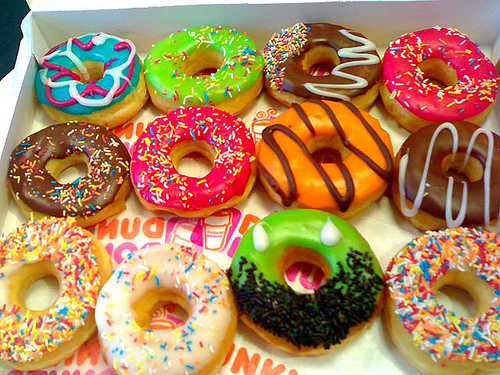
This is to celebrate the big monster face and the bright colours I made. Hello! I’m ready to stop hiding for awhile!
76. A good reading goal is to read a single author for every letter in the alphabet. I did this in 2006 and stopped on Auster, Paul. I couldn’t pick a single author for ‘B’.
That’s right, I’m reading somebody’s list of 100 things they learned in 2006. Apparently that is one of the things I didn’t learn to stop doing last year.
I take notes on paper while I read, and file them chronologically as I finish with each source. On other projects, I’ve recorded just the title and the date in my table of contents, but this time I added the number of pages of notes. It’s a handy little metric! The quantity of notes correlates well with the impact a book had on me, and it’s very easy to scan.
If someone asked me to recommend a book about education or death, so far I would head for anything with five or more pages of notes in my Binder of Doom. (The notes wiki gets a filtered, delayed set of notes.)
Each “page” is a double-sided sheet of paper. For some reason I am self-conscious about the amount of notes I take. I have not been recording these scholastic anxieties and old school-related wounds, but maybe I should start. That could be my next metric— awkward moments prompted by each source.
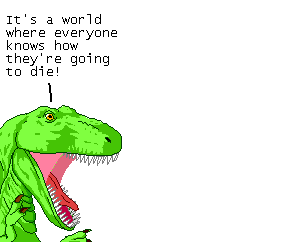
Machine of Death is an upcoming published anthology of short stories edited by Ryan North, Matthew Bennardo, and David Malki !, inspired by this episode of Ryan’s Dinosaur Comics.
All the stories will be about a world where a machine can tell people how they will die.
The machine had been invented a few years ago: a machine that could tell, from just a sample of your blood, how you were going to die. It didn’t give you the date and it didn’t give you specifics. It just spat out a sliver of paper upon which were printed, in careful block letters, the words “DROWNED” or “CANCER” or “OLD AGE” or “CHOKED ON A HANDFUL OF POPCORN”.
At a recent art opening, I pulled exactly such a slip of paper from an art installation by Hank Pine, and the mix of deadly predictions was very similar. A good variety of glamorous or outlandish ways to die (decapitation, dusting accident, lead pipe…), with the occasional realistic downer (I myself got “leukemia”).
Small talk around the death oracle was exactly as described in that call for submissions. “It said ‘lead pipe’… but I don’t know if I’ll be hit with a pipe or poisoned by lead plumbing.”
“OLD AGE”, it had already turned out, could mean either dying of natural causes, or shot by a bedridden man in a botched home invasion. The machine captured that old-world sense of irony in death— you can know how it’s going to happen, but you’ll still be surprised when it does.
I think part of the reason the diseases managed to be shocking was that there were fewer loopholes. “Hey, I… I can’t think of an ironic way to die of AIDS.”
A death oracle might be a good format for my long standing intention to find out, statistically, how I’m likely to die. Filling a hat with 45% “heart attack” would be several levels more morbid, somehow. Not as personalized as the Machine of Death, but just as accurate, in its way. A Pie Chart of Death is within the reach of current technology.
Interview with Guy Maddin, one of my favourite directors, from October 2006:
GM: I’m also kind of pleased with what I came up with. It was such short notice that I didn’t have time to make anything up, I had to just be very honest. So much so that I can’t really show it to my family. I’d be disinherited, things like that.
TB: It’s kind of funny to hear you say that about a film that involves organ harvesting in a lighthouse.
GM: Yeah, I sort of promised myself I’d never talk about that part of growing up. It’s all there now! But sometimes you can hide things in plain sight.
I watched The Saddest Music in the World three times over the weekend, with and without commentary, and now I find myself hanging on every word out of Guy Maddin’s mouth.
His comments about expressionism in the Saddest Music are helping me with my mission to draw. He did things like shoot the actors making assorted facial expressions against a black backdrop so he could stick them in whenever he needed a shot, figuring that nobody really cares whether the backgrounds are consistent or accurate: the characters are in the movie, that’s enough context. I like that specific tactic, to just stick everything in together and nevermind the accuracy. It’s helping me draw, and design websites. I’m good at thinking up parts; less good at accurately proportioning them.
This other comment is helping me think about giant projects that involve a lot of research:
I know the Japanese had a different way of presenting silent film altogether, with a benshi narrator who would get in to characters or supply their own narratives that ran athwart the text unfolding on screen and that sounds really elaborate. The most I wanted my interlocutor to do was sort of season up, spice up, the proceedings a little bit and, truthfully, clarify some spots where I may not have shot things clearly enough. The benshi thing I found out about just a bit too late to figure out how to work with it and incorporate it myself.
That happens to me a lot, getting into a project and then finding really inspirational ideas right at the end. I have to insist that it’s ok, a good sign even, to be spotting neat ideas all the way through a project instead of having a complete and perfect idea right from the beginning.
And of course I’m looking forward to sometime seeing the organ harvesting movie, The Brand Upon The Brain.
Errol Morris made an episode of his short-lived TV show First Person about Temple Grandin, specifically about her decision to study and design cattle slaughterhouses as a way to understand death and dying. It was my favourite episode of the show— I’m going to watch it again for thesis ideas— and this documentary looks equally interesting.
Behold! The only discussion of dead teenager songs that I haven’t found completely tedious!
I love ridiculous catalogs that overwhelm even the archivist, and this archivist is barely keeping a handle on his dead teen songs. If I set out to organize dozens of melodramatic ballads by cause of death (cars, rivers… surfing…) I’d probably get a bit silly too.
Honey – Bobby Goldsboro (1968) Kind of a twist, it sounds like she crashed the car and survived, but then died of some sort of disease. Most of the song is about the tree he planted.
He makes fun of most of the songs, but he still catalogs them. This role model might help me break on through to a “so bad they’re good” appreciation of these songs. I’m always game to stop hating something.
What really makes this list for me, though, is the inclusion of songs I genuinely like. I may be all burnt out on Leader Of The Pack and Tell Laura I Love Her, but I can still handle these post-punk gems:
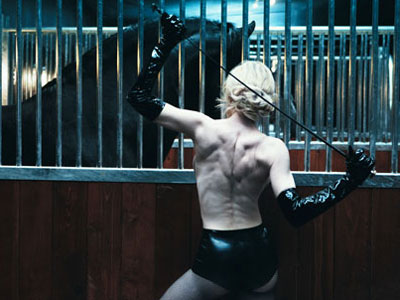
(The photo above is a shot of Madonna that Galen pointed out looks just like Iggy Pop. They’re both kind of undead.)