Toothcase

I went to the Surgeon’s Hall in Edinburgh, which is the original home of the Royal College of Surgeons. These days it contains three creepy museums on the history of surgery, pathology, and dentistry. It gave me lots of ideas relating to my indie thesis, but more on that later.

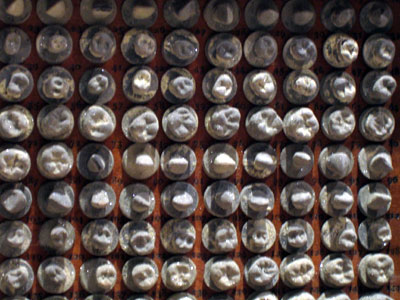
Rubber tooth forms, from the Museum of Dentistry in Edinburgh

Right now, teeth! The Museum of Dentistry was all about collections of things. Sets of antique drill bits, sets of ornate knives, sets of tooth brushes, sets of teeth. I’ve always liked collections of many objects that are similar but not exactly the same.

I remember at the Mendel Museum of Genetics in the Czech Republic, they had all these framed collections showing different phenotypes— 64 similar leaves arranged in a matrix, 25 drawings of similar feathers, 4 types of pea plants in square garden plots. I almost had a seizure, from glee.
Rubber tooth forms, from the Museum of Dentistry in Edinburgh

I don’t know exactly why I enjoy similar sets so much, but I suspect you’ll just know what I mean. Similar-but-not-the-same objects are so common in nature, and so commonly considered beautiful, that there are whole design books on the topic. (My favourite discussion is in Christopher Alexander’s The Timeless Way of Building. Repetition with variation was a big part of his rationale for pattern languages.)
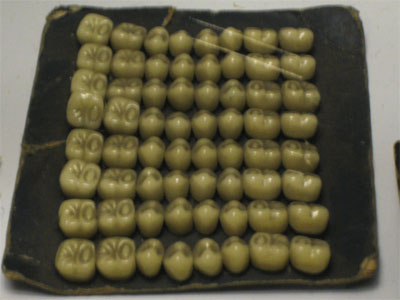
A set of teeth, from the Museum of Dentistry in Edinburgh

So these dentistry sets would have made my day no matter what, but the teeth were off the scale. I had never thought about it, but a mouthful of teeth is a similar-but-not-the-same set to start with, and then setting up grids of multiple mouthfuls in different sizes… my mind reels.
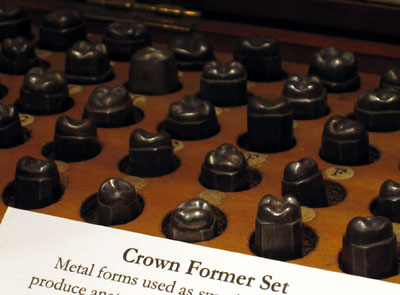
Crown former set, from the Museum of Dentistry in Edinburgh

Furthermore, some of these tooth sets— which were blanks meant for casting false teeth— were arranged in cases. They were a lot like type cases— if I had a tooth case I would definitely keep the top teeth in the upper case and the bottom teeth in the lower case, like letters in a printing font. Thinking about uppercase and lowercase teeth has multiplied my affection for my mouth, because now it is not just a mouth but a printing press for bite marks.
Snacks: a last holdout against globalization

I just spent two weeks in Scotland and England with my mum. It was lots of fun, but I was a little disappointed in how similar everything was to home.

When I was in Europe in 2003, the fashion was so far ahead I could only point and laugh, and there were always some obvious local specialties. In Holland, every pub had Heineken and Grolsch on tap, as you’d expect. Bars in Granada served free tapas with every drink; bars in Barcelona didn’t.

On this trip, we had to hunt and hunt to find anything we couldn’t get in Vancouver. There were more people dressed fashionably, but the frontiers of fashion were set in approximately the same places as they are here.

I made my mum take a highway exit twice so that I could get another fleeting glimpse of some highland cattle, because they were so hard to find. Despite spotting millions of sheep in the countryside, we were hard pressed to find any non-tourist shops selling local woolens. Do Scottish people ignore their huge wool harvest, or do they just wear the dumb tourist sweaters? It was frustrating.

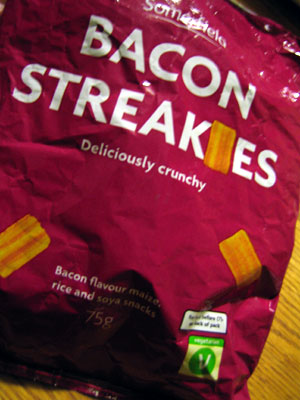
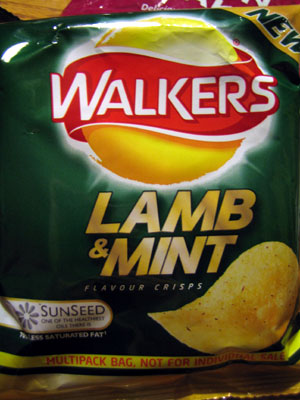
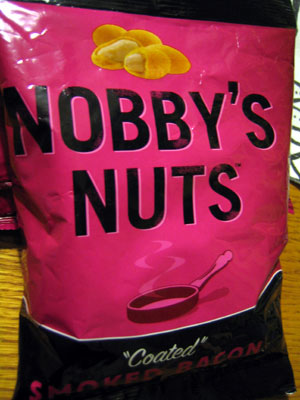
Right after my mum and I had been sort of lamenting that globalization had made travel more boring, we stopped to buy some snacks for the trip to the next place. I remembered all the weird chips and candy I’d hoarded in Eastern Europe, and made a trip down the “crisps and biscuits” aisle.

Gold!

Walker's Lamb and Mint Flavour Crisps

Nobby's Nuts

The green V logo in the corner of the next one means “suitable for vegetarians.”

Bacon Streakies

Besides the snack differences, the UK might be the world headquarters for design that uses an object to replace a letter in its own name. Every mention of Italy used the boot for the L; every fish shop’s name was spelled with a fish… every package of bacon streakies had a little bacon streaky for an I. So there’s that.

Paging… a doctor… of some kind…

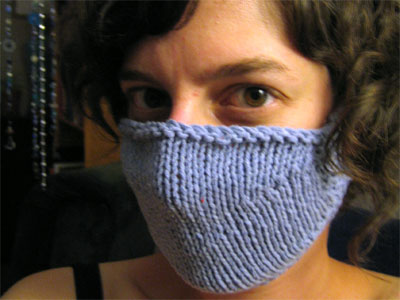
Knitted doctor mask

I’ve been trying to figure out who to name this knitted doctor mask after. It seems like surely there is a doctor who presides over fashion with accidental political relevance, the way Dr. Freud presides over objects with accidental sexual inuendo. Perhaps I am confusing doctors with saints.

Galen, in a heroic effort to work with my vague doctor-related presentiments, suggested Dr. Lagerfeld as the patron doctor of fashion. That’s as far as I’ve gotten. No, he isn’t really a doctor.

Free knitting pattern: cozy doctor mask

The mask is worked in stockinette stitch with a narrow garter stitch border, with garter stitch ear straps attached afterwards. The mask has decreasing short rows to shape the chin, and increasing short rows to shape the nose. It’s surprisingly warm and cozy to wear!

  • Gauge: 4.25 sts and 6 rows per inch
  • Needles: 4.5mm (or size to obtain gauge)
  • Yarn: under 25g of worsted weight
  • Size: adult (one size)
Pattern

Row 1 (RS): sl 1, P2, K to last 3 sts, P3.
Row 2 (WS): sl 1, P to end.

These two rows make up the pattern (stockinette bordered by a 3-stitch garter border).

Main mask

Beginning at bottom edge, CO 30 sts.
Row 1 (RS): sl 1 knitwise, P to end.
Row 2 (begin short row shaping): sl 1 knitwise, P to last 3 sts, wrap and turn.
Row 3: K to last 3 sts, wrap and turn.
Row 4: P to last 4 sts, wrap and turn.
Row 5: K to last 4 sts, wrap and turn.
Continue in this fashion until you have wrapped a total of 5 sts on each side.
Row 12: P across (working wraps together with sts).
Row 13 (RS): work in pattern, working wraps together with sts.
Continue working in pattern for 12 more rows, except m1 inside each border on rows 15 and 23
Row 26 (WS): sl 1, P to last 7 sts, wrap and turn.
Row 27: K to last 7 sts, wrap and turn.
Row 28: P to previous wrap, P wrap together with st, wrap and turn.
Row 29: K to previous wrap, K wrap together with st, wrap and turn.
Continue in this fashion (keeping in pattern), until you have wrapped 5 sts on each side (the last wraps will be on the 3rd sts from the edges).
Row 36 (WS): P across.
Row 37 (RS): sl 1, P across.
Row 38: sl 1, P across.
Row 39: BO all sts purlwise.

Straps

Pick up 3 sts at top of left edge of mask. Work in garter stitch until strap is long enough to fit around ear. BO all sts. Sew end of strap to bottom of left edge of mask.

Repeat on right side of mask.

Finishing

Weave in ends.

Tips and notes

The mask is pretty warm, and I think it would be a great alternative to a scarf. A face-warmer, rather than a neck-warmer. The obvious accessory would be matching gloves (ready for surgery!).

I can’t stop obsessing about the timeliness of a mask. It’s a disguise, in an era of paranoia about privacy and spying. It’s a gag, in an era of paranoia about censorship and secrecy. It’s a veil— one level more retro than burlesque. It’s kitschy like ninjas or pirates. It’s a surrogate beard for the ladies, since hipster facial hair doesn’t seem to be going away.

Three favourite recent masks:

Justin Timberlake in a bandit mask

Harajuku cosplayer on Flickr

Santos hoodie by Anticon

My head is full of plans for masks made of lace, eyelets, stripes, and checkers. Or tweed, for business situations.

Compassion for freaks who buy the t-shirt

I just finished reading Douglas Rushkoff’s old book, Playing The Future, about how people are adapting to the digital age and how it isn’t the end of the world (I gave it 3/5 on Amazon). He points out the conflict between rebel attitudes in subcultures like skateboarding and snowboarding (the book came out in 1996) and the masses of commercial logos and general expense of those sports. Buying commercial products to display your outsider status.

I have noted this commercialism in a lot of subcultures that for me are about DIY or revolutionary acts— geeks buy gadgets, crafters buy stash, sex activists buy toys, environmentalists buy organic, hipsters buy everything, even vagina-body-image nerds have products they promote.

This sometimes gets me down. What is wrong with people that they can’t rise above shopping? Two little quotes that I’ve been saving up are helping me appreciate rebel shoppers.

If your popular revolution demands that its adherents eschew popular culture it’s not going to be very popular.

Cory Doctorow in conversation with RU Sirius

The fallacy is to think that social networks are just made up of people. They’re not; social networks consist of people who are connected by a shared object.

Jyri Engeström on ‘object-centred sociality’, after Karin Knorr Cetina

To me, activities and ideas can be excellent objects to share with friends, but it is starting to make sense that people are eager for more and more stuff to share with their outsider pals. Why just knit together when you can fetishize handspun yarn as well? Maybe sometimes that’s just friendly, not so much evidence of weird addiction.

Further evidence that I’m not really in a target demographic for normal businesses


Name shack

Last night at a screening of short films, I was being introduced to a new guy who kept claiming bad hearing and getting everyone’s name wrong.

(1) This would be a good gimmick for business men who obsess about remembering everyone’s name. You’d have an excuse to repeat the names a lot, plus you could “jokingly” get them wrong and everyone would find you charming. (2) This guy’s misheard names were way better than our normal names (Sarah = Sierra. Jessica = Destiny. Galen = Hayden. We are instantly teen idols or brands of vodka!).

I think he should go into business in some way. Maybe you could call him up and tell him your ideas for naming your pets or the characters in your new novel, and he could just repeat them back to you through his auditory filter of awesomeness. Maybe he could deliver some sort of televised oral history newscast.

Surprise! Hope you’re more vain than paranoid!

Two nights ago, I was talking about web design rates with my friend Michael, who is making a site for a private detective. His ladyfriend Erin suggested he just trade services, and then we were all sort of hoping to be the subject of Michael’s bartered private investigation, just so we could get some weird surveillance photos of ourselves. And now I think that should be a business of its own: just the surveillance photos.

Real detectives probably don’t take big, black and white glossies anymore (nope), but my non-investigative, non-incriminating surveillance photography service sure would. And we’d make a special effort to get shots of the subject holding up her collar against the wind while stepping into a taxi, laughing in a restaurant with an unseen dinner companion, or generally looking over his shoulder all the time. If surveillance is going to be biased and weird, it might as well be biased towards glamour and intrigue.

I can’t stop thinking about what a great (weird, confusing) birthday present that would be for an unsuspecting friend. “It’s… is this a threat?”

Internet wish: find likely pornographic typos

Any page offering advice on choosing a domain name will insist you consider common typos and misunderstandings. No need to end up the latest sexchange URL (lawyersexchange.com, editorsexchange.com…). And nobody wants to end up a typo away from hardcore porn. Especially if your website features Christian hymns.

So why can’t I find a tool to check these things?

I just got an email from a web design client (who really does make Christian hymns) saying that one of their customers had accidentally found porn while trying to type in their website address. “They probably just made a typo.”

But darned if I can figure out where this typo porn actually is. None of my misspelled attempts are registered domains, and I can’t find a tool that suggests similarly spelled URLs that exist.

There are lots of tools to find websites with similar content, but none to find websites with similar addresses. This second tool is what I wish for.

Compassion for teenagers

I get the Baby Fever off and on, and I usually try to remember that babies don’t stay babies, and that if I want to spawn I’ll have to learn to love a teenager. The hormonal creepiness, the narcissism, the volume levels. I’ve actually been practising this, more because I like new skills than because I am laying away emotional supplies for a baby event. I am like a bird-watcher, for teenagers, except I don’t follow them to their nests or anything.

My favourite teenager thing right now is watching little groups of 14 year old girls out on their own. Physically, they are hilarious— even in groups of eight or nine kids, you only get one of each kind. Small and skinny, big and moosey, tall and gangly, eerily voluptuous: nobody has caught up to anybody else by 14, and nobody understands her own hair. I call these groups Variety Packs.

I’ve come to realize that an easy way to love teenagers is to basically laugh about how ridiculous they are. It’s about camp: “Oh, they’re so terrible— I love them!” I’m working on finding a less condescending way to appreciate pupating humans, but for now, the I’m so bershon Flickr pool is feeding my addiction.

Three indie thesis tips, while I get organized

I’ve talked to about four people since I declared ““thesis on!”:/2006/08/10/i-call-it-an-indie-thesis” and already I’m overwhelmed by notes. I’ve got this grand plan involving a wiki, but while I get the squirrels up to speed, here are three solid tips that have immediately become apparent.

3 tips for learning to write a thesis without going to school

  1. People love to talk about their own education. Sir Ken Robinson’s excellent, funny presentation about education from TED 2006 covers this, and so far it’s my experience as well. My friend Towagh just gave me about three hours worth of explanations and advice about Masters work, starting from “OK, a thesis… what’s that?” (Thanks, Towagh!)
  2. If you are going to have a three hour meeting over coffee, pick somewhere with a convenient restroom.
  3. A tip from Towagh that strikes me as hilarious: if you want to talk to a professor, even an imposing, famous professor, call up their Department and ask for their office hours. Do many non-students sneak into office hours? I’m a little suspicious that I should keep this tip under my hat, that I might encourage the one yahoo who will abuse Office Hours and ruin it for all of us. (You know, all of us who want to talk to professors about critical problems without enrolling in school.) It will be a sad day, when office hours have some type of warning sticker attached.

Got any thesis tips of your own? I’d love your comments. (And I should mention: I’d love them even if you’re from the future, and you’re reading this in 2012 and you presume the conversation is dead. I’m posting here while the site is still semi-secret, so don’t feel like a latecomer.)

The best thesis since Xena

I helped my granny pick her peach tree on the weekend, so I took the opportunity to explain my new thesis project to her and ask for her input about mortality and dying.

She’s 86; she grew up on a farm; she’s had her funeral and burial plans pre-paid for years; she tells a story about her experience speaking with the spirit of her recently deceased sister; and we often have conversations about my grandpa’s advanced Alzheimer’s dementia and the merits of burning out versus fading away (elder nursing home version). I thought she’d have lots to contribute.

The first thing out of her mouth?

“Oh darling, there’s a book I’ll have to give you when I’m finished. It’s about one of those… those men who never die? (Well he could die in a fight, but not of old age.) And he’s supposed to hunt evil? It goes back centuries. Just centuries.”

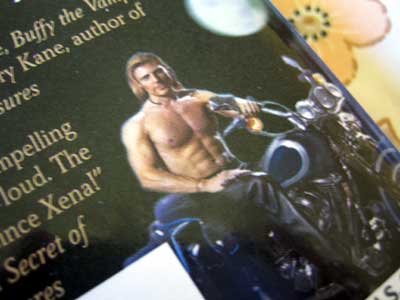
(The name she’s looking for is Dark Hunter, and he surely owes his existence to Boris Vallejo.)

Dark Hunter novel cover

I know that I need to start narrowing my topic as soon as possible— at the moment I’m reminded of my aunt’s high school independent research project on the entire history of ancient China— but for now, while I scope out the lay of the land, it’s pretty cool to just ask everyone I know if they have any tips or resources about dying, to see all the different angles that pop up. I would not have thought to examine sexualized immortality in post Buffy pulp fiction if granny hadn’t suggested it.

A start: normal dying processes

I’ve heard a lot of stories of dying people needing to get a good sleep before they have enough energy to die, or of dying at contrived times like right before an annoying doctor is due to show up, or right after seeing a new baby relative.

I’m sure a lot of those stories are coincidence, but I’m intrigued by the idea that dying is an action the body takes, rather than an event that just happens when the body fails. Zoe pointed out the other day that many people think of death as a failure of medicine, rather than as a normal event in everyone’s life. To me, thinking of death as an active, biological process makes it seem more like a normal function (which I’m interested in, for now).

This morning I’ve been hunting for information about the normal dying process, and how it varies, and whether there are conflicting models for “normal” death responses the way I’m familiar with different, biased models of sexual response from working on my vagina website (and indeed, Kubler-Ross’ stages of grief seem to draw similar controversy to Masters and Johnson’s model of the human sexual response cycle).

Zen Hospice has a great overview of the physical changes a person goes through as they die, from a hospice perspective. I recognize all of those symptoms from the few people I’ve known at the end of their lives. I can see immediately why there are so many comparisons between giving birth, having orgasms, and dying: all involve extreme physical responses that start to seem normal when you know what to expect. Learning about the physical symptoms of dying feels a little like getting to know the birds in your neighbourhood or something: gaining context.

Graceful Exits:How Great Beings Die apparently deals with conscious dying and dying on purpose, such as the idea of elders wandering off alone into the woods to die. It sounds a bit flaky (i.e., possible use of ambiguous generalizations like “aboriginal cultures”), but still really compelling to me. I’m all for special skills, and this intro sort of makes dying sound like a superpower:

Then the person is left alone. He or she sits down, and within a matter of minutes is able to intentionally close down the body and die.

That would be both more and less useful than being able to cry on command.

But, from my scattered reading this morning, I gather that I should do some searching for literature about “deathing” and “timing of death” rather than the process of dying. It’s a bit weird that “dying” gets used more as adjective than as a form of the verb “to die.” When a person “dies” that describes the moment of death fairly precisely, but when a person “is dying” that could refer to almost any stage of life or illness or injury.

This is the kind of jargon I should figure out soon— it’s hard to organize notes when you don’t know the names for things (and stuff).

Ready the moisturizer

This sensory-deprivation floating tank sounds like something I could make at home, using my accidental stockpile of Epsom salts. (I tend to buy supplies, then come home and discover I’ve already bought some. Ask Galen about the quantities of cornmeal we amass before I remember to make polenta.)

Why have I never thought to make a super-floaty bath? Saturating a bath with 10 pounds of Epsom salts would be a good way to use up that part of my craft stash.

Having made several small projects without putting a noticeable dent in the stash, I’m remembering that my original intention with the stash manifesto was to make huge craft projects. Things you can only accomplish with ten pounds of origami paper, not small things here and there. Floating tank, several pints of Epsom salts… I think it counts.

Research on defanging

I’m a little bit fascinated with the idea of going over to hipsters’ houses when they aren’t around, and rifling through their pop culture possessions.

It seems like if you read all a hipster’s books, watched all her movies, listened to all her music, played with all her toys, and looked at all her web bookmarks, she’d have no way to show off her cultivated taste and connections. I think of this as a defanging. “I’m not much for using media consumption for cool points” is how I characterized this fascination over on MOG.

I haven’t quite gotten to the bottom of this defanging fantasy yet, but this CPU post about creating The Nod has at least given me a solid idea about a website I could make to express my troubles.

Sit in a cafe with a Mac PowerBook, and chances are you’ll get The Nod… Display GNOME on your ThinkPad and you’ll get The Nod. But run Windows on your Dell and you won’t.

Why do some things get The Nod but not others? And isn’t it really the user that gets The Nod, and not the product?…

The Nod is a way for one user to tell another:

“We’re smarter.”

Or

“We’re risk-takers.”

Or

“We’re more indie.”

Or

“We’ve been at this from the beginning (unlike these clueless newbies).”

Or…

Gross! I do love that this article was written for marketers, and I think that’s what unlocked my articulation on this issue. It sounds catty and obvious to declare that it’s shallow and maybe vain to use commercial products to proove your identity, but somehow hearing marketers make up catchphrases about it (“The Nod”?) gives me the necessary boost up onto my high horse.

So this defanging website, to express my troubles. I tried out several previous possibilities on Galen, but they all seemed doomed to hypocrisy.

My latest version is this: it would be fun to interview people about what they like to do and how they spend their time, and simply refuse to print any anecdote containing a brand name, a catchphrase, a club affiliation, or the like. Basically anything you could get A Nod about would be blanked out. Maybe even retroactively, if something you mentioned was easily imitated and sparked a trend. It could be sort of a Last Person Standing competition in inimitability.

It ties a little into this quote I read in the beginning of an Ansel Adams photography textbook. I think it was originally about Mozart, and it said something to the effect that “It’s no great accomplishment to be the first to do something. What we should aim for is to be the last; to do something so extraordinary that it can never be repeated.”

Namin’ names

  • Someday, maybe I will start a sysadmin dance band called Deee-link.
  • I hope someone starts selling eels or eggs online, before it becomes completely gauche to add ‘e’ to the front of a word, to denote online commerce. eeggs.com would be pretty awesome, probably.

Jellyfish couture still ascending

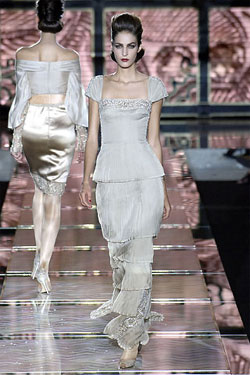
Jellyfish dress by Valentino

I bought some thrift store yarn in Sidney last weekend (three bags of matching nubby grey cotton), and it gave me fashion monkeybrain. I drew a lot of silly outfits in my notebook when we got home, mostly still in the vein of jellyfish couture.

There are two jellyfish garments in particular that I think really need to get made, after looking at the initial Fall 2006 runway photos on Style.com (which is something I apparently do now). The spirit of the times, it is a spirit of jellyfish!

First, I have some sheer, iridescent red fabric that used to be bed curtains, earmarked for a shoulder tutu. I’ve described this in my notebook as “like a big filmy donut made of gauze” and it sits around your shoulders like a huge shawl. (You know, a huge gauze donut that you wear…) It would be like a jellyfish body, around your shoulders (err, my shoulders), and would double as a sort of bizarro 1940s fur collar.

Secondly, the tentacle underskirt. This is something I keep threatening to knit, but which I should probably sew. It would be a long, slim skirt made of verticle ruffles, to turn your legs into jellyfish tentacles. You could wear a shorter, puffy skirt overtop. I see this as the logical evolution of letting a lacy slip show under your dress hem. Just a straight, obvious, rational line, really, the development of the jellyfish underskirt.

But check it: if you ignore the probable artistic “point” of several fashion collections, you can spot a lot of shoulder tutus , long ruffles and general jellyfishiness.

Also worth noting: I hope this Givenchy collection means that my fantasy of women with coiffed facial hair is finally ready for public consumption. If I could grow a beard, I’d style it so hard.

I should really go visit my old relatives

Last night Galen and I popped down to Pagliacci’s to pick up a pre-amp from Brooke, who was playing there. Pag’s jazz jam in full effect! It had been awhile since I’d been down for one of those nights. I think it was officially a Marc Atkinson show, but he was out of town, so the rest of the band asked Brooke to come play, and then various musicians came in off the street, and everyone on stage played several instruments so they all took turns switching. A pot pourri.

Of particular note, I finally got to hear Devon sing, and he is not kidding around about singing. I was having major grampa-convergence feelings watching him get settled on stage, though, because he was wearing the same kind of cuddly, old-man cardigan that my grampa always does, and this great plaid cap. Furthermore, Devon started out sitting in a chair on stage with no instrument and no microphone, no obvious reason for being there, just looking contented and watching the other guys play the intro.

My grampa does that kind of thing a lot, since his Alzheimer’s got noticeable. I’ve done a lot of sitting with the old guy, looking around and being contented. It made me think that my grampa should join a band. I think he’d be into it, as long as they played something old timey.

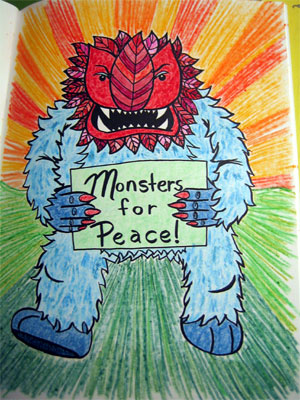
Color This Book

Galen got me a present in Anacortes. Best present ever! I didn’t know I would be so excited about an indie colouring book, but it’s really blowing my mind. This is the first time I’ve done any colouring since I’ve been obsessed with colour schemes and combinations. Playing with colour schemes is a lot more fun when you’re starting from a picture of say, a pensive rhinoceros writing its memoirs, or a knitting squirrel!

I just mailed this one to my parents (for the fridge). It’s red and blue, and coming to getcha.

Monsters for Peace colouring page

Mini me

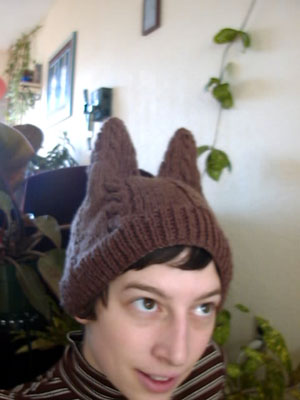
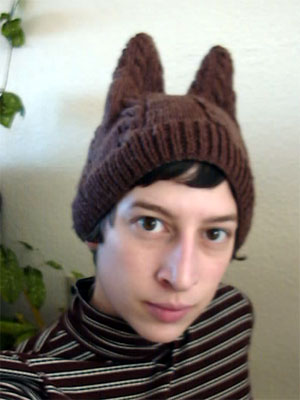
More photos from forgotten file directories. This is me, looking cute and androgynous in a bunny hat I knitted, in December 2002. I was 23. I look a lot younger— the soft (aka crap) focus probably helps. Everybody has baby skin in blurry photos.

I like this one, where I’m making a rabbit face.

Younger me, in a bunny hat

And this one, where I’m making a… stern rabbit face

Younger me, in a bunny hat

I taught myself to knit by inventing that hat, during a 40 hour bus ride to Winnipeg. I double-knit the ears on two straight needles, including the cables on the front and back. For any non-knitters reading this, that’s fucked up, that’s self-torture. When I think about how I learn, this is the project I think of: I don’t so much go for baby steps.

These photos are very funny to me— they might as well have been taken to document the dawn of the current era of me. I was about to be self-employed, living in the first apartment after deciding I only wanted to live in corner suites in Fairfield, addicted to knitting, and cultivating a potted jungle in my apartment. I stand by all those decisions! Way to go, stern bunny, for laying solid foundations.

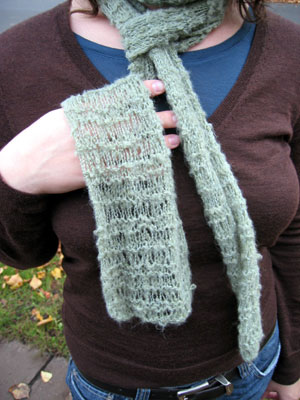
Mossy scarf (with free knitting pattern)

Mossy scarf

Yikes! This classically headless blogger-photo was clearly taken in the fall. Hopefully last fall and not years ago! I found it during an expedition into one of the dustier corners of my hard drive.

It’s a scarf I made from some thrift store yarn.

I tried a few different stitch patterns before settling on this. The pattern made me happy immediately and I still think it really suits the yarn. It reminds me of Old Man’s Beard lichen in a big way.

Dropstitch garter is the True Destiny of skinny, gray-green, wool boucle. Who knew?

If you can’t work out the pattern from the photo, it goes like this (very easy and straightforward).

Mossy scarf

Gauge, needles, etc: whatever, it’s a scarf. Aim on the loose side.

CO 20 (or more)
Rows 1 and 2: K to end.
Row 3: K, wrapping yarn twice. Drop extra wraps on next row.
Repeat these three rows until scarf is desired length.

One 50g ball made a very, very long scarf. I wear it folded in half, wrapped twice around my neck and it still hangs to my waist.

Mossy scarf

You’d yelp too

Euphorbia in bloom

I awoke to this. Giant flower buds have yet to disappoint!

Galen is away on tour, so I exclaimed several things out loud to no one. Fortunately, Marc dropped by to loan me a book on his way to work, so I got to share the special thrill of outlandish botany with another human.

Two neighbourly humans agree: it’s so hairy.

Euphorbia flower-- it's very hairy

My immediate thought was for the pollinator. What is supposed to rub its body on that flower? Marc surmised that the pollinator should be at least as hairy as the plant.

Hopefully the flower is hard at work summoning this creature, and later this afternoon I’ll find some variety of Ancient Beast knocking against the window screen, trying to achieve its hairy destiny.

Of course I needed an anarchist’s perspective

Why didn’t I think earlier to look for anarchist and class-struggle critiques of V for Vendetta? I came out of the theatre thinking that the movie, in which the politics are less extreme, made me appreciate the book’s take on anarchy and revolution all the more. The movie was a good foil for the book, in other words, besides being a fun movie.

This anarchist’s take on the movie covers lots of good ground, especially, I think, regarding modern anarchist ideas as something of a fairy tale— fitting for an action movie.

The comic, and to a lesser extent the film, are often viewed as anarchist. I would submit that they are “anarchist “ mostly because at the time of the writing, the anarchists had the most new, vibrant and semi-underground white subculture. … I think it’s mostly seen as anarchist because anarchist theory is so heavily mythological when it comes to revolution.

The general strike has historically been the mythical event that was most often cast to usher in the new world. Leaving the caveman fetishists aside (who, no, I don’t view as “real” anarchists), the critique of vanguardism and political manipulation has left anarchists, in a post-revolutionary union world, without a grounded theory of revolution. Paris ’68 suggested that students spraypainting walls, refusing to attend class, and fucking in the streets might be enough to disrupt the “Spectacle” and push people towards true awareness of their role in society of oppressed and oppressor. …

… Many anarchists and fellow travelers are so starved for positive signs that we mistake repackaged hipness as revolutionary art.

Mostly I like seeing him criticize the theory in the movie, while still obviously appreciating it as an entertaining movie. So balanced, so personable.

Off to read the further commentary linked from that post!