practicing talking about kenya, somewhat exhausted by it

  • i wondered how this part would be, coming home from a trip to kenya and having to talk to people about ‘africa’ and being a rich white tourist in kenya and so on. so far it is patchy and a bit exhausting, but i think i’m getting better.
  • first good talk with my mum about race and white privilege. finally enough tries.
  • i always need some practice to express things in a way people can understand. maybe because i spend so much time alone, and nonverbally? and hypertextually? i’ve really gotten to where i think in a big cloud of bits, not a focussed or linear way without effort.
  • a product of my thinking too much without talking… a lot of catching up to do on the talking front.

things that came up that i expected:

  • people generalizing about “africa” when i’m talking about specific places in kenya
  • people defining kenyan (and generalized african) societies as on a path of progress or evolution or civilization than ends up at a north american model
  • people much more willing to define or consider social problems in africa than problems at home
  • people defining the colonization process in canada as “more successful” than in kenya without considering that calling this successful defines genocide and occupation as a success strategy as long as it results in consumer luxuries.
  • people judging social and environmental problems in kenya and africa without considering their causes in western countries
  • when i try to process parts of my own privilege i’m uncomfortable with, decisions i would make differently now, i get back a lot of… like apologetic responses. ‘oh you did fine, how could you know any better? no one can do better anyway. that’s how things are.’ so many ways to silence a conversation.

Magical politics, a first attempt.

I’ve been hunting around for radical political magic. I ran into this pretty great book review by a druid, The Spells We Are Under, because it popped up somewhere under the site title “Healing Whiteness.”

[Van] Jones was astonished to find that the vast corporate structures against which he and many other progressives had been campaigning so hard— the WTO, the World Bank, and so on— were treated, by the people who run them, as mere tools to be used or tossed aside at will. The elite see themselves personally as the holders of power, and institutions as their means and modes of power. The activists outside the police barricades, by contrast, see the institutions themselves as the problem. The scene from “The Wizard of Oz” comes forcefully to mind; Dorothy and her friends try to figure out some way to deal with the terrifying apparition of Oz, the Great and Powerful, but never notice the little man behind the curtain.

Juxtaposed with:

Consider George Lakey’s fascinating account of the Otpor movement against Serbian dictator Slobodan Milosevic… One of the tactics Otpor members used to halt police violence against them was to take photos of their wounded and make sure the family members, neighbors, and children of the police got to see them. This was a brilliant bit of magic. The individual human beings who made up that reified abstraction, “the police,” were stripped of that identity by a spell of unnaming, and turned back into neighbors, husbands, children, parents: people who were part of civil society, and subject to its standards and social pressures. That couldn’t have been achieved if Otpor had reified and protested “police brutality,” since that act would have strengthened the reification of police as something other than ordinary members of society.

I know this idea from non-magical people too. (“Those big, powerful corporations have offices and CEOs with addresses.”) But I like having a name for this shift in perspective, and I think I like having a name that triggers dork associations about hobbits and +5 strength against goblins.

Embodiment and drifting.

Talking to Heather about embodiment, being in your body. She had an idea that maybe when teenagers are focussed on having sex even when it is pretty “rape-y” and risky and not beneficial or pleasurable, it has partly to do with their lack of other ways to feel their physicality and be in their bodies. No access to nature, nowhere to safely walk, not allowed to play outside unsupervised, even encouraged to eliminate or replace all body odours, etc. That’s a lot of pressure on sex for being physical.

It got me thinking about how I relate to the internet. I’m on here a LOT, in this disembodied place.

Anyway. I’ve been realizing that one of my big ways to be in my body for the last year or so has been looking at things. Sensing with my eyes, and sensing the reactions my body has to colours and shapes (and letters, boy howdy). When I got to go to the UK with my mum last fall, and we spent so much time in art galleries because it was rainy, that was the most physically altered I’ve felt since I stopped eating psychedelic drugs. High on modern art— physically dizzy and speedy and sometimes getting auras like before a migraine, from seeing enough art nouveau in one room to really experience and understand the concept of biomorphic whiplash. I made this website these colours because they do similar things to me— they are stimulating and encouraging and they make me want to write. I remember using music that way in the past. Galen would come home sometimes and be able to tell when I was working on something important, because I’d be blasting some or other personal power music. In high school— I just remembered this— I did a lot with smells. Other people’s sweaters, specific incense, open window when it rained.

*** where does fucking fit in?? ***

So, notably, none of this involves movement or muscles. It’s all sensing and processing and information. It’s physical to me, but it’s what a lot of people would identify as being in your head.

My forays into physical activity are marked by a lot of head time, too. Office bike— the exercise bike I can pedal while I make websites. Wing chun— if I have to punch and kick to learn which way shoulders bend and how momentum works, I guess that’s alright. Fucking— “erotics is the process through which sex acquires meaning.” I think I get bored, otherwise.

I’ve been casting around for some more physical motion in my life, to make me stronger.

I have high hopes for a bastardized version of this pretentious French art thing, the dérive, or drift. Walking to nowhere. OK. I do not like walking for the sake of walking, even though I love walking. Growing up, my parents were all about taking a walk, but not so much about negotiating where to walk or talking about what they feel like on the walks or whatever, so I have a lot of stored up experience being deeply bored with walks.

Walking to nowhere: ok. Just paying attention to see where you want to walk the most: ok. Also, paying attention to local geography and how it feels, that can go on forever. I think this could be useful in trying to figure out more of how I relate to being a settler on colonized land.

So yeah, I’m glad I’ve practiced walking by myself, home alone from various locations. I’m glad Victoria is a mostly non-threatening place for me to walk around.

“The imperative to renew and expand our observation skills.”

In a world where the quantity of secondary (mediated) observation and interpretation threatens to drown us, the imperative to renew and expand our observation skills (in all forms) is at least as important as the need to sift and make sense of the flood of mediated information. Improved skills of observation and thoughtful interaction are also more likely sources of creative solutions than brave conquests in new fields of specialised knowledge by the armies of science and technology.

The icon for this principle is a person as a tree, emphasising ourselves in nature and transformed by it.

— David Holmgren, co-originator of the permaculture concept, in Permaculture: Principles and Pathways Beyond Sustainability

tantra

Haircuts by children, my vanity.

Awkward stage.

Galen is getting his hair cut by a ten year old in a few weeks, as part of a performance about the segregation and disenfranchisement of children in society. An opportunity to trust the skill and style choices of a kid. I think this is a great idea for a performance and I’ve been telling a lot of people about it. (More explanation if you want it.)

I am not getting my hair cut. It turns out I am still terrified of bad hair cuts. I’m not terrified of no make up, belly rolls, showing cellulite in public, body hair, laundry day outfits, etc. But hair cuts, yes. I’m fascinated.

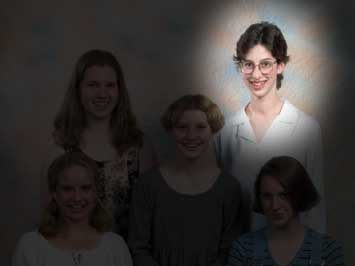
I had unflattering hair cuts that didn’t express my soul essence for about 13 years in a row, between my mum deciding I looked cute with a mushroom cut in grade 1, through a lot of small town $7 haircuts, through getting my friends to chop off my hair in grade 11 (somewhat better), through shaving it off in grade 12 (worse again), growing that out a bit (better again), and deciding to go to my grandmother’s hair stylist when I moved to Victoria. That was how much I knew about haircuts when I was 18. I thought the neighbourhood wash-n-set was the place to go for the punk rock haircut of my dreams. Granny’s stylist did alright as long as I kept it really short. It took me until I was about 20 to realize there were people who knew how to create a haircut on purpose, rather than just cutting to the approximate length and hoping for the best. My hair trauma is not helped by the coincidence that I was a giant nerd during pretty much the exact same time as the ugly haircuts. That photo shows me five minutes after having my hair cut and styled at some $10 Hair Hut type place at the mall in my hometown. It also shows me about 1 month into a three year stretch of on-and-off suicidal depression. COINCIDENCE? I’m joking about 50%. I could have used a hair mentor.

So. This haircuts by children performance may have cured me of my inner judgments about feminist environmentalists who won’t talk about reusable menstrual products. The shoe is on the other foot now. And even making that connection might help me sort out my hair terror. I had my share of menstrual shame and angst as a teenager. Maybe if I think about how I rearranged that, I’ll be able to rearrange my hair anxiety into something more in line with the rest of my values.

In the meantime I am telling a lot of people about these haircuts by children. So far I’ve prompted I think three people to set up appointments, one of them a stranger.

Why.

Keywords for me: BDSM, gender, cystic fibrosis, self-actualization, poetry.

The first time I watched this I got mesmerized and teary and couldn’t tell how much time had passed, especially during the list of hardware and tools.

Family names, Kurt Vonnegut, figuring shit out.

I’ve been considering the idea of giving all my kids different last names. Resurrecting various maiden names or something, picking them the way people often pick middle names out of their whole pool of known family names.

I think it is mainly being married that has me thinking about names and name systems. It’s easy to skip that whole “married name” business, but if you want to give your kid some kind of awesome, non-patriarchal name you actually have to come up with a plan. That gets complicated really fast, even in the common, surface solutions like hyphenating last names or using the mother’s family name in an attempt to go matrilineal (by passing on her dad’s name). All of those schemes run into the usual problems if there is a break from monogamy, if anybody leaves a relationship, breeds with more than one person, or dies. The “team name” gets broken all the time, even if you are trying to play along. Even just making up a new last name doesn’t solve the question of what the grandkids would be called.

Family structures and systems are fucking intense. Where do they all come from? Which ones are good? Research questions.

This multiple last name idea has been wildly unpopular with everyone I’ve mentioned it to. Intensely unpopular. Instant frowning. Worst idea ever. I still kind of like it. Galen and I already have different last names and we manage to be a family team. Maybe it would be good, if we had kids, to remember that they were individual people and not just “ours.” Maybe a team name is just a manifestation of compulsory/wishful monogamy and maybe we can do better than that. It scales well across multiple generations, unlike, say, hyphenation. I’m lucky enough to know a lot of my ancestral family names, and it seems like maybe reusing them would be a fairly robust way to remember your lineage if you moved or were displaced. Or maybe it would just make it impossible to find each other again.

Lacking a unified last name, maybe we could give our household its own name, to make it easy to refer to. That happens sometimes with places populated by roommates. (I’m thinking of places I’ve known called The Husbandry, The Folk Museum, The Queens Den, The Triple Crush Palace…). That doesn’t solve anything about family members who don’t live in the same home, but it’s a start.

This is unresolved. I just found an old booksale purchase called World Revolution and Family Patterns that I’m hoping might contain some inspiration. I also found a Kurt Vonnegut quote via Bex that I have filed away.

12. … Even when Vonnegut dared to propose a utopian scheme, it was a happily dysfunctional one. In Slapstick, Wilbur Swain wins the presidency with a scheme to eliminate loneliness by issuing people complicated middle names (he becomes Wilbur Daffodil-11 Swain) which make them part of new extended families. He advises people to tell new relatives they hate, or members of other families asking for help: “Why don’t you take a flying fuck at a rolling doughnut? Why don’t you take a flying fuck at the mooooooooooooon?” Of course, this fails to prevent plagues, the breakdown of his government, and civil wars later in the story.

Complicated middle names: noted.

Good spells, burning buildings, Alan Moore, Leslie Feinberg.

Alan Moore

I ingested a lot of Alan Moore media when The Watchmen movie came out this month, and I really loved his take on magic (in the sense of spells and incantations, not card tricks) in a interview with Stewart Lee. The magic topic starts at about 5:30 of part three. (Part 1, and part 2 if you want them.)

I suppose the thing with magic is that a lot of it is about writing anyway. “To cast a spell.” That’s a fancy way of saying spelling. Grimoire, the big book of magical secrets. That’s a French way of saying ‘grammar.’ It’s all about language and writing. It’s all about incantation. It’s all about all these things. And so magic, really, it turns out to just be a continuation of the stuff I’ve been doing anyway. Using certain arrangements of words or images to affect people’s consciousness.

I decided to keep that for my multi-year quest about how to communicate. Magick and neo-paganism is a minefield of gender terrorism and cultural appropriation, a bring your own analysis situation. But still, folks who are into magical spells do have a lot of ideas and practice related to speaking intentionally.

After keeping it on my (giant) reading list for years, I finally read Stone Butch Blues recently, and I saved this quote about semi-applicable resources.

I felt as though I was rushing into a burning building to rescue the ideas I needed in my own life.

It’s been a pretty good spell so far— I say it a lot when I’m getting inspired by a book that has a lot of problems and maybe embarrasses or enrages me. It’s good for books written by druids.

“Because love always causes a descent into the Death nature…”

These are quotes from Women Who Run With The Wolves that have been sitting here with no context, unpublished, since February 2009. I think I was interested in talking about love beyond infatuation, love as an action or alliance instead of a feeling. I still am.

I haven’t posted anything here, or done much writing at all, for many months. Spitting out some old drafts seems like a good re-entry. I seem to do this every now and then. Maybe I can promote it as a personal feature instead of a bug.

Anyway. Old quotes.

A part of every [person] resists knowing that in all love relationships Death must have her share. We pretend we can love without our illusions about love dying, pretend we can go on without our superficial expectations dying, pretend we can progress and that our favorite flushes and rushes will never die. But in love, psychically, everything becomes picked apart….

What dies? Illusion dies, expectations die, greed for having it all, for wanting all to be beautiful only, all this dies. Because love always causes a descent into Death nature, we can see why it takes abundant self-power and soulfulness to make that commitment.

More…

In wise stories, love is seldom a romantic tryst between two lovers. For instance, some stories from the circumpolar regions describe the union of two beings whose strength together enables one or both to enter into communication with the soul world and to participate in fate as a dance with life and death.

And more.

It is true that within a single love relationship there are many endings. Yet, somehow and somewhere in the delicate layers of the being that is created when two people love one another, there is both a heart and breath. While one side of the heart empties, the other fills. When one breath runs out, another begins.

Plant dyes, having a smell, odourlessness in general.


Lump indigo (blue)
Old recipe from Outer Hebrides

Boil wool with onion skins till clear yellow, then let wool dry. Have an old pail filled with urine at least two weeks old, or until skin forms on top… Put lump indigo in a muslin bag, heat the “bree” by placing a hot stone in it. Squeeze in the blue bag. Wet the wool and place in the liquid. Cover the vessel and place where it will keep warm… For navy blue, 11 to 21 days are required. Fix with boiled sorrel roots as rinsing water.

— Dye Plants and Dyeing, Brooklyn Botanic Garden Record, 1964.

Books about natural dyeing have a lot of lore I hadn’t foreseen. So many smells! Boiling weird fungi, soaking fiber with onions (“It will take at least four washings to eliminate the odour”), fermenting urine. One book detailed an argument between the author and her editor about whether traditional Harris tweed, dyed with lichens, smelled “musty” or, less judgmentally, “earthy.” I had no idea that tweed used to have a smell. I am fascinated by this, and want to dye all my clothes with different plants to get to know the smells.

Why don’t I expect my clean clothes to have a smell? Not a laundry scent, but a part of their nature. I can remember talking about the smell of my clothes like a normal thing, all the time. Wool sweaters smell sheepy if I get wet in the rain. A couple of weeks ago I told someone (who?) that I liked the smell of raw silk, because I was knitting with a silk blend yarn. I can recall the scent of cotton in my mind’s nose: wet, dry, or hot. Why did I still think of clothes as odourless?

Heather wrote once (or maybe we spoke) about why people are so obsessed with genital odours. Do they smell right? Do they smell too strong? How to keep the smells in control? She suggested that this was partly because we have come to expect the entire rest of our bodies to have no odours at all. Healthy hair, feet, armpits, mouths, and skin in general all have smells, too, but between washing and deodorizing they’ve been redefined as ideally odourless. It’s total fantasy, bodies still smell, but we expect odourlessness. (Like my clothes!) Compared to that, genitals are almost getting smellier by contrast.

Thinking about the more familiar politics of body odours makes me even more interested in knowing what smells are required to make the colours in my clothes. These plant dyes seem like an opportunity to make experiential connections, to know things by observation. To have know what clothes smell like and why, instead of not knowing what shocking petrochemical smells are happening at distant textile factories. It feels grounding. Educating my mind’s nose. I have some pondering to do, regarding wood smoke and other smells that have been banished from modern, civilized, classy life.

I think I will start slow, though, with tea and lavender dyes. Fermenting a bucket of my own urine is going on the “someday I will peek behind this curtain” list along with attending a pig or goat slaughter. Someday.

Movies I watched in June 2009.

I was going to quit making movie lists this month, but I keep them for myself on paper anyway. As long as I post other things too, I don’t mind them being on here.

Movies that passed the Bechdel Test

  • Star Trek (Barely. One chat between roommates.)
  • Away We Go (Lots of varied conversations. This movie was… fine.)

Movies that failed

  • The Neverending Story (Does someone have a movie test where two guys cry about each others’ feelings in a movie? This would pass that.)
  • The Hit
  • Wrath of Khan (Makes a perfect double feature with the new Star Trek.)

Titles in bold are things I’m especially glad I watched.

Unyeasted bread, quests.


Unyeasted breads have a deep, hearty, honest spirit with a certain substantial integrity. Dense and thick-crusted, they require a good bread knife for cutting and a certain endurance for chewing…

No matter how much I mentioned the dense, “bricklike” nature of some of these breads, still I received many letters from people wondering why the bread came out of the oven like a piece of building material. O.K., they are not to everyone’s taste, but some people really like this sort of thing: “How real,” they say, “How flavorful.”

— Edward Espe Brown in The Tassajara Bread Book, 25th Anniversary Edition

I’ve been finding a lot of inspiration in a particular kind of far-out food book. Not dietary inspiration; something like philosophical inspiration. Emotional inspiration? Attitude inspiration. The connecting thread seems to be authors who used to practice more extreme diets. Former vegans, former macrobiotics, former hippies. Some of these books have consistent ways of respecting radicalisms and moderations at the same time, finding another level of inclusion where you get the thorough, grounded ethics of radical thought without the isolating righteousness. I find myself re-reading bits of non-content like the introduction to a recipe, just for the tone or the attitude.

Does that Bread Book passage do any of that for anybody else? I know I’m reading the way I need to read.

This is helping me rename a personal communication quest that I’ve been naming and renaming for, I don’t know, fifteen years? My teenaged fixation was how to be honest and also nice (both in the sense of liked and in the sense of kind). Later it was how to have a critical analysis without alienating people who don’t. How to be compassionate without self-censorship. How to make space for differences without them being cast as disagreements or negativity. How to maintain boundaries without being judgmental. Consideration without passivity. Empathy without enabling. Belonging without conformity. How to make connections across differences. All of these draft mission statements have been discarded or modified, but I’m getting somewhere. I want to joke that it wouldn’t be hard to be both more honest and more kind than teenaged me, but that isn’t true. It has been hard!

Flipping through a chapter called Vegetarian Ethics and Humane Meat that kept me up late last night, I have totally failed to find a quotable section. I started just collecting words. “Much depends,” “life and death and life,” appreciation, reflection, mistakes, “not so easy,” “Plan B,” courage, “emotionally spent,” responsibility, “more directly involved,” experiments, clumsy, “I’m very curious,” “our memories diverge… isn’t memory funny?” Vocabulary for a big, thoughtful mess.

Who said that keeping up with fashion is the ultimate way to create anxiety? Connecting people in a big mess seems like the opposite to that. Seeking ways for many fashions to co-exist together is comforting and useful. So I guess that’s the communication quest for now. It must seem like this is too abstract to possibly be useful in my real life, but I bet I will refer to this in the next 24 hours, trying to explain a decision or action to someone. “It’s like the unyeasted bread! I know how to do this!”

Movies I watched in May 2009


Movies that passed the Bechdel Test

  1. Beyond the Mat (WWF wrestler Chyna goes shopping with her friend. That barely counts but I’m partial to weird shopping scenes.)
  2. The Celebration (Lots of little chats.)
  3. Pan’s Labyrinth (Again, lots of conversations.)
  4. Terminator (A few small chats.)
  5. Terminator 3 (Feminine Terminator steals a woman’s stuff… Can I put only the car chase in bold?)
  6. Doctor Who: Carnival of Monsters (The Doctor’s sidekick tries to enlighten a woman who is stuck in a timeloop.)
  7. The Pee Wee Herman Show (Miss Yvonne and Hermit Hattie talk about make up.)
  8. Big Top Pee Wee (This one is probably for fans only.)

Movies that failed.

  1. A Scanner Darkly (My rational mind rates this movie as only medium-good, but some other part of me has a lot of affection for it. The sad ending. The perfect Philip K. Dick moment when Keanu is told to put himself under extra surveillance. It has a purity.)
  2. Jean Claude Van Damme
  3. Bloodsport (Probably would not have been fun without watching JCVD.)
  4. The Godfather
  5. The Godfather Part 2
  6. Terminator 2
  7. Terminator 4
  8. The Dark Knight (I’m fascinated that I find this movie so satisfying and so fascist at the same time.)

Bold means I’m glad I watched it.

This month’s lists are evidence that my neighbours Casey and Jessica are fond of renting entire series of Hollywood movies. I have also watched with them: all the Die Hard movies, all the Rambo movies, Alien and Predator in preparation for Alien vs. Predator, and probably more.

The fact that I go along for these action movie marathons could probably go in the same category as the facts that I only like to watch sports when international championships are broadcast at 4 in the morning, and that if I don’t see the midnight premier of questionable superhero movies I probably will never watch them. Bland content is a good foil for intense viewing contexts.

A funny moment in science violence.


The impassioned claim that there exists an unemotional, value-free scientific method (or context of justification) may be interpreted as an emotional rejection and repudiation of the feminine and, if this is so, it would mean that scientific practice carried out (supposedly) in an “objective,” value-free, unemotional way is in fact deeply and emotionally repressive of the feminine.

— Brian Easley, “Patriarchy, Scientists, and Nuclear Warriors”

Galen forwarded me a reading for his feminist men’s discussion group and I laughed out loud at this part. The rest is here: Patriarchy, Scientists and Nuclear Warriors, by Brian Easlea.

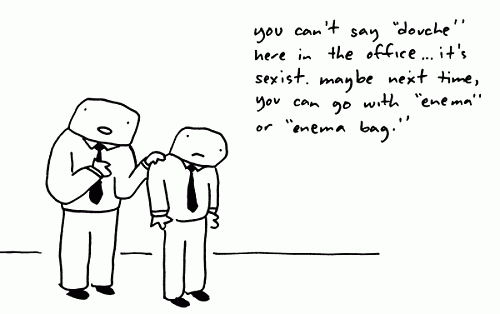
Cussing towards equality: douche vs. enema

douche enema office, from Toothpaste for Dinner

Surprisingly / not surprisingly, I have thought a lot about the value of “douche” as a politically correct cuss word. I’ve adopted it as my all-purpose, positive family values cussing option. My take is that douches are maligned for feminist and body-positive reasons. Douches are marketed to clean vaginas that are already self-cleaning, and the unnecessary douches can cause microflora imbalances and infections. Douches are terrible, urban legend birth control that can actually increase the chances of conceiving. Douches: body hating, body damaging, anti-choice, agents of unnecessary consumption. And fun to say. Doooosh.

Meanwhile, almost every other cuss word is maligned for some body-hating, bigoted reason. Genitals, bodily fluids, sexual activities… I love all those things. I need a bigger pallette of loving cusses before I can give up the fun sounds of fuck, shit, tits, ass, cock, sucking, blowing, and company, but it’s good to have a start.

Other takes on douche as a swear? Seeing it paired up with enemas is actually giving me pause. I’m thinking the only reason enemas get a bad rap is because of taboos about buttholes, and related taboos about gay sex and maybe enema sex play. I’m pretty much pro-butthole on all those issues. So then I wonder if I should be considering the sex play possibilities of douches, and any douche fetish communities I might be further marginalizing. The problem: everything can be used for sex play. That criteria would eliminate every possible PC swear word. I’m sticking with douche for now, but I’d love to hear from anyone offended by that.

Homemade deodorant, a straight-up re-link.

Do us a favor stinky, by Natalie Dee.

Every time I mention that I use homemade deodorant, I realize that I’ve never actually linked to the awesome internet recipe that I use.

So here it is, Angry Chicken’s homemade deodorant recipe, styled after Lush’s Aromacreme natural deodorant but less likely to cause a rash. This is the only deodorant recipe I’ve ever tried, and I’ve been using it happily for about a year. It’s cheap and it works and it gives me a better vibe than the “you stink” industry.

Our personal household version is a little simpler, like so:

5 Tablespoons shea butter
3 Tablespoons baking soda
2 Tablespoons corn starch
Essential Oil (ylang ylang, rosewood, nutmeg and cinnamon)

Melt, stir, pour into container(s), cool. Store extra in the fridge.

Dot in the Dreamy Garden

In her golden years, my mom suffers from Dementia with Lewy Bodies (think Parkinson’s + Alzheimer’s).

Here we are in the garden. She’s calling me Jim (my father’s name) and thinking she’s having a dream…

I expected this video to make me sad, but I felt happy watching it. I spent a lot of afternoons sitting in gardens with my grandpa in his advancing dementia, and our interactions were often like this. Me guessing what would help him or soothe him, just sitting and telling each other we loved each other with words and pats and hand squeezes. My trying to understand his observations but not really getting it; him trying to understand my observations but not really getting it; both of us trying to be ok with that. I’m happy that sometimes when communication breaks down, it can break down into just inarticulate love.

And I just posted about putting ugly things in context to make them beautiful.