Compassion for freaks who buy the t-shirt

I just finished reading Douglas Rushkoff’s old book, Playing The Future, about how people are adapting to the digital age and how it isn’t the end of the world (I gave it 3/5 on Amazon). He points out the conflict between rebel attitudes in subcultures like skateboarding and snowboarding (the book came out in 1996) and the masses of commercial logos and general expense of those sports. Buying commercial products to display your outsider status.

I have noted this commercialism in a lot of subcultures that for me are about DIY or revolutionary acts— geeks buy gadgets, crafters buy stash, sex activists buy toys, environmentalists buy organic, hipsters buy everything, even vagina-body-image nerds have products they promote.

This sometimes gets me down. What is wrong with people that they can’t rise above shopping? Two little quotes that I’ve been saving up are helping me appreciate rebel shoppers.

If your popular revolution demands that its adherents eschew popular culture it’s not going to be very popular.

Cory Doctorow in conversation with RU Sirius

The fallacy is to think that social networks are just made up of people. They’re not; social networks consist of people who are connected by a shared object.

Jyri Engeström on ‘object-centred sociality’, after Karin Knorr Cetina

To me, activities and ideas can be excellent objects to share with friends, but it is starting to make sense that people are eager for more and more stuff to share with their outsider pals. Why just knit together when you can fetishize handspun yarn as well? Maybe sometimes that’s just friendly, not so much evidence of weird addiction.

Compassion for teenagers

I get the Baby Fever off and on, and I usually try to remember that babies don’t stay babies, and that if I want to spawn I’ll have to learn to love a teenager. The hormonal creepiness, the narcissism, the volume levels. I’ve actually been practising this, more because I like new skills than because I am laying away emotional supplies for a baby event. I am like a bird-watcher, for teenagers, except I don’t follow them to their nests or anything.

My favourite teenager thing right now is watching little groups of 14 year old girls out on their own. Physically, they are hilarious— even in groups of eight or nine kids, you only get one of each kind. Small and skinny, big and moosey, tall and gangly, eerily voluptuous: nobody has caught up to anybody else by 14, and nobody understands her own hair. I call these groups Variety Packs.

I’ve come to realize that an easy way to love teenagers is to basically laugh about how ridiculous they are. It’s about camp: “Oh, they’re so terrible— I love them!” I’m working on finding a less condescending way to appreciate pupating humans, but for now, the I’m so bershon Flickr pool is feeding my addiction.

A start: normal dying processes

I’ve heard a lot of stories of dying people needing to get a good sleep before they have enough energy to die, or of dying at contrived times like right before an annoying doctor is due to show up, or right after seeing a new baby relative.

I’m sure a lot of those stories are coincidence, but I’m intrigued by the idea that dying is an action the body takes, rather than an event that just happens when the body fails. Zoe pointed out the other day that many people think of death as a failure of medicine, rather than as a normal event in everyone’s life. To me, thinking of death as an active, biological process makes it seem more like a normal function (which I’m interested in, for now).

This morning I’ve been hunting for information about the normal dying process, and how it varies, and whether there are conflicting models for “normal” death responses the way I’m familiar with different, biased models of sexual response from working on my vagina website (and indeed, Kubler-Ross’ stages of grief seem to draw similar controversy to Masters and Johnson’s model of the human sexual response cycle).

Zen Hospice has a great overview of the physical changes a person goes through as they die, from a hospice perspective. I recognize all of those symptoms from the few people I’ve known at the end of their lives. I can see immediately why there are so many comparisons between giving birth, having orgasms, and dying: all involve extreme physical responses that start to seem normal when you know what to expect. Learning about the physical symptoms of dying feels a little like getting to know the birds in your neighbourhood or something: gaining context.

Graceful Exits:How Great Beings Die apparently deals with conscious dying and dying on purpose, such as the idea of elders wandering off alone into the woods to die. It sounds a bit flaky (i.e., possible use of ambiguous generalizations like “aboriginal cultures”), but still really compelling to me. I’m all for special skills, and this intro sort of makes dying sound like a superpower:

Then the person is left alone. He or she sits down, and within a matter of minutes is able to intentionally close down the body and die.

That would be both more and less useful than being able to cry on command.

But, from my scattered reading this morning, I gather that I should do some searching for literature about “deathing” and “timing of death” rather than the process of dying. It’s a bit weird that “dying” gets used more as adjective than as a form of the verb “to die.” When a person “dies” that describes the moment of death fairly precisely, but when a person “is dying” that could refer to almost any stage of life or illness or injury.

This is the kind of jargon I should figure out soon— it’s hard to organize notes when you don’t know the names for things (and stuff).

Research on defanging

I’m a little bit fascinated with the idea of going over to hipsters’ houses when they aren’t around, and rifling through their pop culture possessions.

It seems like if you read all a hipster’s books, watched all her movies, listened to all her music, played with all her toys, and looked at all her web bookmarks, she’d have no way to show off her cultivated taste and connections. I think of this as a defanging. “I’m not much for using media consumption for cool points” is how I characterized this fascination over on MOG.

I haven’t quite gotten to the bottom of this defanging fantasy yet, but this CPU post about creating The Nod has at least given me a solid idea about a website I could make to express my troubles.

Sit in a cafe with a Mac PowerBook, and chances are you’ll get The Nod… Display GNOME on your ThinkPad and you’ll get The Nod. But run Windows on your Dell and you won’t.

Why do some things get The Nod but not others? And isn’t it really the user that gets The Nod, and not the product?…

The Nod is a way for one user to tell another:

“We’re smarter.”

Or

“We’re risk-takers.”

Or

“We’re more indie.”

Or

“We’ve been at this from the beginning (unlike these clueless newbies).”

Or…

Gross! I do love that this article was written for marketers, and I think that’s what unlocked my articulation on this issue. It sounds catty and obvious to declare that it’s shallow and maybe vain to use commercial products to proove your identity, but somehow hearing marketers make up catchphrases about it (“The Nod”?) gives me the necessary boost up onto my high horse.

So this defanging website, to express my troubles. I tried out several previous possibilities on Galen, but they all seemed doomed to hypocrisy.

My latest version is this: it would be fun to interview people about what they like to do and how they spend their time, and simply refuse to print any anecdote containing a brand name, a catchphrase, a club affiliation, or the like. Basically anything you could get A Nod about would be blanked out. Maybe even retroactively, if something you mentioned was easily imitated and sparked a trend. It could be sort of a Last Person Standing competition in inimitability.

It ties a little into this quote I read in the beginning of an Ansel Adams photography textbook. I think it was originally about Mozart, and it said something to the effect that “It’s no great accomplishment to be the first to do something. What we should aim for is to be the last; to do something so extraordinary that it can never be repeated.”

Of course I needed an anarchist’s perspective

Why didn’t I think earlier to look for anarchist and class-struggle critiques of V for Vendetta? I came out of the theatre thinking that the movie, in which the politics are less extreme, made me appreciate the book’s take on anarchy and revolution all the more. The movie was a good foil for the book, in other words, besides being a fun movie.

This anarchist’s take on the movie covers lots of good ground, especially, I think, regarding modern anarchist ideas as something of a fairy tale— fitting for an action movie.

The comic, and to a lesser extent the film, are often viewed as anarchist. I would submit that they are “anarchist “ mostly because at the time of the writing, the anarchists had the most new, vibrant and semi-underground white subculture. … I think it’s mostly seen as anarchist because anarchist theory is so heavily mythological when it comes to revolution.

The general strike has historically been the mythical event that was most often cast to usher in the new world. Leaving the caveman fetishists aside (who, no, I don’t view as “real” anarchists), the critique of vanguardism and political manipulation has left anarchists, in a post-revolutionary union world, without a grounded theory of revolution. Paris ’68 suggested that students spraypainting walls, refusing to attend class, and fucking in the streets might be enough to disrupt the “Spectacle” and push people towards true awareness of their role in society of oppressed and oppressor. …

… Many anarchists and fellow travelers are so starved for positive signs that we mistake repackaged hipness as revolutionary art.

Mostly I like seeing him criticize the theory in the movie, while still obviously appreciating it as an entertaining movie. So balanced, so personable.

Off to read the further commentary linked from that post!

Fair tax and other aphrodisiacs

Grist has a great little article about economic responsibility, the neglected cousin of social and environmental responsibilities.

Much more than most progressive or activist websites, Grist seems to make an effort to come up with a simple vision of priorities, and start pushing the vocabulary to go with it. I appreciate their thoroughness, and skill. In this piece, the writers suggest we need to refocus on gigantic environmental issues like global warming, and we can’t do that without more sustainable economics.

Incidentally, how did economists get to be such rock stars on the internet? It started before Freakonomics, maybe to do with social software engineering and online community theory? It’s Clay Shirky’s fault maybe? I have no basis for this hunch.

In any case, the latest bit of Grist that puts a twinkle in my eye:

Economic issues have long been the poor cousins within the corporate-responsibility debate. For many years, they were considered to be synonymous with financial issues, and widely assumed to be well managed. But as concerns like fair trade, fair pricing, and fair wages have increasingly made headlines, it has become clear that economic issues are surprisingly ill-understood by most corporations, and an underrepresented dimension of the corporate-responsibility agenda.

And getting into the meaty words and definitions:

Let’s just toy with one of these dimensions: economic equity. This addresses the reasonably transparent — and certainly strategic — management of the creation and distribution of wealth. It includes issues like fair trade; fair wages (is it reasonable for 50 cents of the price of a $100 sneaker to go to production workers, and $18 to the retail labor selling them?); fair pricing (is it reasonable for the world’s poorest to pay from two to 20 times as much as the richest for their food, water, energy, and drugs?); and — the new humdinger — fair tax (is it responsible for business to see corporate taxes purely as a cost to be avoided, rather than part of their “social contract” with society?).

‘Fair tax’ would be a hot response to any mention of ‘“tax relief”:http://www.rockridgeinstitute.org/projects/strategic/simple_framing,’ which is a phrase that I notice has started popping up in Canada now that we’ve got a conservative federal government. (“Hot response?” Hot? This is what I’m talking about. Since when do economic buzz words have sex appeal?)

Activist patterns

I posted this in a discussion about The Grim Meathook Future over on Warren Ellis’ new Die Puny Humans site.

I find all this talk of leaders and critical masses and movements fascinating. To my mind, everything keeps getting more fractured and more complicated and we can’t put it back in a nice tidy box. Simple, reductionist, comprehensible viewpoints only lasted until we built machines that could handle thousands of variables at once. Now look how many things actually have thousands of variables at work. Practically every news story boils down to “it had more consequences than we thought.”

I don’t think any kind of movement will gel. These problems are bigger than human minds can handle, at least the way we’re used to thinking. When, before now, have average peasants fancied they might figure out how to alter the course of every society on earth in this level of detail? I think progress will be about learning to deal with complexity, and not just the parts with catchy names like “emergence” or “the long tail.” Parts like “a land war in Asia” or “we’re all getting cancer.”

Lots of fields have formal techniques for dealing with complexity. “Scale later” in software, etc. I’d be really curious to collect similar patterns from activists or politicians.

Then I immediately thought of a bunch of possible patterns and places to find them. I’m going to post them here, before I go see to what degree my comment has been eviscerated by other puny humans. I can’t believe I said “practically every…” on the internet. Bring on the nitpickers!

These are mostly about compassion.

  • The Fog of War documentary about Robert MacNamara by Errol Morris talks a lot about understanding your enemy and understanding that war is very complicated
  • Cory Doctorow says, “If your popular revolution demands that we give up on popular entertainment it won’t be very popular.” I think that’s a big part of the problem facing environmentalism these days.
  • The Ethical Slut gave me a lot of ideas about getting what I want without imposing on other people, and about finding ways to collaborate.
  • Fernando Flores gave me ideas about using trust as a tool for change, and as a good partner for criticism. I wish his books weren’t so ’80s.
  • I’d really like to hear Heather Corrina’s ideas about patterns for activists, because she spends so much time and energy on activism.
  • Lots of people talk about 80/20 rules, but I like Umbra Fisk’s explanation best.
  • Women, Passion and Celibacy is really angry and ranty, but it had a lot of good ideas about doing without things, in this case sexual relationships. The author compared celibacy to vegetarianism, which actually blew my mind. I like to compare both those things to atheism, and reduced consumerism.

How are we going to get all these bears back in?

Orca In The City

Victoria has a history, and I think a proud history, of shitty public art. Until recently, the scope of debate could be summed up as a war between abstract sculptures that annoy old people and hockey fans, and a teeming horde of orcas.

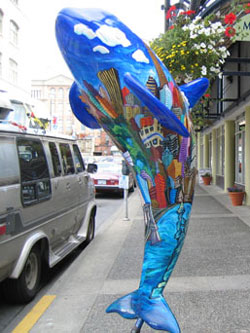
Orca murals, orca mosaics, orca sidewalk chalk, maybe an eagle or a salmon painted somewhere for good measure, but most prominently, a whole army of mass-produced, fiberglass Orcas In The City sculptures, each decorated by a different local artist.

Orcas In The City were bland and oppressive (seriously— the organizers put ‘Arts’ in quotations in their goal statement), but no one was supposed to complain about them because they were only temporary and they were auctioned for charity. Think of the children.

I flipped the bird on one of the more overtly branded Orcas at least once, but I regret never having ruined a tourist’s Orca family portrait by humping an exposed tail flipper or something. I have a lingering vendetta about the Orcas, with apologies to The Children.

Enter Spirit Bears

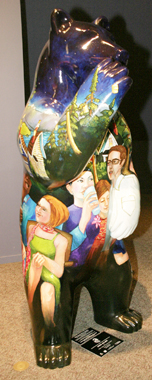
Spirit Bear featuring a funky neighbourhood scene

Suddenly, this spring, a new menace. Sir Bartholomew is not alone, and he’s even less distinguishable from the other Spirit Bears In The City than was the typical Orca In The City. A spirit bear is a white grizzly bear, if you’re not familiar with Pacific Northwest variations on junior high unicorn-and-kitten fetishes, and the decoration jobs seem to have been rationed out exclusively to the artists who made their Orca contributions look the most like the inside of a Starbucks. It’s wall to wall funky neighbourhood scenes. I know I’m biased towards neon red and blue as the official colours of 2006, but I don’t think I’m alone in believing that yellow and purple should take a well-deserved break. Let yellow and purple recover from their hard work portraying free spirits and Italian snack foods.

Worst of all, the Spirit Bears have broken free of the tourist containment zone and have been popping up as far from the Inner Harbour as Island Blue printers. I yelled out loud when I spotted the specimen at Fort and Quadra.

What’s a concerned citizen to do? How are we going to get all these bears back in?

Toronto got saddled with Moose In The City, so apparently this ride doesn’t hit bottom until it has dipped deep into Canadiana cliché pap. This aggression must not stand! Besides writing to the organizers at the Lions Club and begging them to at least consider funny animals for future mass-blanding fundraisers (goats are a good standby), what is the fitting response?

Three different people have suggested blowing up the bears somehow, but I’m taken with this Knitta Please textile graffiti. I don’t have the time or the tendon health to knit any quantity of bear shrouds, but I think some sewn hoods secured with zip ties would do the trick. As much as the bears stimulate my gag reflex, I’m a non-destructive kind of person and I wouldn’t want to actually destroy someone’s art.

I favour a sign reading “Out of Order” as the finishing touch.

Ugh, hipster parenting is so vain

Pam sent me a link to this article about hipster parents who are convinced they have tapped into eternal youth. They’ve got the same fashion and music as kids who are 18 or 20, so they figure they’ll be permanently in touch with Kids These Days, including their own.

When you read that article, can you see the veil waiting to be lifted? Vanity is tangible. (Shiver— do I know where mine is right now?)

  • I want to take bets on what a hipster midlife-meltdown will look like. What if it’s spectacular?
  • I wonder how much this obsession with having cool kids has to do with being embarrassed about your own uncool youth? That’s a losing proposition— if a whole generation has a hipster childhood, that’s no longer rare or cool. What a drag. Bonus: you still have the same uncool childhood.
  • I’d really like not to project so obviously on my children, when I get down to breeding. Oh, the irony of trying to be cooler than the cooler-than-thou people…
  • Many critics, I think, tend to miss the point of “generations” by focussing on what amounts to essentialism. I crave the analysis that starts, “Do you have the original mindset to back up that haircut, or are you just another white, middle-class, heterosexual, married, consumer parent with a new coat of paint?”
  • Doesn’t the anti-corporate attitude belong to Generation X, by rights? Are hipsters just Gen-X as a fashion industry, or am I missing something?
  • Those grids of white people… those are really scary, yes?

I have a morbid fascination with hipsters that I’m trying to figure out, obviously. I don’t exactly fit the definition, but I can pass (at this moment I’m wearing sassy glasses and listening to The Fiery Furnaces while making websites and living with an indie musician, for example). I suspect my hipster fascination means there’s some part of me I’m not quite comfortable with.

It might be about identifying with a subculture I don’t entirely support, about not being analytical or conscious enough about my lifestyle. I’m on a real radical-awakenings kick this month, which I know has been simmering unnamed for a long time. A big part of my cringing about hipsters might be that I find the consumerism, nostalgia and vanity really disappointing, but I don’t really know what to do about it or how to be Out and Loud about that stuff, which I suspect is an important thing to do.

Oh, settling into my identity! Forgetting to do it for awhile and then catching up! (That’s a song.)

Future parents of lesbians

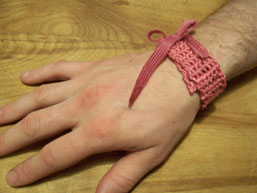
I didn’t notice anything remarkable about these packages until I was on the way out the door to mail them this afternoon.

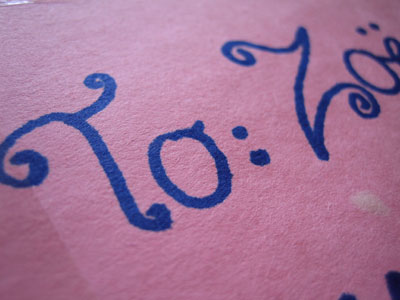
Galen, man of the house, addressed this one:

To: Zoe...

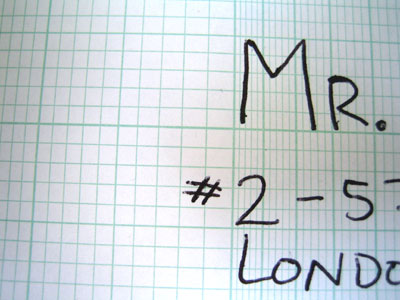
And this is the product of my womanly touch:

Mr. #2-5 Londo...

You can watch the progress towards this moment in both our family trees. Grandmothers with business diplomas, fathers who stayed home with babies, and so on. In a couple of generations, the clan will surely have morphed into swashbuckling androgynes of some sort. Hot! (… for my own fictional great-grandchildren! Um, I stand by it!)

I am such a lightweight radical

Yesterday was a steady stream of culture-clash encounters with, I don’t know, The Patriarchy. The Lookist, Erotophobic Mainstream. It embarrasses me to feel like a radical, because I’m not a proper, educated, active radical. I’m not in the habit of thinking about politics or explaining my point of view; I stay home and work on projects of my own devising so much that it is easy to think I am average and mainstream. But apparently life gets a lot more mainstream than me.

  • First email of the day was a band newsletter that referred to a fictional “big dude in a pseudo-latex french maid outfit” as “Ewww.” All the dudes I’ve seen in french maid outfits have been pretty hot.
  • Later email from a friend declared “there is nothing more horrifying than the image of thousands of miniature Lily Tomllins running amok.” I think Lily Tomlin is awesome. I shouldn’t refer to Quinn as The Patriarchy, but I don’t see why else Lily Tomlin could be so horrifying.
  • Vicar’s boss wouldn’t let him play Deerhoof in the retail store. Not even The Runner’s Four, which I consider a mainstream rock album. Except, oh right, Deerhoof.
  • As a perfect bookend, I spent half of Chet’s set at Logan’s sitting on a couch comparing worldviews with JR. This involved lengthy shouted statements about the possibility of excellent pornography, my eagerness to find new and scarier boundaries, and a whole lot of talk about the beauty of polyamory done well and the genius of The Ethical Slut. (And lots of shouts from JR about oppression breeding art, freedom from animal instincts, and his disappearing sex drive. It was fun! We did agree on the freeing power of intentional celibacy, but I don’t know if I made that clear.)

This was a lot of clashes in one day, for me. I wonder if I just had more contact with the world outside my multipurpose room, or if I was primed to dismantle Unjust Privilege after spending Thursday reading radical and activist blogs. It is not possible to know.

power jam

costumes. costumes are a productivity tool.

this morning, on my way between breakfast and the bank, i saw a business man running full tilt down the street. a business man like from a children’s book: in a conservative, navy blue suit and tie, with dress shoes, holding an open umbrella upright above his head. running fast, with long steps making his trousers flap. his tie might have been over his shoulder, but that seems like an embellishment that i would add.

i used to want to organize some kind of annual soccer game where everyone would wear power suits. navy vs. brown (i.e., bankers vs. car salesmen), or white shirts vs. blue shirts. (i also like camping in skirts and mary janes, or just generally taking control of my office wear.)

but the connection that made me realize what an excellent, if obtuse, productivity tool was available to me in costumes was remembering, when i saw the business man running, how much better i like doing housework if i’m wearing a tiara and carrying a wine glass. the glass could be full of water or hot tea for all i care, but carrying it around makes dusting or scrubbing a fun time. an event.

i’m sure you understand right away, what it is like to do housework in a tiara and carrying a wine glass (or a martini glass), because i tried explaining all of this at the sara marreiros show tonight and everybody caught on right away. “you should get some of those slippers with the fluff on the front.” and the thing is, i had some and i ran them into the ground doing housework. we are all on the same page here.

i’ve been thinking about running stairs lately anyway, because it seems like a weird and efficient urban exercise option, and i think if i got a washable power suit i could really get into running. you can wear running shoes with a skirt suit, i think. that’s a classic commuter move. nylons would be best but i have to draw the line somewhere (and they look really weird with my furry legs).

a lot of self-employees and telecommuters make a point of getting properly dressed to work at home, because it gets them into productivity mode. i do that too (my key items are a bra and real pants). i’d like to figure out a home office costume that goes one level further, not just into productivity mode but into like, titan of industry mode. what is the word for one of those pillars of society who wield massive business powers yet are admired for their philanthropy and preferably also some type of artistic skill? genius? character? sarah’s imaginary friend? i want to get into like, gomez addams mode. mon sauvage!

contenders for my new work outfit.

  • a clerical cloak of some type
  • a green bookkeeping visor and crisp shirt
  • power suit
  • my old default: the tiara and the wine glass
  • sassy underwear (possibly combined with the clerical cloak?)
  • dresses with hosiery and jewellery. and footwear.
  • cleanroom spacesuit.
  • specialized garment, like a lab coat or a utility belt
  • monochrome outfit of any kind

i think part of what is holding me back from my ultimate productivity-sauvage costume is that all the glamorous titans of yore were dudes, and the lady workers did not have cool 3-piece suits that suggest timeless power. this is an unforeseen feminist battleground.

Mmm, mysteries.

I’m a little embarrassed to be quoting Einstein here, but I really liked this bit from The World As I See It (via Communication Nation):

“The most beautiful experience we can have is the mysterious. It is the fundamental emotion that stands at the cradle of true art and true science…

“I am satisfied with the mystery of life’s eternity and with a knowledge, a sense, of the marvelous structure of existence — as well as the humble attempt to understand even a tiny portion of the Reason that manifests itself in nature.”

Einstein relates the experience of mystery to religiosity, but for me it’s the cornerstone of atheism. Mysteries remain mysteries, and are satisfying without reaching for explanations.

(I realize Einstein is not an embarrassing figure; it’s just that he gets quoted in such flaky ways. The idea of anti-science new agers using Einstein to back up their desire to make science bow down to rainbow vibes is a bit of a cliche for me. There is a chiropractor at the corner where I cross to check my postbox who has several “Imagination is more important than knowledge” posters propped up in the window, and it makes me cringe. I don’t mind rainbow vibes, but I do mind bad science and dumb posters.)

Commies commies commies!


Milton Glaser in The Believer : I think the worst scam that was ever performed on the innocent American people is this idea that retirement is desirable. It’s only desirable for people who really hate what they do.

Oh, that makes me happy. I get so tired of people who don’t do work that they love. I sympathize when my friends are trying to figure out what they want to do, but I have a lot more fun when somebody is actually excited about a plan.

I remember a class debate in about grade 10 social studies, a typical assignment to argue the merits of capitalism versus communism. The argument that, as I remember it, won the debate for the commies was that money is not a failsafe motivator for work, or everyone would want to be a highly paid doctor or lawyer. People do work for love too, in greater or lesser ways. Some work is so well-loved that nobody can get paid to do it (e.g., most art, parenting).

I go through phases of being frustrated by that, that a lot of great work gets done without pay, and some people can’t afford to do the great work they’re capable of. But right now, I’m just glad for the parade of free work that constitutes the bulk of the internet. Just people making stuff out of love. Bunch of commies!

(Sometimes it is really obvious that I have a tendency to take each new idea that I like and make it the symbol of my life philosophy for a week, until it has been processed and integrated throughout my entire brain. I don’t think a grade 10 class debate really resonated with me as the height of political discourse; it just stuck as the identifiable moment when this particular idea took root with me. Mr. Hansen and his rumoured hippie butterfly tattoo awarding the day to the communists.)

Ranty movie moment (Kill Bill)

Galen and I watched the second part of Kill Bill last night (yes, I’m always late watching movies…), and it was kind of weird for both of us. I was prepared to dismiss it as basically an idiotic pastiche of Tarantino’s favourite pop culture, but then I watched the “making of” bit in the special features. It amounted to all of the actors verbally fellating Q.T. for half an hour about his operatic scope and his ability to write better than Shakespeare did. Yow. I hope I never get myself into a position where no one will critique me to my face.

Really, I was enjoying the movie as a vacant piece of cool-looking entertainment until about the last 15 minutes, when…

(spoiler!)

… The Bride starts explaining why she ran away and her only story was that finding out she was pregnant changed her whole personality and made her quit her job. Add that to the insistent way that her unborn baby gets referred to as a person— repeatedly, during the entire two volumes— and I got a little creeped out by Tarantino’s take on reproductive rights. But, you know, oh well, artists have statements, the whole plot was minimalist, and the guy was probably just looking for some kind of primal, female motivation for his Amazonian lead. I can deal. I’m even pro-choice about the right to enjoy misogynist entertainment.

(end spoiler)

More annoying to me is that during the “let’s fellate the director” special feature, Uma and Quentin both make points about The Bride being so empowered, and about this movie featuring empowered women empowering themselves with power. Is this seriously what passes for empowerment among movie stars? Blond babes acting out the director’s girl-on-girl fantasies by kicking the shit out of each other? Chicks who are mortal enemies because they dated the same guy? Women who wimp out because of their uteruses? A main character who gets specifically attacked in her various woman parts— shot in the tits, rendered infertile, raped, manipulated through her child?

Presumably the celebrities consider these characters empowered because they can kick ass, but every time this prowess gets mentioned in the movie it is in the form “she’s pretty good… for a girl.” Top female assassin. Deadliest woman in the world. The chicks even refer to themselves that way, while they are killing some of your deadlier male assassins. That’s dumb, and distracting in a movie made since 1970.

When I rant like this, I get self-conscious about being a feminazi. This kind of rant doesn’t seem like an activist manifesto to me. My parents and almost everyone I know understands this stuff. I was raised in this context. A lot of my life plays out in a post-feminist context, if I may toss around some jargon for a moment. Ranting like this is sort of the same as complaining about an overpriced restaurant. You don’t have to go back there yourself so there’s no further action that needs to be taken, but you might as well warn your friends in case they care about the same things.