Unyeasted bread, quests.


Unyeasted breads have a deep, hearty, honest spirit with a certain substantial integrity. Dense and thick-crusted, they require a good bread knife for cutting and a certain endurance for chewing…

No matter how much I mentioned the dense, “bricklike” nature of some of these breads, still I received many letters from people wondering why the bread came out of the oven like a piece of building material. O.K., they are not to everyone’s taste, but some people really like this sort of thing: “How real,” they say, “How flavorful.”

— Edward Espe Brown in The Tassajara Bread Book, 25th Anniversary Edition

I’ve been finding a lot of inspiration in a particular kind of far-out food book. Not dietary inspiration; something like philosophical inspiration. Emotional inspiration? Attitude inspiration. The connecting thread seems to be authors who used to practice more extreme diets. Former vegans, former macrobiotics, former hippies. Some of these books have consistent ways of respecting radicalisms and moderations at the same time, finding another level of inclusion where you get the thorough, grounded ethics of radical thought without the isolating righteousness. I find myself re-reading bits of non-content like the introduction to a recipe, just for the tone or the attitude.

Does that Bread Book passage do any of that for anybody else? I know I’m reading the way I need to read.

This is helping me rename a personal communication quest that I’ve been naming and renaming for, I don’t know, fifteen years? My teenaged fixation was how to be honest and also nice (both in the sense of liked and in the sense of kind). Later it was how to have a critical analysis without alienating people who don’t. How to be compassionate without self-censorship. How to make space for differences without them being cast as disagreements or negativity. How to maintain boundaries without being judgmental. Consideration without passivity. Empathy without enabling. Belonging without conformity. How to make connections across differences. All of these draft mission statements have been discarded or modified, but I’m getting somewhere. I want to joke that it wouldn’t be hard to be both more honest and more kind than teenaged me, but that isn’t true. It has been hard!

Flipping through a chapter called Vegetarian Ethics and Humane Meat that kept me up late last night, I have totally failed to find a quotable section. I started just collecting words. “Much depends,” “life and death and life,” appreciation, reflection, mistakes, “not so easy,” “Plan B,” courage, “emotionally spent,” responsibility, “more directly involved,” experiments, clumsy, “I’m very curious,” “our memories diverge… isn’t memory funny?” Vocabulary for a big, thoughtful mess.

Who said that keeping up with fashion is the ultimate way to create anxiety? Connecting people in a big mess seems like the opposite to that. Seeking ways for many fashions to co-exist together is comforting and useful. So I guess that’s the communication quest for now. It must seem like this is too abstract to possibly be useful in my real life, but I bet I will refer to this in the next 24 hours, trying to explain a decision or action to someone. “It’s like the unyeasted bread! I know how to do this!”

Movies I watched in May 2009


Movies that passed the Bechdel Test

  1. Beyond the Mat (WWF wrestler Chyna goes shopping with her friend. That barely counts but I’m partial to weird shopping scenes.)
  2. The Celebration (Lots of little chats.)
  3. Pan’s Labyrinth (Again, lots of conversations.)
  4. Terminator (A few small chats.)
  5. Terminator 3 (Feminine Terminator steals a woman’s stuff… Can I put only the car chase in bold?)
  6. Doctor Who: Carnival of Monsters (The Doctor’s sidekick tries to enlighten a woman who is stuck in a timeloop.)
  7. The Pee Wee Herman Show (Miss Yvonne and Hermit Hattie talk about make up.)
  8. Big Top Pee Wee (This one is probably for fans only.)

Movies that failed.

  1. A Scanner Darkly (My rational mind rates this movie as only medium-good, but some other part of me has a lot of affection for it. The sad ending. The perfect Philip K. Dick moment when Keanu is told to put himself under extra surveillance. It has a purity.)
  2. Jean Claude Van Damme
  3. Bloodsport (Probably would not have been fun without watching JCVD.)
  4. The Godfather
  5. The Godfather Part 2
  6. Terminator 2
  7. Terminator 4
  8. The Dark Knight (I’m fascinated that I find this movie so satisfying and so fascist at the same time.)

Bold means I’m glad I watched it.

This month’s lists are evidence that my neighbours Casey and Jessica are fond of renting entire series of Hollywood movies. I have also watched with them: all the Die Hard movies, all the Rambo movies, Alien and Predator in preparation for Alien vs. Predator, and probably more.

The fact that I go along for these action movie marathons could probably go in the same category as the facts that I only like to watch sports when international championships are broadcast at 4 in the morning, and that if I don’t see the midnight premier of questionable superhero movies I probably will never watch them. Bland content is a good foil for intense viewing contexts.

A funny moment in science violence.


The impassioned claim that there exists an unemotional, value-free scientific method (or context of justification) may be interpreted as an emotional rejection and repudiation of the feminine and, if this is so, it would mean that scientific practice carried out (supposedly) in an “objective,” value-free, unemotional way is in fact deeply and emotionally repressive of the feminine.

— Brian Easley, “Patriarchy, Scientists, and Nuclear Warriors”

Galen forwarded me a reading for his feminist men’s discussion group and I laughed out loud at this part. The rest is here: Patriarchy, Scientists and Nuclear Warriors, by Brian Easlea.

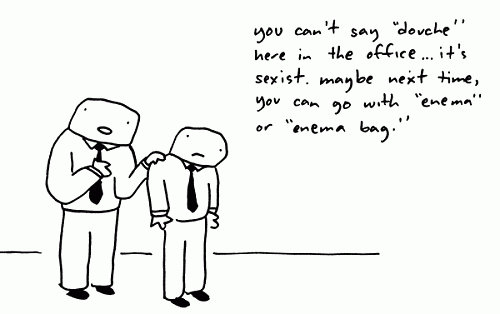
Cussing towards equality: douche vs. enema

douche enema office, from Toothpaste for Dinner

Surprisingly / not surprisingly, I have thought a lot about the value of “douche” as a politically correct cuss word. I’ve adopted it as my all-purpose, positive family values cussing option. My take is that douches are maligned for feminist and body-positive reasons. Douches are marketed to clean vaginas that are already self-cleaning, and the unnecessary douches can cause microflora imbalances and infections. Douches are terrible, urban legend birth control that can actually increase the chances of conceiving. Douches: body hating, body damaging, anti-choice, agents of unnecessary consumption. And fun to say. Doooosh.

Meanwhile, almost every other cuss word is maligned for some body-hating, bigoted reason. Genitals, bodily fluids, sexual activities… I love all those things. I need a bigger pallette of loving cusses before I can give up the fun sounds of fuck, shit, tits, ass, cock, sucking, blowing, and company, but it’s good to have a start.

Other takes on douche as a swear? Seeing it paired up with enemas is actually giving me pause. I’m thinking the only reason enemas get a bad rap is because of taboos about buttholes, and related taboos about gay sex and maybe enema sex play. I’m pretty much pro-butthole on all those issues. So then I wonder if I should be considering the sex play possibilities of douches, and any douche fetish communities I might be further marginalizing. The problem: everything can be used for sex play. That criteria would eliminate every possible PC swear word. I’m sticking with douche for now, but I’d love to hear from anyone offended by that.

Survivalism as if self-sufficiency is an illusion.


How do I protect [my disaster supplies] from the unprepared and desperate have-nots if I don’t already have a fort-knox style bunker?

Obviously the first priority will be to avoid conflict in the first place, if possible. The cause of conflict in your question was a shortage of supplies, and the potential aggressors are disorganized. So the easiest way to avoid conflict in that case is to make sure that there are enough essential supplies to go around for your neighbours. . . . That’s why I think that community sufficiency is much more important than just self-sufficiency.

— Aric McBay on Strategies for shortages, from In The Wake: A Collective Manual-in-progress for Outliving Civilization

I often feel self-conscious reading (and liking!) a certain type of anti-civilization literature. I’m trying to come up with a concise way to explain the appeal without just making a joke out of it (crazy survivalists!). Part of it is this struggle to take care of oneself in a cooperative way. The whole anti-civilization argument, at least from the people I’ve been checking out, comes from the premise that civilization makes cooperative self-care impossible, because the civilized are always destroying and overshooting their (our) landbase and depending on imperialism to survive. It’s that situation where one competitive person can ruin a whole group’s attempt to use cooperation and consensus.

So there are a whole lot of ideas in there about resisting a hierarchical, destructive culture without creating a new hierarchical culture in its place.

Douglas Rushkoff on individualism and disempowerment.

Another affirmation that cooperation can be more empowering than only looking out for number one, this time from economics and media theory. This is Douglas Rushkoff in his opening invocation at Personal Democracy Forum 2008 (transcript, video/audio). If you’re going to listen to a whole presentation, I prefer his similar 56th Annual Korzybski Lecture but I couldn’t find a transcript of that one.

The individual we think of today was actually born in the Renaissance. The Vesuvian Man, Da Vinci’s great drawing of a man in a perfect square and circle— independent and self-sufficient. This is the Renaissance ideal.

It was the birth of this thinking, individuated person that led to the ethos underlying the Enlightenment. Once we understood ourselves as individuals, we understood ourselves as having rights. The Rights of Man. A right to property. The right to personal freedom.

The Enlightenment— for all its greatness— was still oh, so personal in its conception. The reader alone in his study, contemplating how his vote matters. One man, one vote. We fight revolutions for our individual rights as we understood them. There were mass actions, but these were masses of individuals, fighting for their personal freedoms.

Ironically, with each leap towards individuality there was a corresponding increase in the power of central authorities. Remember, the Renaissance also brought us centralized currencies, chartered corporations, and nation states. As individuals become concerned with their personal plights, their former power as a collective moves to central authorities. Local currencies, investments, and civic institutions dissolve as self-interest increases. The authority associated with them moves to the center and away from all those voting people.

(Emphasis mine.)

I really notice the undefined “we” in that speech. He is expecting to be heard by people who take European history as their own history.

Interconnected quotations about interconnection.


‘Individualism’ is not to be mistaken for freedom to choose moral, political and cultural alternatives of one’s own making. Each person is expected to operate ‘individually’ but in more or less similar ways and similar directions. . . . ‘Individualism’ in the United States refers to privatization and the absence of communal forms of production, consumption and recreation.

— Michael Parenti quoted by Alfie Kohn in No Contest: The Case Against Competition

This is so similar to the quotation from yesterday, about how disabled people often define independence.

A disability activist perspective on independence, and on working less.


“Professionals tend to define independence in terms of self-care activities such as washing, dressing, toileting, cooking and eating without assistance. Disabled people, however, define independence differently, seeing it as the ability to be in control of and make decisions about one’s life, rather than doing things alone or without help.”

— Michael Oliver quoted by Sunny Taylor in The Right Not To Work: Power and Disability

I looked up Sunaura Taylor after enjoying her discussion with Judith Butler in the movie Examined Life. They talked about walking as it related to disability and gender issues, and about the politics of helping each other and asking for help. At one point they stopped into a thrift store to get a sweater for Sunaura, which was suddenly revealed as a Queer Eye make-over scene such as I have occasionally wished for. Queer shopping with politics intact; it was quite beautiful! I had a little thrill, there in the cinema.

Part of the thrill was seeing the two of them act out an interdependent version of shopping, with Judith helping Sunaura try things on and the store clerk adjusting her usual check out techniques. It was very clear that all of the people benefited from working together, and it was also clear that to accomplish that they had to work outside of usual store policies and etiquette expectations.

I have been finding affirmations of interdependence in a lot of different sources lately, and they really cheer me up. I’m hunting for ways to resist competition and hierarchy without resorting to competitive tactics, and in the meantime it is very encouraging just to watch people cooperate within structures that are set up to facilitate competition. Life affirming.

Taking a different angle on accepting all of us instead of competing to find the winners, here is another quotation from that essay. This is especially for Erin and anyone else who is into working less.

The right not to work is the right not to have your value determined by your productivity as a worker, by your employability or salary… What I mean by the right not to work is perhaps as much a shift in ideology or consciousness as it is a material shift. It is about our relation not only to labor but the significance of performing that labor, and to the idea that only through the performance of wage labor does the human being actually accrue value themselves. It is about cultivating a skeptical attitude regarding the significance of work, which should not be taken at face value as a sign of equality and enfranchisement, but should be analyzed more critically. Even in situations where enforcement of the ADA and government subsidies to corporations lead to the employment of the disabled, who tends to benefit, employers or employees?

One more, because I really like this question:

The minority of the impaired population that does have gainful employment are paid less than their able-bodied counterparts and are fired more often (and these statistics are more egregious for disabled minorities). To ensure that employers are able to squeeze surplus value out of disabled workers, thousands are forced into dead-end and segregated jobs and legally paid below minimum wage (for example, in the case of “sheltered workshops” for those with developmental disabilities). The condescension towards the workers in such environments is severe. Why should working be considered so essential that disabled people are allowed to be taken advantage of, and, moreover, expected to be grateful for such an “opportunity”?

In praise of experiencing underwear.

Fifi, by Strumpet & Pink

Willow, by Strumpet & Pink

Hunting Through the Ruffles, by Strumpet & Pink

Garden of Delights, by Strumpet & Pink

From the Strumpet & Pink website, a goal I can get behind:

Our knickers are experiential and focus
on feeling rather than objectification.

Years ago, my friend Logan talked so much about wanting velvet underwear with the pile facing inwards that someone finally made him some. Fuzzy on the inside.

Apologies for all the skinny, pale-skinned bums. I thought the ruffles were worth it. I am imagining my future undercrafts.

I’m noticing how gardening books can be colonial.


Edible gardens have been part of human culture for thousands of years. Along with harnessing fire, developing the wheel and domesticating animals, cultivating food is one of the benchmarks of human advancement. Growing plants that provide food and learning to store it for times of scarcity were advancements that allowed humans to develop civilizations.

— First paragraph of the introduction to The Canadian Edible Garden: Vegetables, Herbs, Fruits & Seeds by Alison Beck.

It’s been awhile since something like “the benchmarks of human advancement” would have slipped by me as a neutral measurement (when you define everyone’s progress by how similar they are to you, you can assume have problems with privilege), but I think I am noticing more assumptions now about the value of civilization and technology. I’m also noticing that the author’s list of “advancements” that allow humans to create civilizations skipped over colonization, slavery, militarism, genocide and all that.

I recently read Endgame: The Problem of Civilization & Resistance (thanks for the tip, Sarah), which is a thorough take-down of the assumption that civilization is an advanced way of living (vs. unsustainable and terrorist), that the point of technology is to become advanced (vs. to maintain a relationship with your landbase), that agriculture is an efficient way to gather food (vs. temporary and destructive). I think that was the book that got me reading about destroying agriculture. I’ve been reading a lot of books at once; it’s hard to keep track.

I am seeing this garden book as much more oppressive than I would have before, with a Eurocentric, anti-indigenous, environmentally unconscious position.

This is good, it gets me thinking about my love of gardening. I’m realizing that what I care about is getting to know plants and soil and living systems, resisting consumerism and capitalism by gathering my own food, and taking time to physically experience and love a patch of the outdoors. None of that actually requires a garden. I could be wildcrafting, or working more with local plant permaculture and forest gardens. Those are difficult when land is privately owned and violently policed, and wilderness is mostly destroyed and constantly under threat. Wild forests don’t need me in there taking all my food right now. And it’s hard to conceive of perennial ecosystems on temporarily rented space.

So… how could I be talking with my neighbours about guerrilla permaculture and land reclamation?

Colonization games

Game Developers Conference seems to be on right now. A few years ago I would have been following posts about the presentations. I’m still interested in interactivity design and game design, but I am taking a break from the technorati’s vision of revolution and progress (short version: pretend everyone can have a cell phone without destroying the planet).

Seeing all the GDC headlines reminded me of watching Will Wright present the demo of his super-hyped Spore game at the elite/elitist TED conference in 2007.

That’s the first time I remember being horrified by game design. Will Wright, known for his non-competitive, open-creative-outlet games, Mr. SimCity, spent fifteen minutes talking about teaching kids to colonize territory. Ouch. It is easy to dismiss the racist, sexist, violent shooter games when there are supposed alternatives. Where do you go from the alternatives when they have all the same domination and hate in a more covert, abstract form?

Are there any video games out there about resisting colonization? I mean as a whole system, not just in terms of blowing up invaders from space using weapons you built by invading and occupying your own planet to get resources and labour. I never got around to writing Will Wright to ask him to read up on what colonization really means before developing his next game idea. Spore II: Indigenous Resistance. I’d play that.

So here I am wishing for better video games when I am intending to take a break from people who focus on saving the world by building video games and electronic gadgets. Moving on.

Considering destroying agriculture: more soothing than I expected.

I am feeling excited to research radical ecology and anti-industrial ideas lately. This is one result of considering my Scottishness: I decided to read extra-radical critiques of Eurocentric civilizations as a respite from the horrifying, delusional narratives in books about Scottish settler history.

Somehow I didn’t realize there were folks in radical ecology movements looking at very intersectional politics of oppression and how they relate to fundamental systems like agriculture, cities, and industrial production. Sometimes I find an analysis that also overlaps with what I know of media theory about currencies, clocks and the alphabet. I’m still in a skeptical phase where I am cross-referencing everything and looking for criticisms, but it is very relaxing to feel like there might be a way to fit a lot of interests together. One huge, complex idea to apply instead of a whole bunch of big, complex ideas.

This morning I was listening to ideas about agriculture.

Lierre Keith: A Hard Look at Agriculture, and Strategies for Collapse, a podcast at Resistance is Fertile. Why even veganism and local organic farming is not sustainable.

You have to understand what agriculture is. In very brute terms, you take a piece of land, you clear every living thing off it— and I mean down to the bacteria— and then you plant it to human use. It’s biotic cleansing. This lets the human population grow to gigantic proportions, because instead of sharing that land with millions of other creatures we’re only growing humans on it….

Besides the fact that you’ve permanently displaced any number of species— and when i say that, we’re really talking about extinction— the real problem is that you’re destroying your topsoil and topsoil is the basis of life [on land]…. We have to talk about overshoot.

And pretty soon, she starts connecting this to systems of oppression.

So you’ve got these power centers that arise wherever agriculture is started and they need a constant influx of new resources because they’ve overshot their landbase. Because you have a surplus, that means somebody else can steal it, so the first thing that happens in agricultural societies is you have a class of people whose sole purpose is to be soldiers. You’ve got the beginnings of militarism. The surplus has to be protected. But the surplus is also what lets there be an entire class of people who don’t have to get food, all they have to do is fight. So now you’ve got a class of soldiers.

The other thing that the power base needs is more resources because they’re constantly using them up. So the other job of those soldiers is to go out and get more and bring it back.

And the third thing that agriculture needs is slaves, because it’s back-breaking labour. By the year 1800, when the fossil fuel age began, three quarters of the people on this planet were either living in conditions of slavery or indentured servitude. The only reason that we’ve forgotten this is because we’re using machines now to do that work, but believe me when the fossil fuel runs out, we are going to remember just how much work is involved in this.

It’s this feedback loop, where agriculture creates the need for a military and the military is made possible by the surplus of agriculture. And the entire system together needs to keep taking land because it’s forever using up its own soil.

They go on to make connections between agriculture and patriarchy, disability rights, classism, imperialism, and some more.

I have a million ideas about things to do, but I want to post some more inputs before I write about them. I was quiet for so long that I feel like I have a lot of catching up to do just to make my premises clear.

Alternatives to handsome.

Sarah H commented about handsomeness and masculinity.

I find it really useful to consider ideas of handsomeness in relation to concepts of masculinity— I can see where my own notions of handsomeness are based in someone (of any gender) being visibly self-controlled, unemotional and hardened. I wonder how we can reclaim words like this— like how do we compliment our loved ones on looking cute, without using words that reinforce these concepts of masculinity? I have tended to use the word handsome, but now it doesn’t seem appropriate.

I am interested in this too. I hadn’t considered the word handsome before, but I use it a lot (also to describe a person of any gender). After some reflection, I think for me it is a replacement for saying something more personal and honest. I’m making a judgment about beauty and gender instead of attending to my feelings and needs. There is an idea I like in non-violent communication, that making judgments reinforces hierarchy and external authority. From Nonviolent Communication: A Language of Life:

Most of us grew up speaking a language that encourages us to label, compare, demand, and pronounce judgments rather than to be aware of what we are feeling and needing. …

Life-alienating communication both stems from and supports hierarchical or domination societies. Where large populations are controlled by a small number of individuals for their own benefit, it would be to the interest of kings, czars, nobles, etc. that the masses be educated in a way that renders them slave-like in mentality. The language of wrongness, “should” and “have to” is perfectly suited for this purpose: the more people are trained to think in terms of moralistic judgments that imply wrongness and badness, the more they are being trained to look outside themselves— to outside authorities— for the definition of what constitutes right, wrong, good and bad. When we are in contact with our feelings and needs, we humans no longer make good slaves and underlings.

To work for anarchist/non-hierarchical relationships, I’ve been practicing not judging things as “masculine” or “feminine” and instead just saying what they are and how I feel about them. E.g., If I let go of describing a boy or man as effeminate, I can usually find more accurate, specific observations. Maybe he’s caring and kind, and likes to wear bright colours. And maybe I feel happy about that because I value kindness and diverse clothing options. I forget this all the time, but when I remember to get specific I like the way it makes me more aware of both the person and myself. I also like that it goes beyond resisting within binary gender and gets outside of gender altogether. Instead of questioning who can have feminine qualities, it is a way of questioning why we call some things feminine at all. I think that celebrating a man or boy for his feminine qualities still reinforces that passive, traumatized personalities are called feminine while aggressive, traumatized personalities are called masculine.

I’m thinking I could replace “handsome” the same way, with concrete observations and personal feelings. On top of letting go of judgments about gender (anyone can have a strong jaw or dark eyebrows), it would skip judgments about who looks more or less beautiful. Previously I’ve tried celebrating everyone as beautiful “in their own way” but I find it works the same way as celebrating genderblurred masculine and feminine qualities. It still reinforces the idea that I can judge who is beautiful or ugly and that it matters. I’d rather find ways to take responsibility for what I see and how I feel about it.

That has me wondering what I am trying to communicate when I tell someone they look handsome. I like to look at them? That is still very vague. I think they have social power because they fit a currently fashionable ideal look? I don’t want to play that game. When I look at their nose I feel hot and bothered? That is more what I’m aiming for. I think I’m using compliments as a substitute for conversations about desire and sensual appreciation. Wow. I would way rather have the desire/appreciation conversation.

I’m going to try eliminating handsome from my vocabulary for a few days, to find out what else I can talk about. I’m not sold on permanently eliminating words that describe judgmental categories because I also use them to talk about politics and the categories themselves, but a temporary ban seems like a good experiment in awareness.

More ideas?

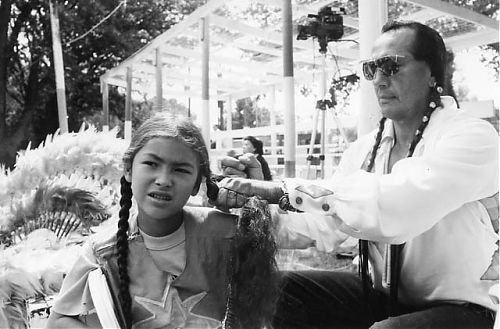
Russell Means on orality and literacy

Russell Means braids his son's hair, by Ilka Hartmann

I like the way Russell Means began his 1980 speech, For America To Live, Europe Must Die.

The only possible opening for a statement of this kind is that I detest writing. The process itself epitomizes the European concept of “legitimate” thinking; what is written has an importance that is denied the spoken. My culture, the Lakota culture, has an oral tradition, so I ordinarily reject writing. It is one of the white world’s ways of destroying the cultures of non-European peoples, the imposing of an abstraction over the spoken relationship of a people.

So what you read here is not what I’ve written. It’s what I’ve said and someone else has written down. I will allow this because it seems that the only way to communicate with the white world is through the dead, dry leaves of a book. I don’t really care whether my words reach whites or not.

I read a lot of media theory, where orality and literacy is a giant topic. (I can see a book called Orality and Literacy from my desk.) And I think this is the first time I’ve encountered a first person, pro-orality perspective from someone with an oral culture. I feel shocked to realize this. But of course books about media have a bias towards text. And of course online articles have a bias towards text and mass media. Somehow I had the two topics in my mind, media theory and resisting white supremacy, but hadn’t made many connections between them.

There’s a rule of thumb which can be applied here. You cannot judge the real nature of a European revolutionary doctrine on the basis of the changes it proposes to make within the European power structure and society. You can only judge it by the effects it will have on non-European peoples. This is because every revolution in European history has served to reinforce Europe’s tendencies and abilities to export destruction to other peoples, other cultures and the environment itself. I defy anyone to point out an example where this is not true.

Means was talking about Marxism, but now I am thinking about printing presses and the internet.

Lierre Keith on gender

I enjoyed this interview with Lierre Keith about destroying civilization, especially these definitions of genders.

Sexual domination and subordination are institutionalized into the very concepts of masculine and feminine. Masculinity is simply a conglomeration of the personality traits necessary for the patriarchal soldier-rapist: physically strong, emotionally cauterized, rational, domineering, cruel. All of this is supposed to add up to “handsome” as well. Likewise femininity is ultimately a description of the personality that results from trauma and powerlessness: weak, passive, yielding, emotional, hyper-vigilant to the needs of the dominators and desperate for the dominator’s attention.

On scarcity.


Capitalism works on the same principle as a glass company whose employees spend their nights breaking people’s windows and their days boasting of the public service they provide.

— Alfie Kohn in No Contest: The Case Against Competition

Soneteer


A sonnet is built on a fourteen-line frame, of five-foot lines. Hence, the soneteer knows exactly where he is headed, although he may not know how to get there.

I finished reading The Elements of Style. The famed, much recommended Elements of Style. It’s alright. You need to bring your own race and class analysis goggles. An example.

Style rule #2. Write in a way that comes naturally.

Style rule #15. Do not use dialect unless your ear is good.

Style rule #20. Avoid foreign languages.

Where this leaves a person whose natural dialect doesn’t sound good to an English professor is a matter for the analysis goggles.

I would at least pair the book with this old, also somewhat famed, David Foster Wallace essay about English usage wars.

That essay is a delight but I feel sad when I read it. I feel sad reading anything by DFW since his suicide, but there’s more this time. He gets all the way to seeing that language has class signifiers and that Standard Written English is an elitist, white, academic dialect, and then he gives in. His best suggestion for surviving in this classist, white supremacist (capitalist colonial heteropatriarchal… might as well get it all in there) system is to learn to pass. That is soul crushing advice.

I’ve gotten this vibe from a lot of David Foster Wallace’s writing. There’s a part that is generous and open and loving and grounded (he calls it a Democratic Spirit in that essay), and then a part with… I want to say with no faith in the power of consciousness. I don’t know if that’s exactly it. But something. Resignation? I count him as one of my favourite authors, but usually when I read something by him I have to debrief afterward. I just looked at my little list of “books read in 2006” and saw that my note for Infinite Jest was “not sure yet.” (Since then I’ve given it as a gift at least three times.)

I am really wishing that Dark Daughta’s archives were still public so I could link to something about passing and anxiety, or about changing the power dynamics of a situation by speaking and acting with a grounded analysis. DD, since you went members only, I sure notice how much I was depending on your output and not pitching in, so thanks for that wake up. If I find alternate links I will come back and stick them in.

Down with praise, emotional dentistry, granfallooning.

I continue to publish drafts that have been lingering in the archives. This one lingered because it was veering towards criticising my friends and I was too scared and distracted to get it to a place that was honest and compassionate instead of either judgmental or passive. Check out how non-intense it is. This is the type of stuff that has been terrifying me for years. It’s kind of funny.

. . .

9 Feb 2008

I just went to the dentist for the first time in about seven or eight years. This particular dentist is explicitly “an emotional guy” who gives a lot of compliments about teeth, and expresses a lot of care and encouragement about your dental health. Full on, “I know I just met you, but I really care about your teeth and gums, because I know that dental health can really impact a person.” Totally sincere, enthusiastic. OK. Awesome. It also ran right into this discomfort I have with receiving compliments and praise, which I thought about a lot on the walk home from my appointment.

So I’ve been wanting to write out my ideas about praise and compliments, but I’ve determined that first I need to deal with this other dentist-related thing, being that a lot of my friends go to the same dentist and I’m a bit afraid of sparking some “we’re all in the Dr. Bjornson club!” celebrations. (This is a real “everything good is actually bad!” kind of post. I dislike compliments, and furthermore I dislike belonging! No fun allowed!) I’ve been belatedly discovering Kurt Vonnegut’s books, and in the last one I read (Cat’s Cradle), he uses this invented word, granfalloon, to describe an allegiance based on a shallow or pointless shared trait, like being from Iowa or going to the same dentist. I am happy to have this word, even just to clarify for myself that I don’t want to avoid all kinds of belonging. Only granfallooning gets the diss, because it is meaningless and distracting, and is, I think, a kind of vanity.

. . .

So, then, over a year later, I’ve thought a lot about my problem with compliments. I think there are two parts; one where I’m crazy and one where some compliments are crazy. I have book quotes to go with both of these.

The part about living in a crazy world is like this. From Nonviolent Communication.

Conventional compliments often take the form of judgements, however positive, and are sometimes offered to manipulate the behavior of others.

And the part about my own craziness goes like this. From Women Who Run With The Wolves, in a chapter about procrastination and creative blocks.

Troublesome contaminants in the river [of soul/creativity] are obvious when a woman turns away sincere compliments about her creative life. There may be only a little pollution, as in the offhanded “Oh, how nice you are to give such a compliment,” or there may be massive trouble on the river: “Oh, this old thing” or “You must be out of your mind.” … These are all signs of an injured animus. Good things flow into the woman but are immediately poisoned.

Not that my teeth are my creative life, but being a person who was both terrible at accepting compliments and struggling with intense procrastination at the same time, I figure it translates.

An anti-war horror movie I’d like to see, old random drafts.

In the spirit of spitting things out rather than polishing them forever and driving myself crazy, I’m going through my archives and publishing drafts.

A couple of years ago I was reading a lot about horror and monsters. At some point I saved quotations from The Monster Show: A Cultural History of Horror.

p.186, regarding WWI vets.

The Frankenstein pictures continued to be a cultural dumping ground for the processed images of men blown to pieces, and the shell-shocked fantasy of fitting them back together again.

That was the first idea I ever heard about horror as a mirror of culture, from a Chuck Palahniuk interview. It doesn’t make me want to watch horror movies, particularly. But this next movie is something I would like to see.

p.205-6

For his unnerving final sequence— completely irrational, but nonetheless a devastating moral statement— [Abel] Gance recruited actual members of the Union des Gueules Cassées, and created a nightmarish montage of all the ruined faces that had been haunting the world’s cinemas for the past fifteen years in the guise of “horror entertainment.” The actual men are nameless, but they could easily be the living models for the masks worn by Lon Chaney, Boris Karloff, Lionel Atwill, and others. As a conscious antiwar statement, J’Accuse is superior; as an unintentional revelation of horror’s major subtext in the twenties and thirties, it is breathtaking.

Re-entry, being Scottish, the other end of cultural appropriation, not yet being able to write short sentences but maybe one day.

I’ve been sitting here for three weeks attempting to write my grand re-debut in blogging, where I would declare my intention to overshare again like I haven’t since about 2002, note that a lot of anxiety that I was blaming on work deadlines actually seems to stem from not writing enough about things I care about, and delve into the limitations I’ve been accidentally sticking to regarding not scaring my family or offending my friends or embarrassing my partner, but how about I skip that for now since it has become a bit of an albatross, and just post something already?

Yes!

So I’ve been thinking about European ethnicities, whiteness, colonialism, and cultural appropriation, and what I need to do to make sense of being, apparently, of 100% Scottish ancestry.

This Scottishness is new-ish information because my dad was adopted. Until my dad (or my mum?) saw his adoption paperwork a couple of years ago I thought of myself as half Scottish, half mystery, and really, mostly as a generic white settler person. Lately it has occurred to me that if I can get more rooted in being a specifically Scottish-descended settler person, I might be able to use that to subvert whiteness a bit. I’m thinking that since whiteness works as a generic, supposedly neutral, supposedly non-racial racial quality, then knowing my ethnicity better might help me to be more aware of whiteness instead of taking it for granted, and also might help start conversations about race and privilege in everyday life. This is very early stages here. I get the impression a lot of people have thought about this, and I have a lot of reading and thinking to do. I don’t know what “understanding my Scottishness” would look like yet. I’m hesitant to suddenly care about kilts and druids partly because maybe they aren’t relevant to me, and partly because I associate, e.g., Celtic knotwork jewellery with New Agers and metal bands. More on that in a minute.

This is part of a bigger, backwards personal growth quest. Years ago I started reading about death and dying, and got interested in denial. There’s a lot of writing about denial in radical politics and anti-oppression work. Privilege and denial, collusion and denial, performance and pretending. Darkdaughta writes (or did write, when she was public) especially clear analyses of how personal denial perpetuates political oppression.

Trying to be thoroughly anti-oppressive, then, merges right up with trying to be an honest person, and both missions lead to sorting through my family dynamics, my parents’ families, and back and back. It’s useful to apply some historical context and political analysis to all of that. So again, I have a lot more reading and thinking and talking to do.

For starters, I’ve been hunting for general history about Scotland and colonialism. It is very easy to find writing about the oppression of Scotland by England, but, predictably, harder to find anti-colonial perspectives on Scottish settlers.

This caption was the first promising thing I found: Professor Geoff Palmer of Heriot-Watt University believes Scotland is still in denial over its role in British slavery. A signal! Involving the codeword, denial! I found some leads and put some books on hold at the library about Scotland and colonialism.

Towards the end of that article though, they are talking about other aspects of the Scottish diaspora, and the subject turns to cultural appropriation.

David Hesse, an “urban intellectual from Zurich”, who gave up a journalism career to study in Edinburgh, says: “You could call my field the imagined diaspora. I investigate highland games in Germany and Scottish clubs in eastern Europe. I look at people dressing up as Scots. Those people have no “real” Scottish ancestry but feel aesthetic connections. I think international fascinations with Scotland and Scottish-looking things are a phenomenon.”

Hesse sees imaginary Scottishness as an identity that is becoming increasingly popular in northern Europe. “It is a folk identity, but it is quite macho. It involves military music and martial games. It is also a generally white phenomenon.”

I laughed when I read that. Cultural appropriation has never inconvenienced me before, but I think this is what’s going on with my cautiousness towards anything celtic. It’s been taken over by metal bands and the scented candle crowd. I’m used to thinking about cultural appropriation from the other end, choosing not to wear dreadlocks or sari silks, not to get tattoos of asian calligraphy, not to use imaginary ancient aboriginal terms for my menstrual period. I think Operation: WTF Scottish Roots is working already. Things that made intellectual sense make a little more experiential sense.

So, hi again internet. It’s been years since I wrote regularly and I think I must still write like a twenty two year old, but I’m ok with just spitting things out until I get the hang of it.

Alternatives to mastery.

'Adept' by Jason Engle

I’ve been thinking about the word master for a few months, off and on. Mastery, masterpiece, master crafter, masterwork. It’s a problem because I’m really interested in work, practice, and skills, but master is not a positive word to me. It’s like expert, or authority. Knowledge as domination or exclusivity. I’m into DIY and cooperative visions of skill and work, so I’ve been keeping an eye out for more accurate vocabulary.

Today I am promoting adept to regular rotation. It’s from the Latin “to attain,” and definitely +2 against social hierarchies.

I am very excited!

Look good naked, bring your own analysis, a lot of video links.

A bloggy friend of Erin’s posted about a TV show called How To Look Good Naked. I don’t have cable, and I didn’t know anything about this show. This blogger, Sarah, said the show basically relied on body image coaching to help women like their nude bodies, with no weight loss or surgery suggestions at all. I found this improbably thrilling news regarding a reality makeover show, so I looked it up on YouTube. This is from the American version (the original is British).

They just pointed out that plastic surgery doesn’t work? On TV? And they used their feelings to decide how to solve their personal distress? Yay hooray! The clips I found raise a ton problems for me, but wow, I am really happy to see this conversation happening on a mainstream makeover show.

Problems/boring parts:

And yet, I am still definitely pleased to see a rounded woman’s butt cellulite on screen in a positive context, hear someone make the basic point that clothes need to fit your body and not vice versa, and even see men touching each other fairly comfortably.

This is a very narrow discussion of body image, but it is at least in a direction that I value: unpacking all the crap that people said you should do and deciding for yourself. (My body and I are totally bff almost all the time anyway, so I’m not disappointed about the lack of new ground.)

It’s quite the comment on the state of TV that eliminating weight loss and surgery without discussing anything else is cause for celebration, but maybe these baby steps will make some room for a similar show that adds a couple of elements, and then a couple more. No weight loss, no surgery, and no dissing fat. Or getting to know your body without looking at it. Queer eye for the straight girl, finally, or a show where women come up with ways to enjoy their bodies without a host/star/authority at all. I dream.

Ernst Haeckel, categorization, sets of sets, primary colours, dog tv

Ernst Haeckel, Kunstformen der Natur

I fell into a bit of a well of naturalism and anatomy links, and ended up wanting to read Stuffed Animals and Pickled Heads: The Culture and Evolution of Natural History Museums, although I’m pretty sure it isn’t as critical or curious as I want it to be. One review quotes this tedious oversimplification as a “philosophical insight into the scientific and human impulse to categorize.”

“To have a concept… is to have its negation already in tow…. There is a class of things called ‘dog,’ and there is a class of things (quite substantial, in fact) that are ‘not-dog.’… Language and thought cannot really function without this most basic tool for carving up reality.”

Never heard of fuzzy continuums and the rewards of using them, I guess? Odd, since natural history museums are full of ambiguous specimens (two headed mutant dog, alleged dog-cow hybrid, newly discovered tentative dog, etc) that illustrate quite nicely the space between dog and not-dog. Sort of dog. Possible dog. Both dog and yet not dog. Natural history museums are pretty much ground zero for failed categorization schemes and fuzzy margins, sets that are more complicated than somebody was hoping they would be. Maybe the quote is just out of context. There are a lot of ellipses in there.

To balance out the sad saga of binary categories in science, I like to think about primary colours. These seem like a life-affirming, pro-ambiguity, scientific success. Primary colours are sets of colours that are chosen to maximize the usefulness of the spectrum between them. A noble, everybody-wins way to think about categorization, and also an easily visualized example of information organized into multiple overlapping continua. Wikipedia points out that “Any choice of primary colors is essentially arbitrary; for example, an early color photographic process, autochrome, typically used orange, green, and violet primaries.” Concrete! Maybe this is because colour science is so bluntly tied up in perception and perspective. It has to be aware of observer bias and intention, because it is about observing. My favourite bit of that Wikipedia page:

If a human and an animal both look at a natural color, they see it as natural; however, if both look at a color reproduced via primary colors, for example on a color television screen, the human may see it as matching the natural color, while the animal does not; in this sense, reproduction of color via primaries must be “tuned” to the color vision system of the observer.

I wonder how long it will be before someone makes a TV for dogs, with two kinds of pixels instead of RGB. Or TV for bees, with four kinds.